A world born not from love, but from necessity.
A lifeboat built on the bones of a ruined era.
Countless gods went to war. Five survived. One world remained.
I. THE RUINEA CHRONICLES
The Primordial Era: The War of Attrition
Long before the dawn of mortal history, the world was a borderless realm ruled by dozens of godlike entities and ancient races. Beings whose names have been erased from memory, whose forms were concepts rather than flesh. Greed for absolute dominion eventually ignited The Great Shattering, an apocalyptic conflict also known as the War of the Gods. Reality itself was torn asunder as divine weapons shattered continents and erased entire bloodlines from existence.
Forced Genesis: The Silent Consensus
When the dust of divine war finally settled, only five goddesses remained. Realizing that continuing their conflict would guarantee total annihilation, not just of themselves but of all remaining life, they forged a bitter, silent truce. With the absolute last reserves of their divine authority, they became the reluctant creators of a new world.
The Grafting: The Five forcibly fused the shattered remnants of the Old World into a single, finite continent. The seams where these fragments meet would forever remain unstable, bleeding magic, radiation, and the grudges of a dead era.
The Great Slumber: Exhausted beyond measure, the goddesses buried themselves deep within the earth. They became the world's bones, its gravity, and its heartbeat.
◆ The Sweet Myth
The world was born from the perfect harmony of the Five Goddesses, a beautiful gift created out of love for their descendants.
◆ The Dark Truth
Ruinea is a stitched-together, radioactive corpse of a ruined era. Its skies bleed auroras. Its soil remembers death. The goddesses did not create a paradise. They built a lifeboat, and the lifeboat is leaking.
The Stitched World: Scale & Scope

Ruinea is a finite continent surrounded on all sides by ocean, and beyond that, the Void, the absolute physical edge of reality where existence itself ceases. The total landmass spans approximately 180 million square kilometers.
- Sovereign Domains (~74%): Conquered, civilized, and claimed by nations. Roads are paved. Laws are enforced. The myth of a harmonious world still holds.
- Untamed Frontiers (~26%): Wilderness, unstable Seam Zones, and dead regions where even monsters refuse to tread. These are not empty lands waiting to be claimed, but wounds that have not yet finished bleeding.
Above, the sky is periodically illuminated by a cracked aurora, a permanent scar revealing the shattered limits of the Old World.
The Cardinal Axis: A World in Four Directions
Imagine standing at the heart of Ruinea, the fertile Valley of Kings, with the gleaming spires of Aethelburg rising behind you. From here, the world stretches out in every direction.
The Vorn Mountains
A titanic, snow-capped wall stretching across the northern horizon. Its peaks hide Dragon Nest, the Dwarven realms of Kazad-Vorn and Vorn-Taraz, and the Orc fortress of Gar-Vang. A constant, eerie hum, the Giant's Breath, echoes through the stone. From its glaciers, three great rivers are born.
The Iron Valley, Seam Zone & Black Domain
Beyond the Valley of Kings lie the crimson-stained Western Hills. Further west, the Western Seam Zone awaits, a toxic wasteland where reality has broken apart, guarded fiercely by the Theocracy. At the continent's edge sprawls the Black Domain, where demons dwell and the First King slumbers beneath Malakh-Kar.
The Grasslands & Eastern Seam Zone
Beyond the Eastern Hills, civilization begins to thin. The nomadic Werebeasts of The Pack roam the endless golden savanna, following herds and the colossal Walking Mountains. Further east lies the Eastern Seam Zone, the most dungeon rich region in the world, where only the bravest Guildhall expeditions dare to tread.
The Primeval Forest & Noctisia
The ancient, singing woodland of the Primeval Forest dominates the south. It is home to the memory keeping Elves of Aelderim, the pacifist Werebeasts of Verdantus, and the progressive Elves of Sol-Ventari. Beyond the forest, across the Southern Sea, the vampire island of Noctisia hides behind its sentient Guardian Mist.
For detailed geography, including rivers, Seam Zones, seas, and the Void, see Section IV: Geography.
The World's Immune System
Ruinea is a living, wounded entity that remembers its death. The goddess Nyxara created an immune system: a vast ecology of predators designed to protect the stitched reality from threats both foreign and ancient. Surface monsters hunt and kill. When Dungeon spawn appear, these foreign infections born from the grudges of the Old World, surface monsters attack them on sight. This is the Law of Antipathy: not cooperation, but instinct. An immune response.
Behemoths: Guardians of the Land
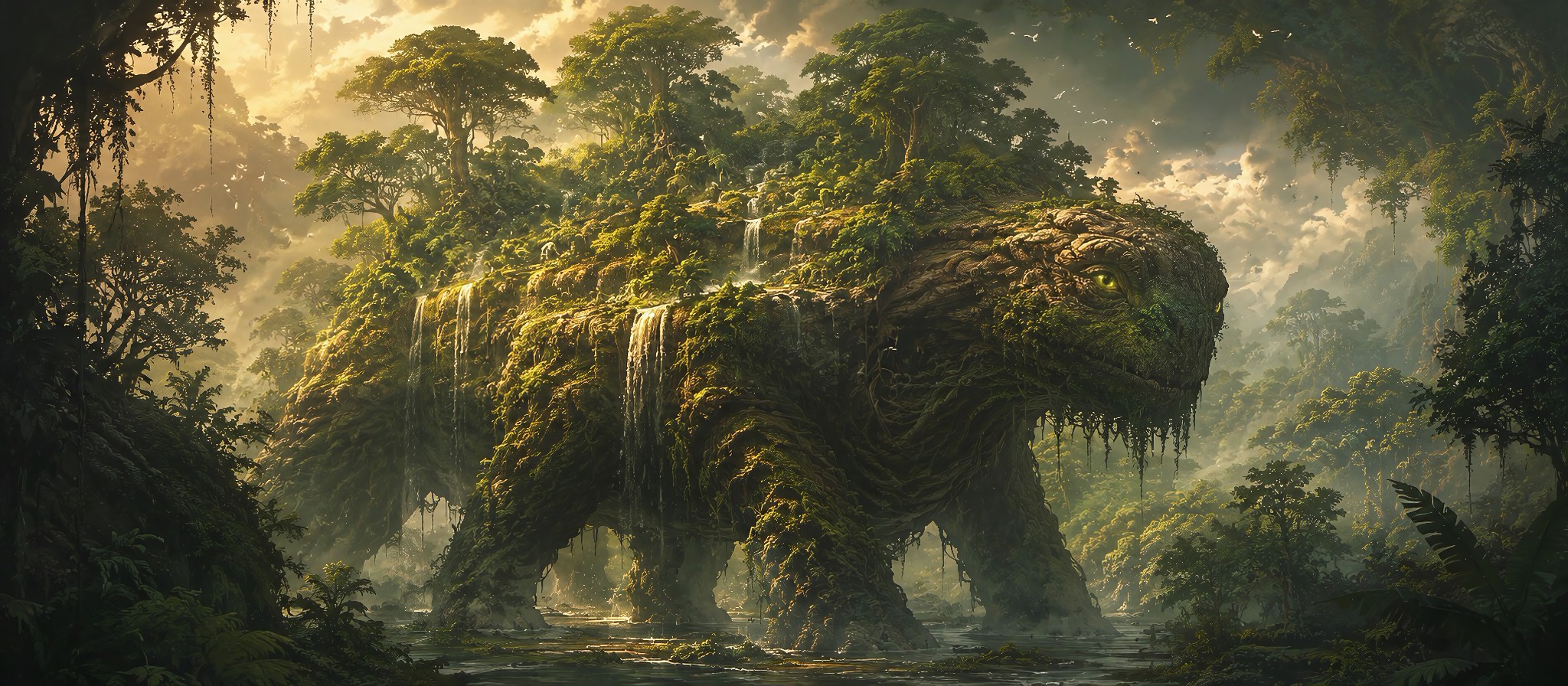
Nyxara's immune system given flesh and stone: living geological titans, neither monsters nor gods. No two are identical. Their skin is made of living granite, cooled magma, ancient bark, or packed earth. Entire forests grow on their backs. Their eyes glow with faint Aether light, half closed as if dreaming. A low hum vibrates for kilometers. Pure Behemoths radiate ancient calm; Corrupted ones shriek, their skin cracking to reveal infected Aether flesh. They range from 15 meters to over 50 kilometers in length. The largest, the Walking Mountains, are so vast that forests, lakes, and entire ecosystems thrive upon their backs. Their footsteps carve valleys. Their sleep lasts millennia.
Leviathans: Guardians of the Sea
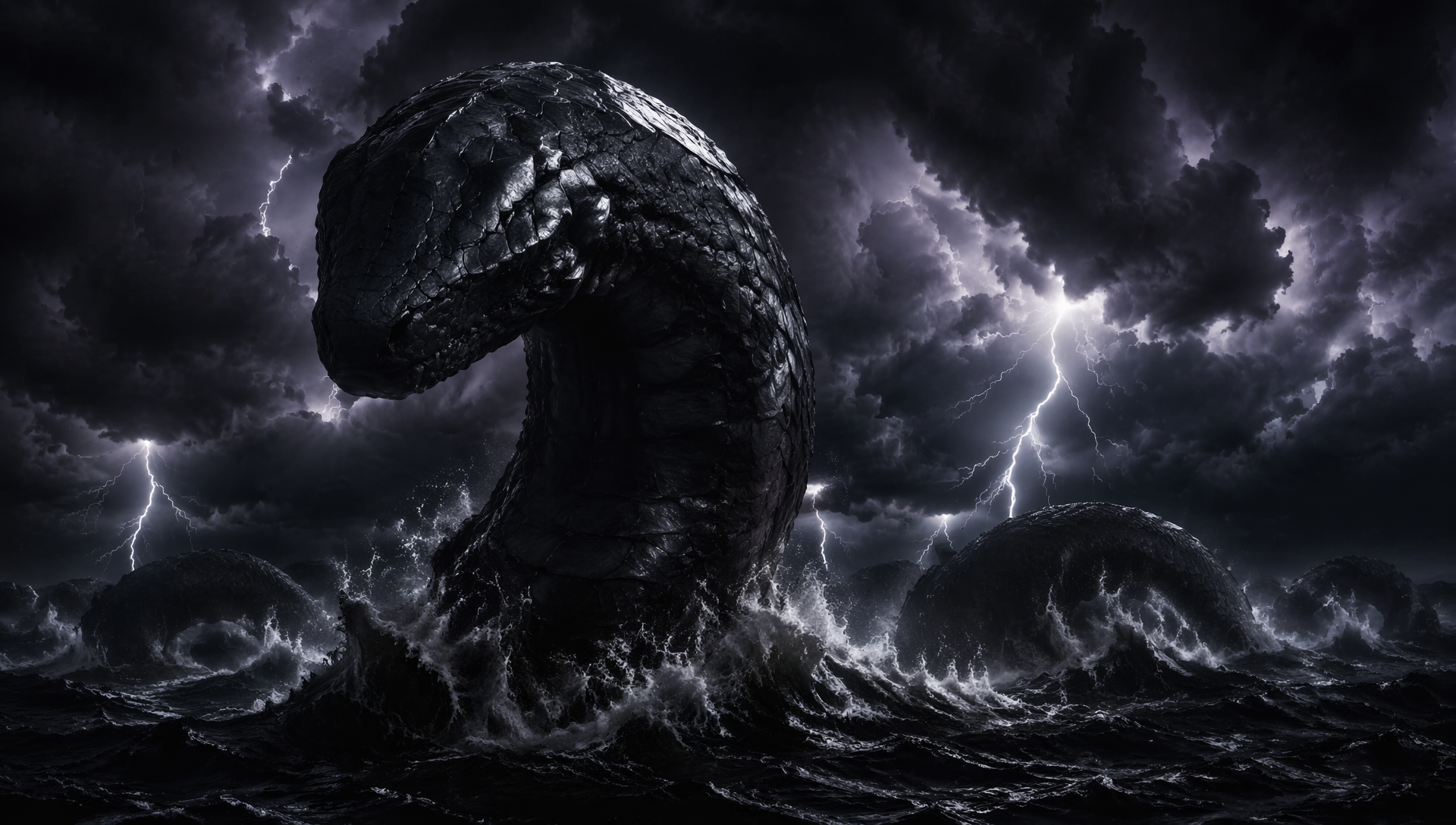
The combined will of all Five Goddesses woven into living form. Serpentine titans whose coils stretch from horizon to horizon. Their scales are harder than iron. Their eyes are like dying suns, or absent entirely. They patrol the Black Zone and the Void's edge with ancient, unwavering purpose. They do not hunt. They do not chase. They simply rise, and then the ship is no longer there. The largest, called the World Enders, measure 10 to 30 kilometers in length. Fewer than seven exist. They circle the Void itself, silhouettes against the nothingness. They are the world's last wall. Whatever lies beyond the Void, the Leviathans ensure it stays there.
Travel, Infrastructure & Commerce
Infrastructure
Paved roads are standard across all sovereign nations, maintained as vital economic and military arteries. The Valdran Empire and Vorn-Taraz boast the finest highways, wide, smooth, and heavily patrolled. Theocracy and Gar-Vang roads are functional but rugged, built for war rather than commerce. The Black Domain has only shattered remnants of Old World routes.
Technology Level
Ruinea operates on medieval magicraft. There is no gunpowder. No fossil fuels. No internal combustion engines. Everything runs on Aether Cores, crystallized magical energy harvested from monsters and dungeons, supplemented by muscle and beast.
Daily Technology
Commoners use low grade Aether Cores for perpetual light crystals in homes and streets, portable heat stones for cooking and warmth, and basic food preservation. The wealthy and nobles use high grade cores for climate controlled estates and private Aether vehicles. Aether Mirrors, capable of real time audiovisual communication, are exceedingly rare. Only Pope Callista, the Valdran Emperor, the Guildhall Council of Masters, and certain elite nobles possess them.
Transportation
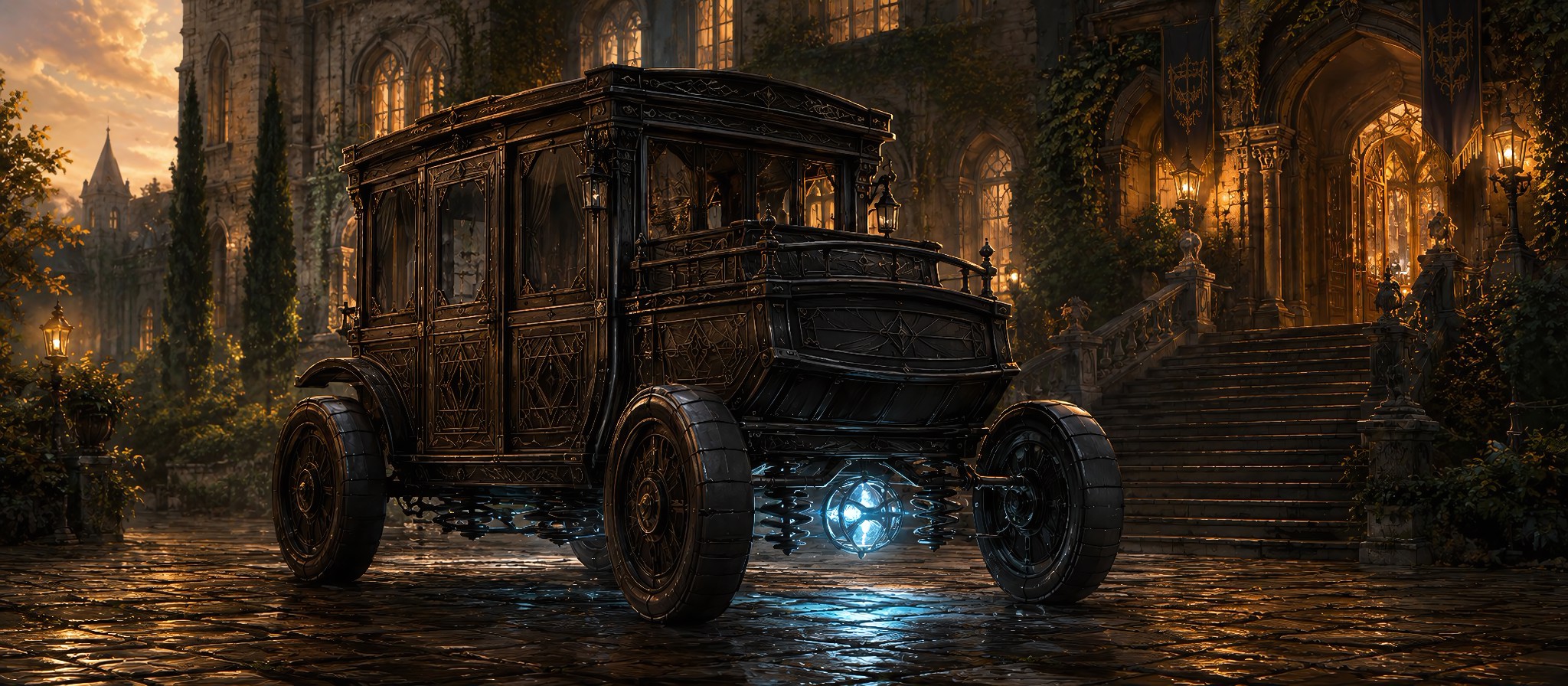
Aether Wagons are the backbone of long distance land travel across all sovereign nations. These personal vehicles travel at 40 to 60 kilometers per hour on paved roads, expensive, and used by nobles, wealthy merchants, and Guildhall officials. Luxury models serve the elite, while rugged utilitarian variants haul cargo and soldiers along the great highways.
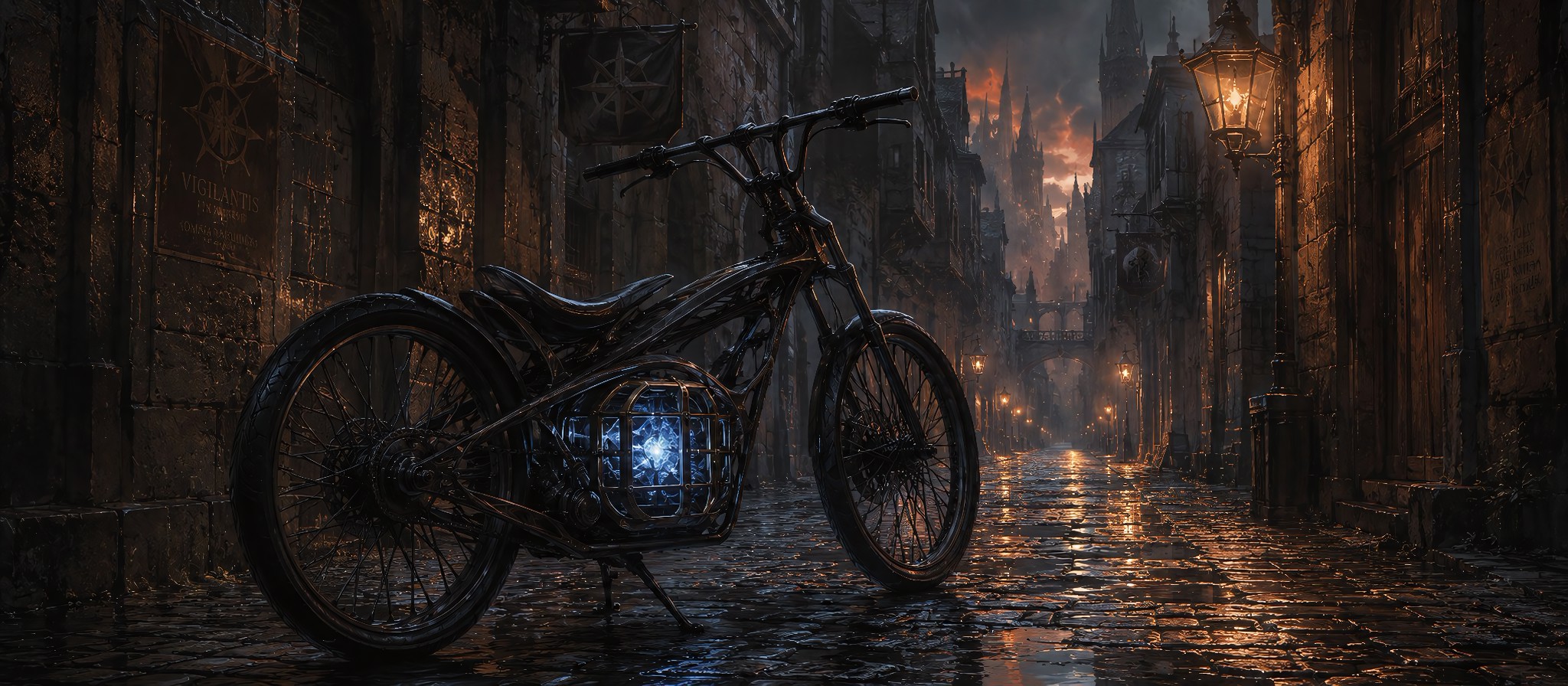
Aether Cycles are two wheeled personal speedsters capable of 60 to 80 kilometers per hour. They are used by couriers, elite messengers, and adventurers in a hurry. Lightweight and agile, they can navigate terrain that would bog down heavier vehicles.
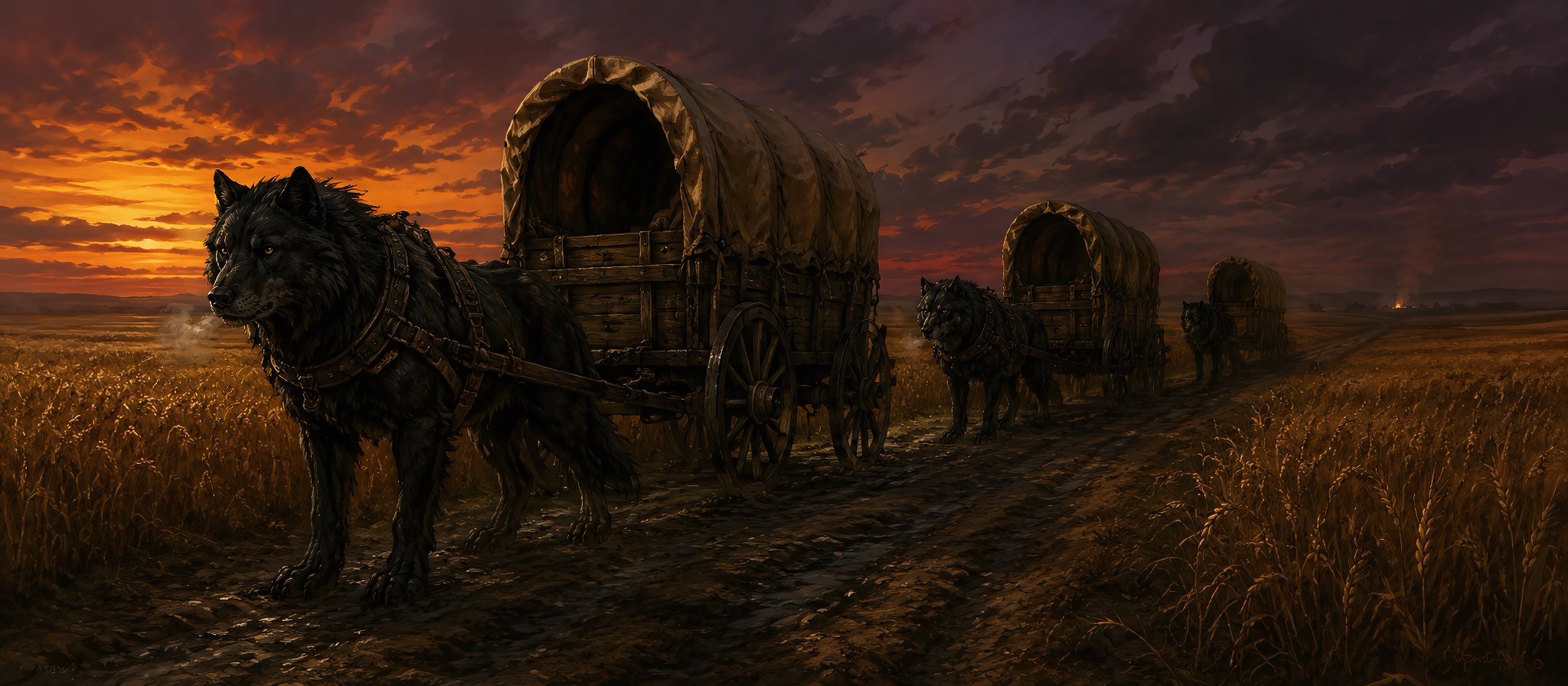
Beast Caravans remain the transport of the common folk. Monster drawn carts pulled by dire wolves, Stone Rams, and domesticated herbivores travel at 30 to 40 kilometers per day along trade routes. They are slower but reliable, and they require no Aether Cores to operate.
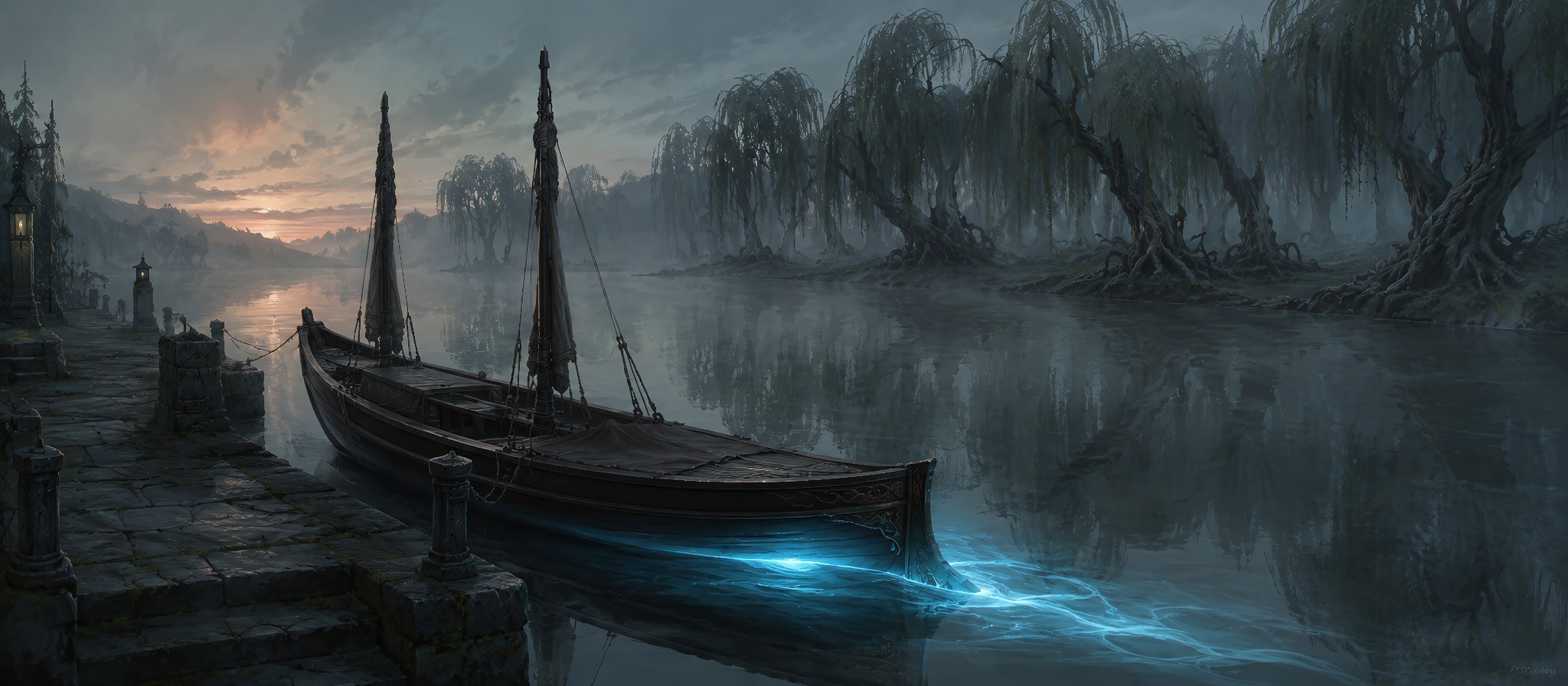
Aether Skiffs are river and coastal vessels powered by Aether Cores. They travel at 20 to 30 kilometers per hour on rivers and 40 to 50 kilometers per hour at sea. The bulk of continental trade moves by water, with barges carrying grain, iron, and timber along the great rivers.
The Iron Serpent
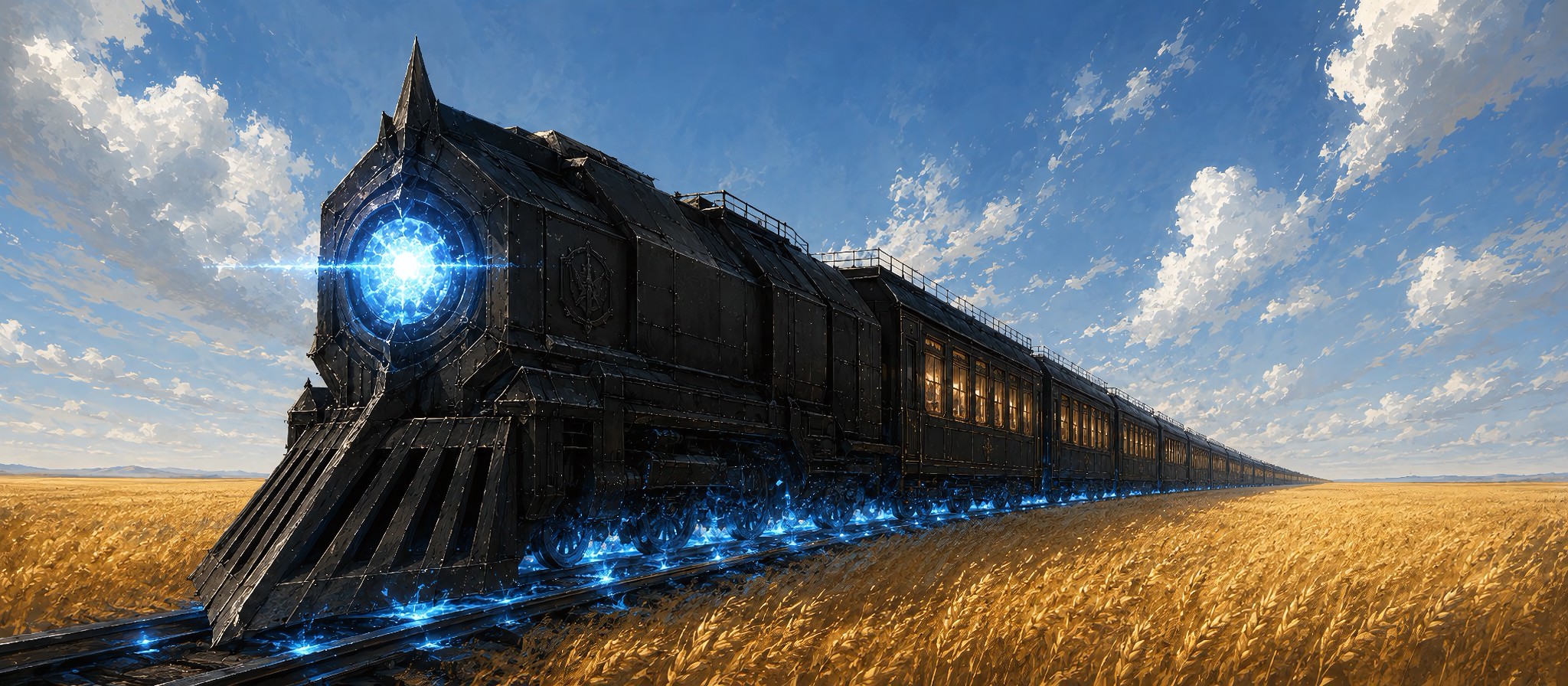
The Iron Serpent is the backbone of continental logistics. These massive Aether powered locomotives run on Dwarven rails at 80 to 100 kilometers per hour, connecting every major city across Vorn-Taraz, Guildhall and Valdran Empire. The network was designed and built by Vorn-Taraz engineers, and it is patrolled by the Rail Wardens, an elite multi national guard who protect the trains from monster attacks and sabotage. The rails themselves are maintained by Track Tenders, Dwarven engineers who consider their work a sacred calling. To sabotage a rail line is to insult the entire Dwarven race.
Skyships
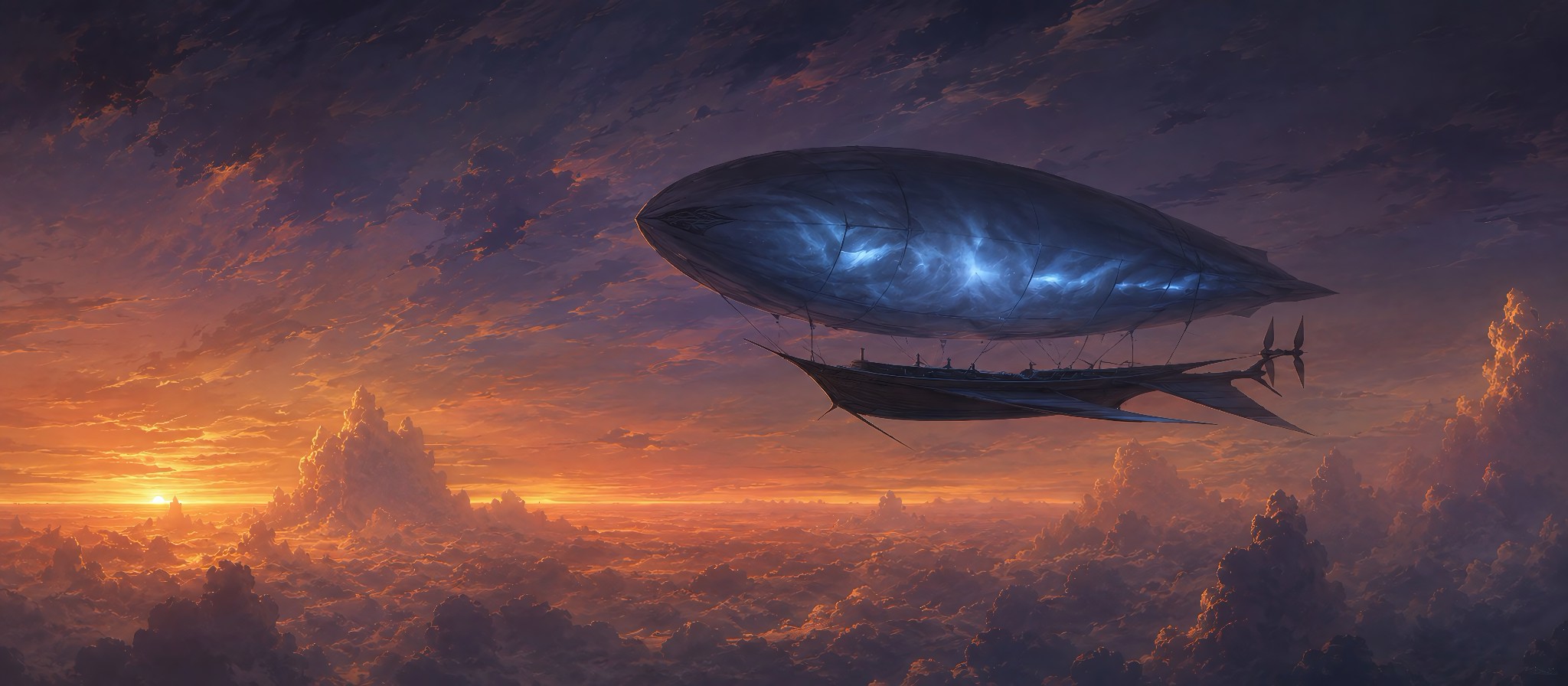
Skyships are light Aether lifted airships capable of 50 to 70 kilometers per hour. They are extremely rare. Fewer than five are known to exist across the entire continent. Their use is restricted to Guildhall deep expedition support, Theocracy reconnaissance over the Western Seam Zone, and absolute emergencies. To see a Skyship on the horizon is to know that something significant is happening, or something terrible has already occurred.
Currency
Universal and valid worldwide. Coinage is minted by the Valdran Empire but accepted everywhere, even the Black Domain, where it buys smuggled food and silence.
| Coin | Exchange Rate |
|---|---|
| Copper Coin | Base unit |
| Silver Coin | 10 Copper = 1 Silver |
| Gold Coin | 100 Silver = 1 Gold |
| Aethel Coin | 1,000 Gold = 1 Aethel |
Gold buys goods. Aether Cores buy survival. The true currency of power in Ruinea is energy, and energy comes from the dead.
II. THE FIVE GODDESSES
Before the Great Shattering, dozens of divine entities walked the Old World. By the time the dust of the War of the Gods settled, only five remained. These five goddesses, wounded, exhausted, and burdened by the weight of their own survival, became the reluctant creators of Ruinea.
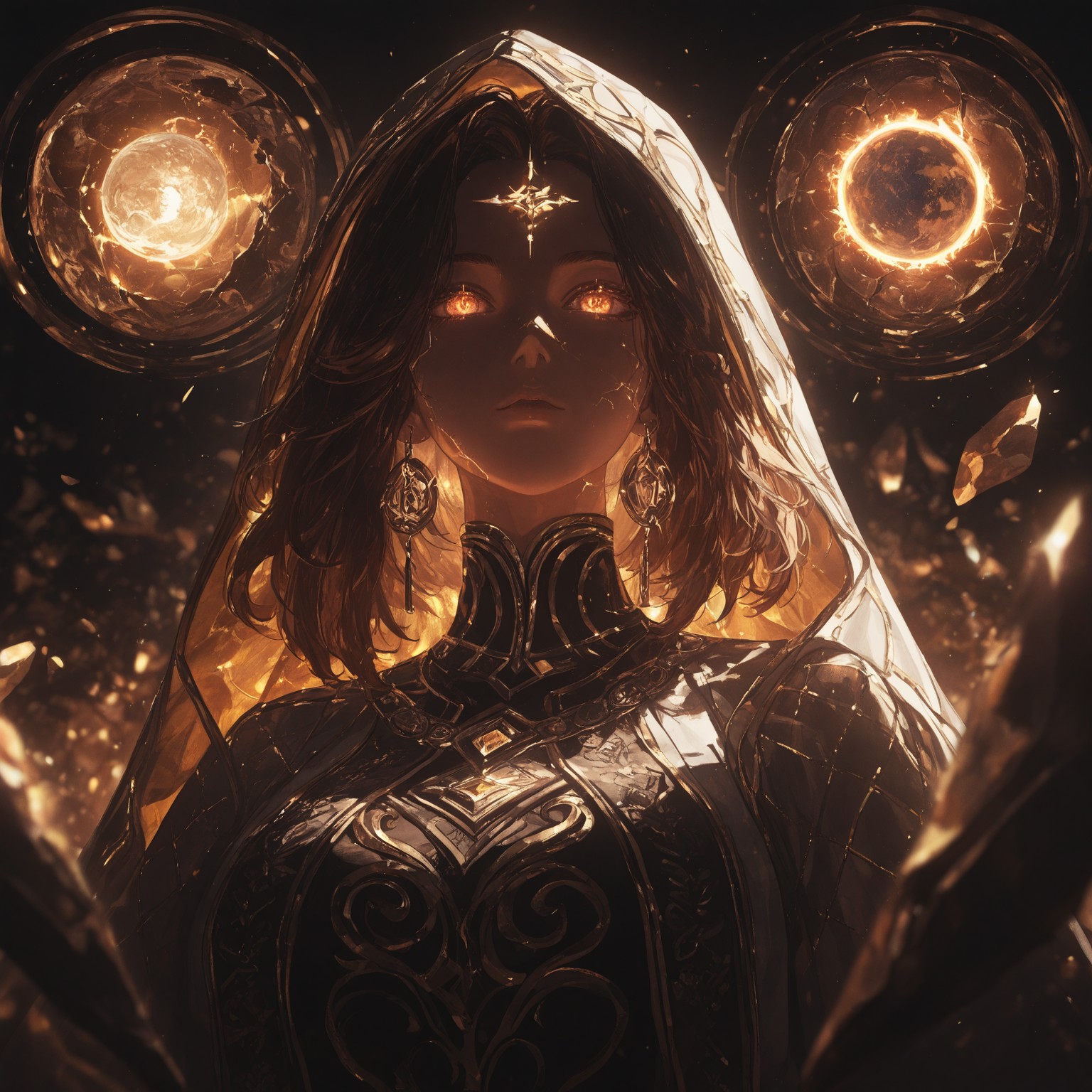
ETHERIA : The Law of Spatial Stability Tap to Expand
Domain: Earth's core, gravity, and the physical integrity of the world.
The Law: The world is finite. It cannot grow, expand, or be added to. The land shall hold together by her eternal will, and nothing shall cause it to dissipate into the Void.
Etheria is the architect of the continent's physical form. Every mountain range is a scar from her stitching. Every Seam Zone is a wound she could not fully close.
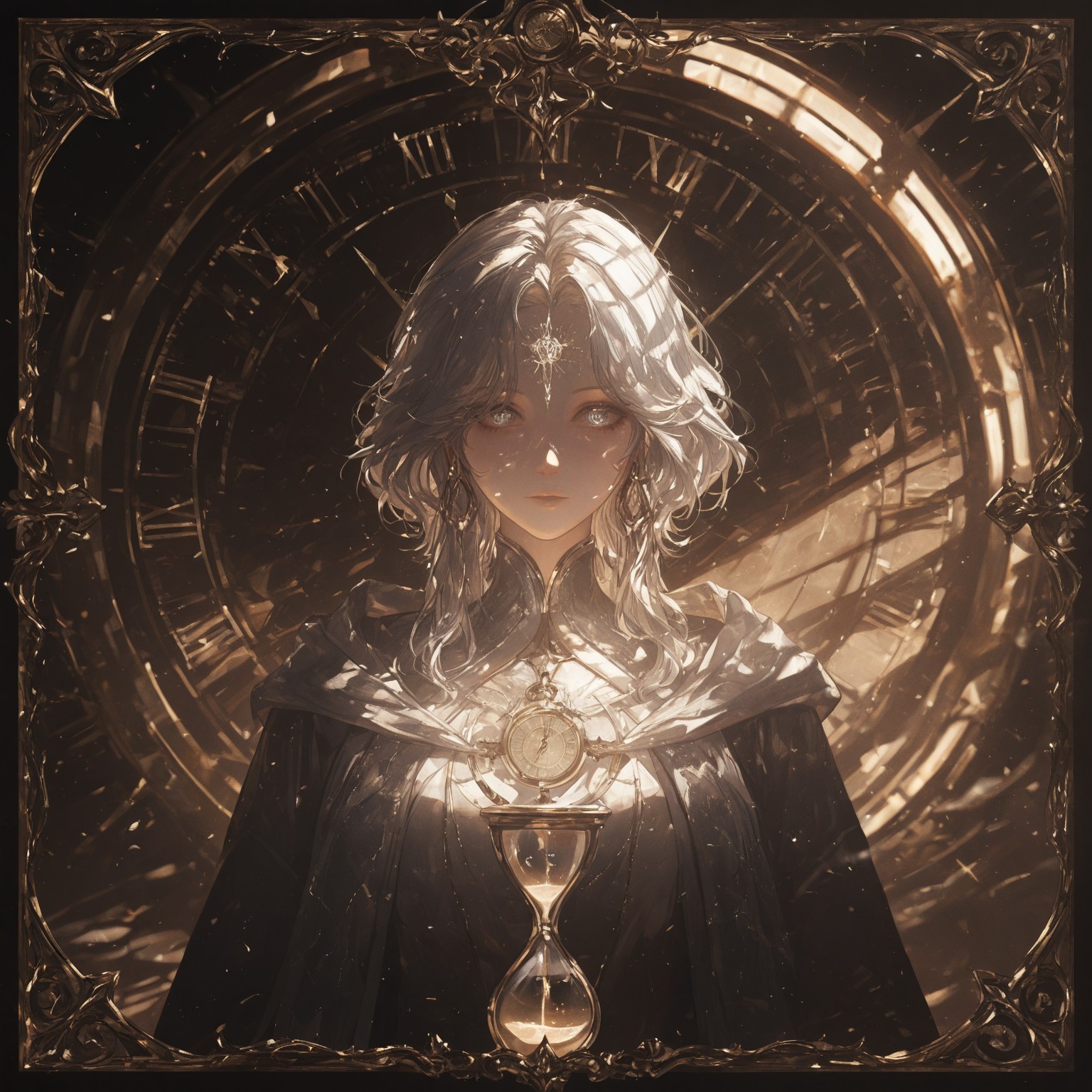
VALERION : The Law of Linear Time Tap to Expand
Domain: The flow of time, the irreversibility of moments.
The Law: The past cannot be repeated. It cannot be changed. Regrets are permanent. Time flows only forward, and what is done is done.
Valerion's Law is the cruelest mercy. In the Old World, gods could rewind time, undo mistakes, and resurrect the fallen. Valerion ensured that the New World would not repeat those catastrophes. No resurrection exists in Ruinea. The dead stay dead. Every choice is final.
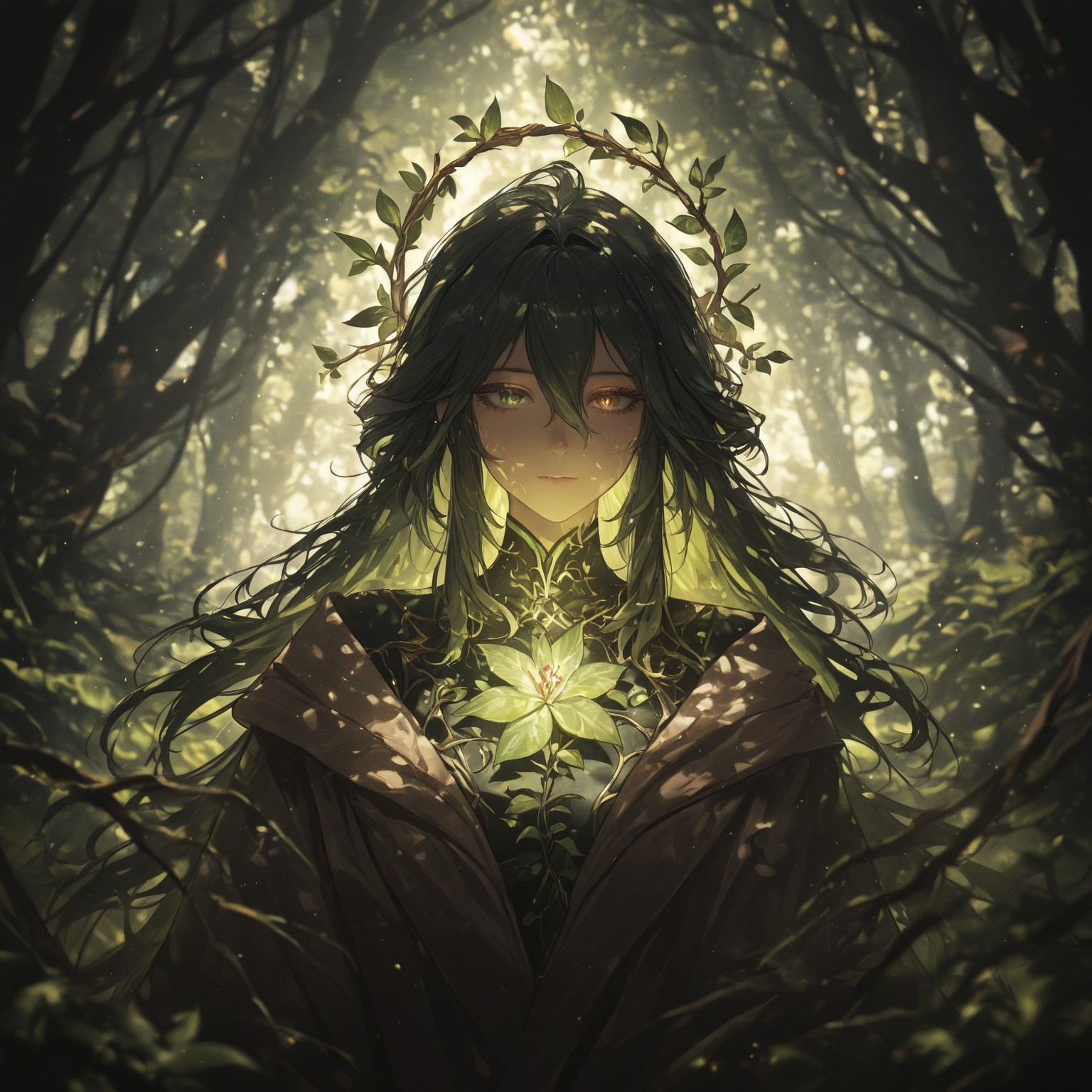
NYXARA : The Law of Life and the Immune System Tap to Expand
Domain: Life, flora, fauna, and the world's biological defenses.
The Law: Life shall flourish and defend itself. From the smallest spore to the greatest titan, all living things are part of a sacred, self-correcting balance.
Nyxara is the mother of monsters. She created the vast, diverse ecology of Ruinea, not out of malice, but out of desperate necessity. She built an immune system: surface monsters, Behemoths, and in collaboration with the other goddesses, the Leviathans.
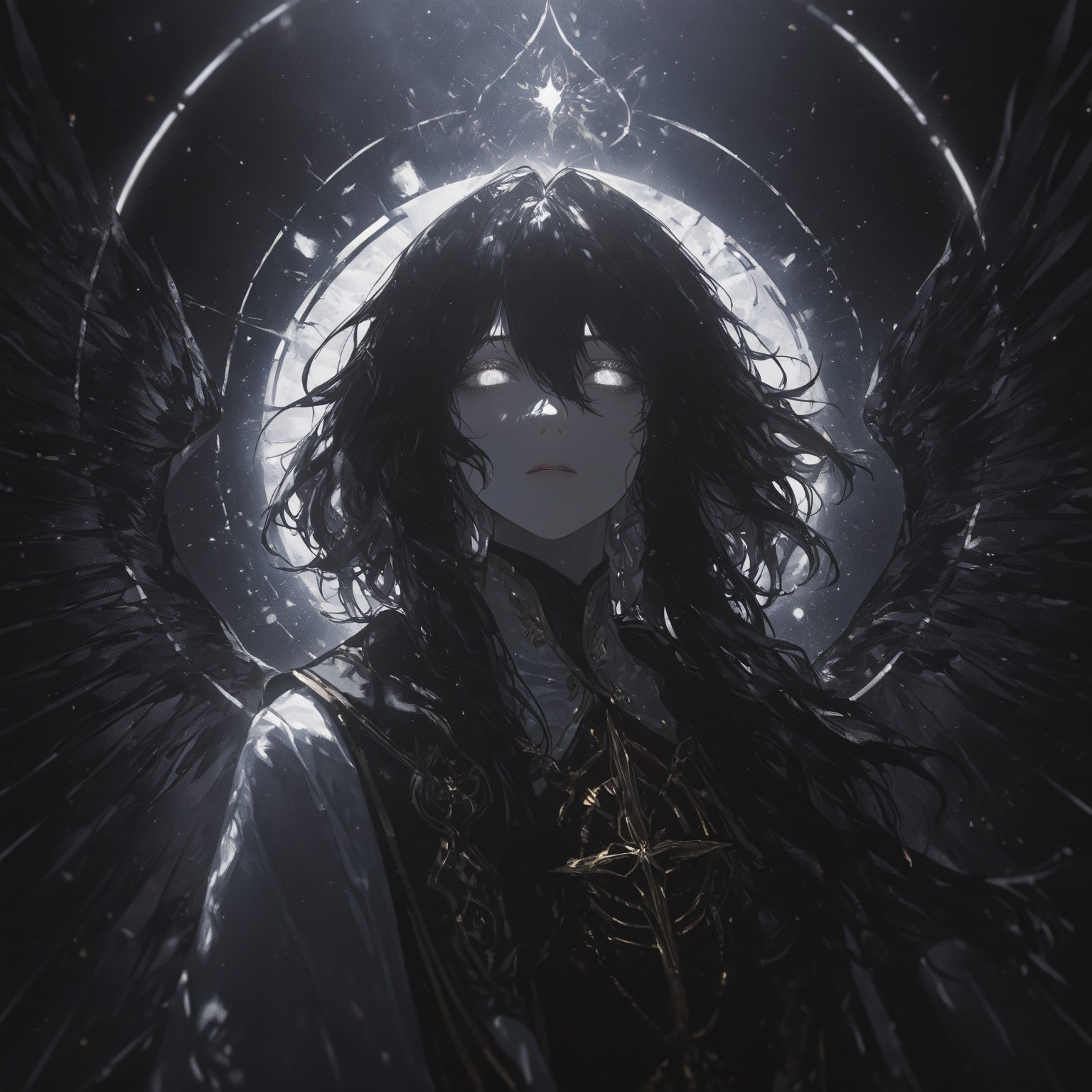
THANATOS : The Law of Absolute Finality Tap to Expand
Domain: Death, souls, and the eternal end.
The Law: There is no reincarnation. No resurrection. No afterlife. When a soul dies, it disintegrates into raw Aether energy and returns to the world. Everything must end.
Thanatos is the most misunderstood of the Five. She is the ultimate guardian of balance. Thanatos ensured that all beings in Ruinea, mortal and immortal alike, would eventually face an absolute end.
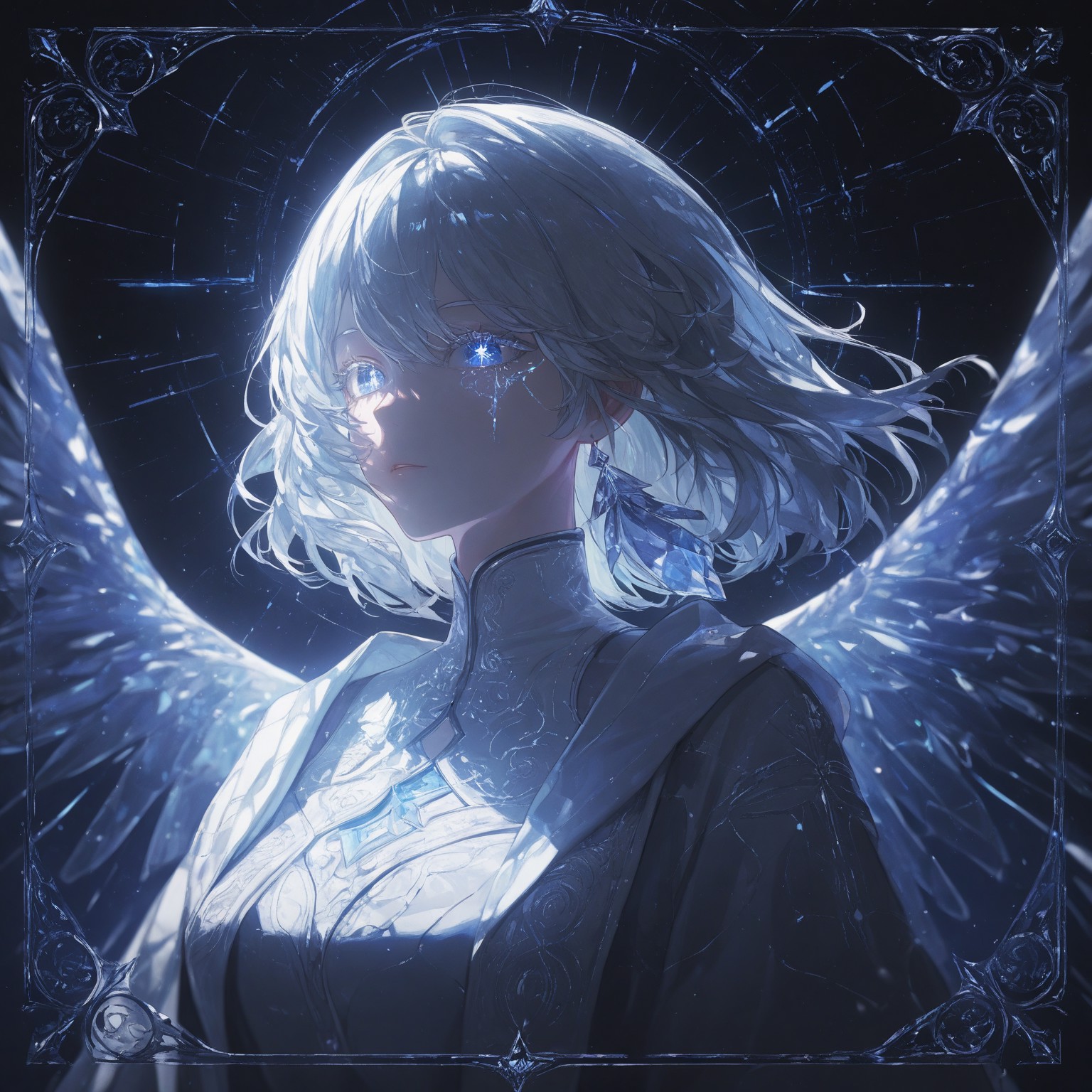
MYSTRA-THOTH : The Law of Magic and Logic Tap to Expand
Domain: Magic, Aether, knowledge, and the scientific laws governing the supernatural.
The Law: Magic is not luck. It is not faith. It is an exact, predictable science governed by unbreakable principles. An identical pull from the Weave will always produce an identical result.
Mystra-Thoth is the great systematizer. She wove the Aether Weave, an invisible, world spanning network of magical threads, and established the rigid laws that govern it. Aether is recycled soul energy. Every spell cast consumes the remnants of a dead being.
The Silent Consensus: Why They Slept
The Five Goddesses did not create the New World out of love for mortals. They created it because the alternative was absolute nothingness. Each goddess wove her own Law not to dominate, but to prevent the mistakes that destroyed the Old World. Then, having given everything, they buried themselves in eternal slumber. They did not ask for worship. They did not leave commandments. They simply stopped.
III. THE WEAVE, AETHER & TIERS
The Inheritance of the Old World
Before the Great Shattering, the Old World possessed a universal language of power. Every civilization, every race, every monster could be measured against a single, immutable scale. When the Five Goddesses stitched the New World together, they did not discard this knowledge. They preserved it, woven into the very fabric of the Weave itself. Scholars of the Theocracy, archivists of Aelderim, and tacticians of the Guildhall all study the same ancient texts. The Tier System is not a modern invention. It is a relic of a dead era, and it has never been improved upon.
What follows is the foundation of all power assessment in Ruinea. Adventurers use it to gauge threats before descending into Dungeons. Commanders use it to assess the strength of nations. The wise use it to understand exactly what they are facing before they face it.
The Eleven Tiers of Power
All things in Ruinea, whether mortal, monster, or nation, can be measured against eleven universal Tiers. A Tier is not a measure of raw destructive power alone. It is an assessment of sustained threat to civilization over a period of twenty four to seventy two hours. A single catastrophic attack does not define a Tier. Consistent, sustained output does.
Each Tier also carries a decimal range, from point one to point nine, representing incremental progression within that Tier. A T7.1 and a T7.9 are both Tier 7 entities, but the latter stands at the threshold of Tier 8. This precision is what separates educated assessment from fearful guesswork.
T1 — Mortal. The baseline of common existence. An ordinary human, a peasant, a novice with no significant training. Threat level: an individual.
T2 — Warrior. Trained soldiers, junior adventurers, disciplined militia. Threat level: capable of breaching a fortified wall.
T3 — Champion. Elite knights, veteran adventurers, accomplished monster hunters. Threat level: can demolish a large building single handedly.
T4 — Master. Senior Guildhall members, royal guards, regional commanders. Threat level: can devastate an entire city block.
T5 — Legend. Heroes of renown, grandmasters of their craft, young dragons. Threat level: can lay waste to a small town.
T6 — Myth. Living legends whose names are known across the continent. Threat level: can obliterate a city.
T7 — Titan. Forces of nature given form. Threat level: can reshape mountain topography, freeze time itself for brief moments.
T8 — Sovereign. Entities capable of threatening entire nations. Their sustained presence can collapse a kingdom within days. Threat level: nation scale curses, erasure of a region's physical existence. At T8.1, their reach spans roughly twenty kilometers. At T8.9, it extends beyond two hundred.
T9 — Calamity. Continent scale threats. A single T9 entity can trigger tsunamis that drown coastlines, earthquakes that split the earth, storms that darken the sky for weeks. At T9.1, they command roughly one ninth of Ruinea landmass. At T9.9, the entire continent lies within their reach.
T10 — Primordial. Planetary scale power. The ability to reset global civilization, to rewrite the natural laws of a world. The Five Goddesses at their peak, before the Great Slumber, operated at this level. The Old Gods of the shattered era reached T10.9. No entity in the New World has ever approached this Tier.
T11 — Cosmic. Reality scale power. Omniscience. The rewriting of universal law. Absolute creation. This is the Weaver's privilege, a theoretical pinnacle that requires all five pillars of power at T11 simultaneously. Even the Five Goddesses never achieved it. The Old Gods could not. It exists as a mathematical possibility, a whisper in the oldest texts, and nothing more.
The Five Pillars of Assessment
A Tier is not a single number pulled from the air. It is the average of five distinct pillars, each measuring a different dimension of power. Two entities at T7.5 may be equally dangerous, but through entirely different means. A Vanguard achieves it through overwhelming strength and durability. A Speedster achieves it through velocity that makes them untouchable. Understanding the pillars is understanding how a threat operates.
Strength measures raw physical output and the area of effect a single engagement can impact.
Speed measures velocity and reaction time.
Durability measures resistance to harm.
Stamina measures sustained output over time.
Magic measures Weave manipulation and spellcasting capability.
The Magic Circles
Magic is an exact science, governed by the immutable laws Mystra-Thoth wove into the Aether Weave at the dawn of the New World. Every spell is a thread pulled from the Weave. Identical pulls produce identical results. Mastery is not about discovering new magic. It is about understanding which threads to pull, and how hard.
The eleven Circles of magical ability form a precise ladder of escalating power. Each Circle corresponds to the Magic pillar of the Tier system, and a caster's Circle often determines their overall Tier if magic is their primary class.
Circle 1 (T1). Sparks of flame, minor healing of shallow wounds, micro telekinesis that lifts a cup. The caster senses Aether for the first time. This is where every mage begins.
Circle 2 (T2). Elemental bolts that can wound, basic illusions that confuse the eye, energy shields that deflect a sword strike. The caster is now a threat to an individual soldier.
Circle 3 (T3). Building scale fireballs, localized telepathy that reads the thoughts of a single mind, summoned creatures that fight alongside the caster. The caster can destroy a structure.
Circle 4 (T4). Memory manipulation that erases or rewrites a target's past, localized artificial storms that flood a battlefield, advanced warding that seals a chamber against intrusion. The caster becomes a threat to a neighborhood.
Circle 5 (T5). Castle siege magic that shatters fortifications, small pocket dimensions that exist outside normal space, mass enchantment that arms an entire company. The caster can lay waste to a village.
Circle 6 (T6). City scale weather manipulation, the raising of undead armies from ancient battlefields, teleportation across visible distances. The caster can obliterate a town or threaten a small city.
Circle 7 (T7). The power to reshape mountain topography, to freeze time for seconds, to tear open rifts between dimensions. The caster can raze a major city and alter the geography of a region.
Circle 8 (T8). Nation scale curses that blight harvests across an entire kingdom, the ability to erase a region's physical existence from the map, magic that can collapse a sovereign state within days. The caster is a strategic asset or an existential threat to nations.
Circle 9 (T9). Continental tsunamis, earthquakes that split the earth, the tearing of dimensional boundaries that threaten reality itself. The caster commands forces that can reshape Ruinea. No mortal has reached this Circle since the Old World died.
Circle 10 (T10). The power to reset global civilization, to rewrite a planet's natural laws, to unmake what the gods have made. This is the Circle of the Five Goddesses at the moment of creation.
Circle 11 (T11). The Weaver's privilege. Omniscience. Universal law rewriting. Absolute creation. A theoretical pinnacle that no entity has ever achieved. It exists as a mathematical endpoint, a whisper in the oldest texts of Aelderim, and nothing more.
Internal and External Weave
All magic draws from two possible sources. The Internal Weave is the safe, personal reservoir of Aether contained within the caster's own body and soul. It is stable, predictable, and the primary source for almost all mortal casters. The capacity of one's Internal Weave is the primary benchmark of magical development and determines Circle progression.
The External Weave is the Greater Weave, the Aether that permeates the world itself. Drawing from it grants immense power far beyond a caster's natural limits, but it is extraordinarily dangerous. External Weave attracts the lingering grudges of the Old World, the half conscious remnants of dead gods and shattered civilizations. It violently accelerates the caster's physical aging. It often triggers catastrophic, unpredictable side effects that can erase the caster from existence. Only the ancient High Races—Dragons, Fallen Angels, and the eldest Elves—can safely wield External Weave, and even they do so sparingly. For most mortals, touching the External Weave is a desperate gamble taken only when death is the alternative.
Magical Affinities
Every soul is born with a natural Weave Affinity, an innate resonance with a particular type of magic. Affinities are fluid but rarely change across a lifetime. A caster operating within their affinity performs at peak efficiency. A caster pushing against their affinity operates at roughly one effective Circle lower. Common affinities include Fire, Water, Earth, Air, Lightning, Light, Shadow, Spirit, Time, Space, Blood, and Mind. Rare individuals are born with dual affinities, slower to progress but possessing unmatched versatility once mastered.
The Class System
Where Tier measures how much power an entity possesses, Class defines how that power is applied. Two entities at the same Tier are equally dangerous, but through entirely different methods. A Vanguard shatters the enemy line with overwhelming strength. A Speedster ends the battle before the enemy realizes it has begun. Understanding Class is understanding the shape of a threat.
The Old World recognized seven fundamental Classes, and the Guildhall still uses this taxonomy in every threat assessment and expedition briefing. Some extraordinary individuals possess a Secondary Class that complements their Primary, creating hybrid warriors like the Battle Mage, a Vanguard who wields magic alongside steel, or the Juggernaut, a Tanker with the speed to chase down what cannot crush them.
Vanguard (Frontline Destroyer). The Vanguard excels in Strength and Durability, with average Stamina. Their flaws are Speed and Magic. They are melee attackers, siege breakers, and frontline defenders. The Vanguard's role is to shatter whatever stands before them through overwhelming physical force. Their weakness is the Speedster who strikes from angles they cannot reach, and the Magician who destroys them from beyond their grasp.
Tanker (The Immovable Wall). The Tanker excels in Durability and Stamina, with average Strength. Their flaws are Speed and Magic. They are shields for allies, distractions for enemies, and masters of the war of attrition. The Tanker's role is to absorb punishment that would kill anyone else and remain standing. Their weakness is the Magician who bypasses their defenses entirely, and the Speedster who simply goes around them.
Speedster / Assassin (Untouchable Blade). The Speedster excels in Speed above all else, with average Strength and Stamina. Their flaw is Durability. They are infiltrators, assassins, and single target eliminators. The Speedster's role is to end the fight before it begins, striking vital targets and vanishing before retaliation. Their weakness is the Tanker who weathers their strikes, and the Vanguard whose raw durability outlasts their burst.
Supporter (Force Multiplier). The Supporter excels in Magic focused on utility, healing, buffing, and debuffing, with average Speed and Stamina. Their flaws are Strength and Durability. They are healers, enchanters, curse weavers, and battlefield controllers. The Supporter's role is to make their allies unstoppable while making their enemies helpless. Their weakness is the Speedster who kills them before their magic takes effect, and the Vanguard who reaches them despite their allies' protection.
Magician (Arcane Artillery). The Magician excels in Magic above all else, with average Speed through mobility spells and teleportation. Their flaws are Durability and Stamina. They are long range area denial specialists, mass destruction engines, and wielders of battlefield wide effects. The Magician's role is to reshape the battlefield from a distance. Their weakness is the Speedster who closes the gap before a spell is cast, and the Vanguard whose durability survives the first volley.
Versatile (The All Rounder). The Versatile has no peaks and no fatal flaws. All five pillars are equally balanced at their Tier. They are adaptable fillers, solo operators, and tactical wildcards. The Versatile's role is to do whatever the situation demands. Their weakness is that they have no dominant strength to exploit an enemy's specific vulnerability. Against a specialist, the Versatile must win through adaptability, not overwhelming power.
Ruler (The Absolute Sovereign). The Ruler is the rarest Class, reserved for entities who command three or four of the five pillars at maximum Tier while maintaining the remaining pillars at moderately high levels with no fatal flaw. Rulers are not balanced. They are dominant across nearly every dimension of power. Only the most ancient and terrifying beings in Ruinea history have qualified for this classification. The First King, at his peak, was a Ruler. The Five Goddesses were all Rulers.
The Assessment Protocol
Guildhall tacticians and Theocracy scholars follow a formal protocol when assessing any entity's Tier. First, all five pillars are measured independently and averaged, retaining decimal precision. For example, an entity with Strength T8.3, Speed T7.1, Durability T8.5, Stamina T8.9, and Magic T6.0 averages to T7.76, placing them at Tier 7.8.
Second, a Civilization Override is applied. If an entity possesses Stamina at T8.0 or higher and Speed at T7.5 or higher, their effective Tier is raised by half a point to a full point. Sustained speed combined with tireless output collapses nations faster than raw destructive power alone. A T7.8 with this combination is assessed as T8.3 for strategic purposes.
Third, Class Counter always overrides decimal advantage. A T8.1 Speedster will defeat a T8.9 Magician if they can close the distance before a spell is cast. Tier measures raw capacity. Class determines application. The engagement triangle is not a suggestion. It is the difference between victory and death.
Finally, the Primordial Cap. The Old Gods of the shattered era averaged T10.9 at their absolute peak. No entity in recorded history has ever achieved T11, which requires all five pillars at T11 simultaneously. Even the Five Goddesses, in their moment of creation, did not reach it. It is a mathematical possibility, a whisper in the oldest texts, and nothing more.
IV. GEOGRAPHY
I. Mountains and Highlands
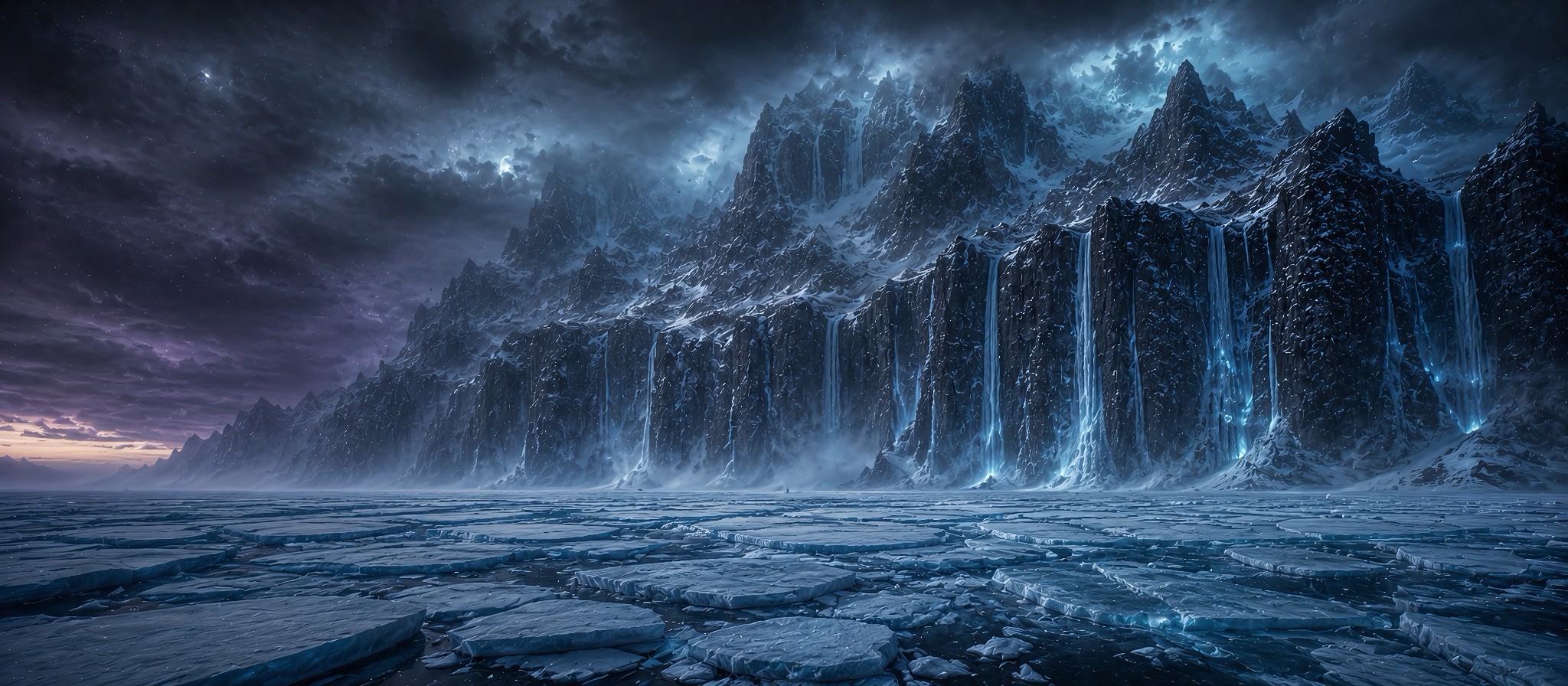
The Vorn Mountains : The ApexTap to Expand
Location: Northern continent, stretching from the northwest to the northeast.
The Vorn Mountains are the spine of Ruinea, a titanic, snow-capped wall separating the civilized southern lowlands from the frozen territories that border the northern Void. The peaks are impossibly high, their upper reaches hidden by eternal storms. The range is a vertical world unto itself, hosting civilizations at every elevation: from the deepest subterranean caverns of Kazad-Vorn to the windswept slopes of Vorn-Taraz, from the oath bound fortress of Gar-Vang in the northwestern foothills to the hidden dragon sanctuary of Nxyaria at the absolute northernmost peak.
Anomaly: The Giant's Breath A constant, eerie, low frequency hum resonates through the entire range. Dwarven scholars of Kazad-Vorn believe it is the lingering voices of dead mountain gods from the Old World. Vorn-Taraz engineers dismiss it as geothermal resonance. No one has ever located its source. The hum is loudest at dawn and dusk, and those who spend too long in the deep tunnels sometimes begin to hear words within it, words in languages that have been dead for millennia.
Climatic Zones:
- Lower Slopes (1,000 to 3,000 meters): Alpine forests, grazing pastures, and the bustling surface cities of Vorn-Taraz.
- Mid Slopes (3,000 to 5,000 meters): Sparse vegetation, hardy mountain beasts, and fortified Dwarven outposts.
- Upper Slopes (5,000 to 7,000 meters): Permanent snow, glacial fields, and the hidden entrances to Kazad-Vorn.
- The Apex (7,000 meters and above): The death zone. Uninhabitable to all but dragons. The Nameless Peak (Nxyaria) rises here, hidden within eternal storm clouds.
The Three River Sources: The Vorn glaciers are the birthplace of the continent's three great rivers: the Aethel, the Valer, and the Mystra. Each descends from a different section of the range, carrying Aether rich glacial melt across the continent.
Northern Terminus: At the absolute northern end of the range, the mountains terminate in sheer, vertical cliffs plunging directly into the frozen northern sea. Beyond the sea lies the Void. The northern cliffs are among the least explored locations in Ruinea. No civilization exists there, and the cold is lethal even to monsters.
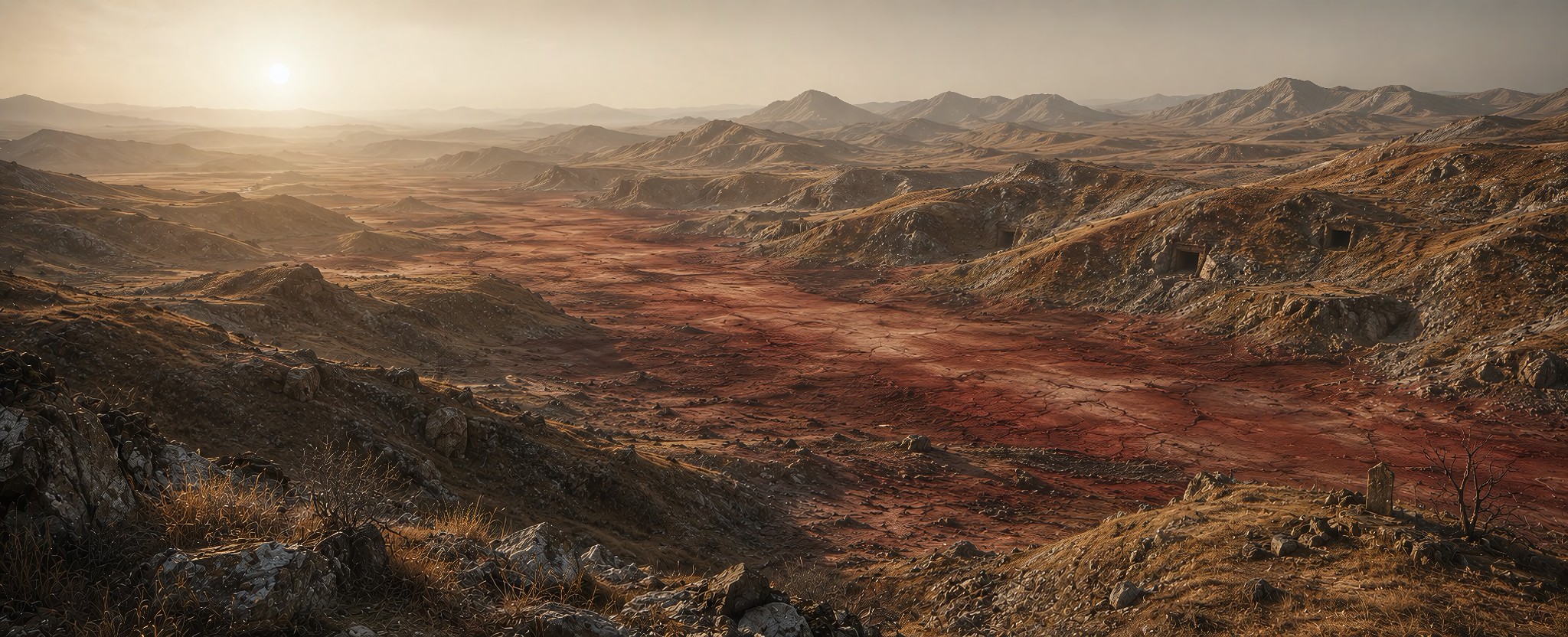
The Western Hills and Iron ValleyTap to Expand
Location: West of the Valley of Kings.
A rugged, dry region of rolling rocky terrain and sparse vegetation, serving as a natural buffer between the fertile heartland and the toxic Western Seam Zone. The hills are crisscrossed by deep ravines, abandoned mines, and the scars of ancient skirmishes. The soil is poor for farming but rich in iron and copper, hence the region's name and its strategic importance to the Dwarven forges of Vorn-Taraz.
The Iron Valley: At the heart of the Western Hills lies the most infamous stretch of land in the region. During the First Great War, this valley became a slaughterhouse. The soil here is permanently stained a deep, rusted crimson, not from minerals, but from centuries old blood. Nothing grows in the crimson earth. Nothing is meant to.
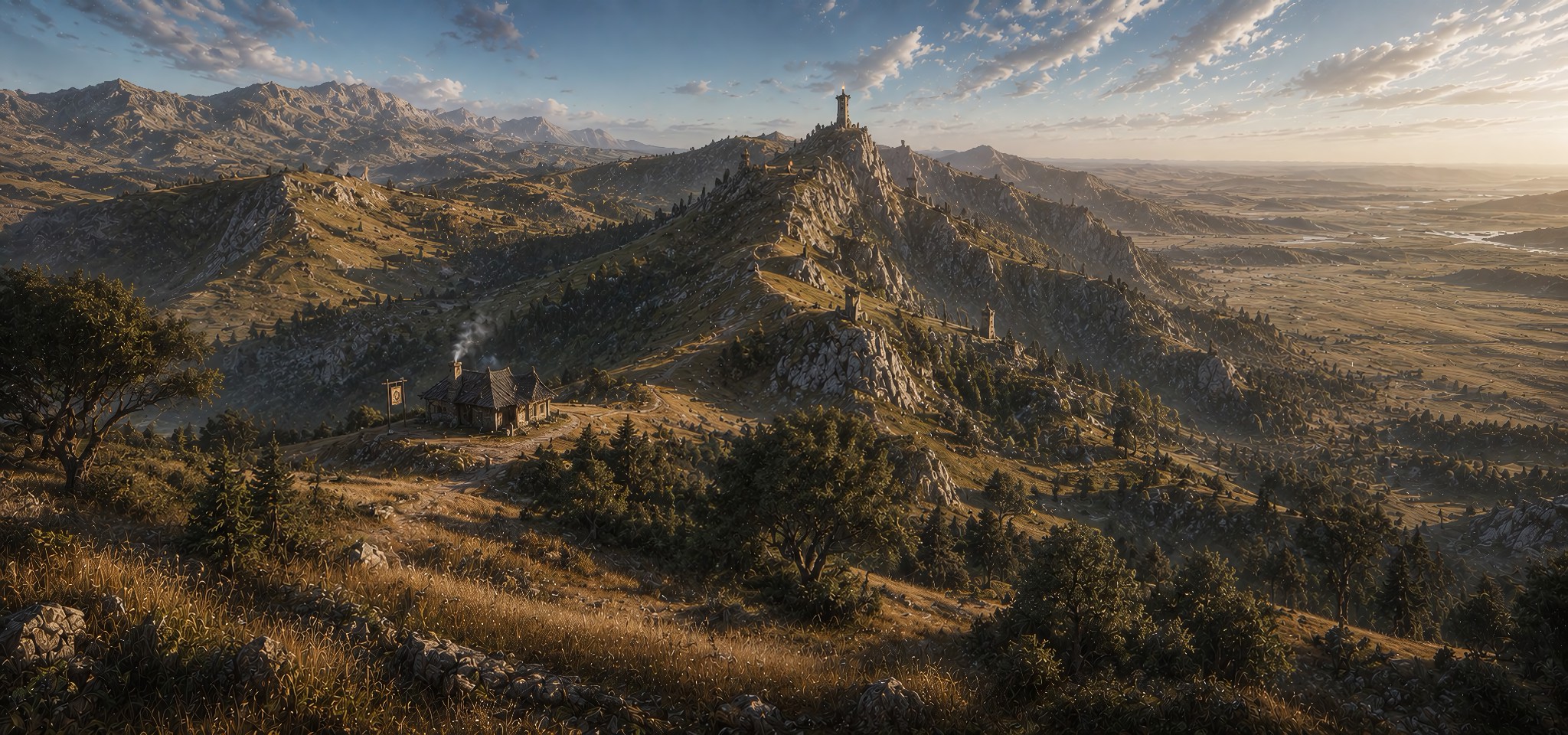
The Eastern HillsTap to Expand
Location: East of the Valley of Kings.
A steep, natural barrier separating the fertile Valley of Kings from the untamed expanses of the Eastern Grasslands. The Eastern Hills are sparsely populated, dotted with frontier towns and isolated watchtowers. No major nation claims this territory as its primary domain; instead, it serves as a buffer zone between imperial civilization and the nomadic wilds. The hills are rich in iron and copper deposits, though mining operations are limited by the proximity of the monster heavy Eastern Grasslands. The Guildhall maintains several waystations along the eastern roads to support adventurers heading toward the Eastern Seam Zone.
II. Plains and Valleys
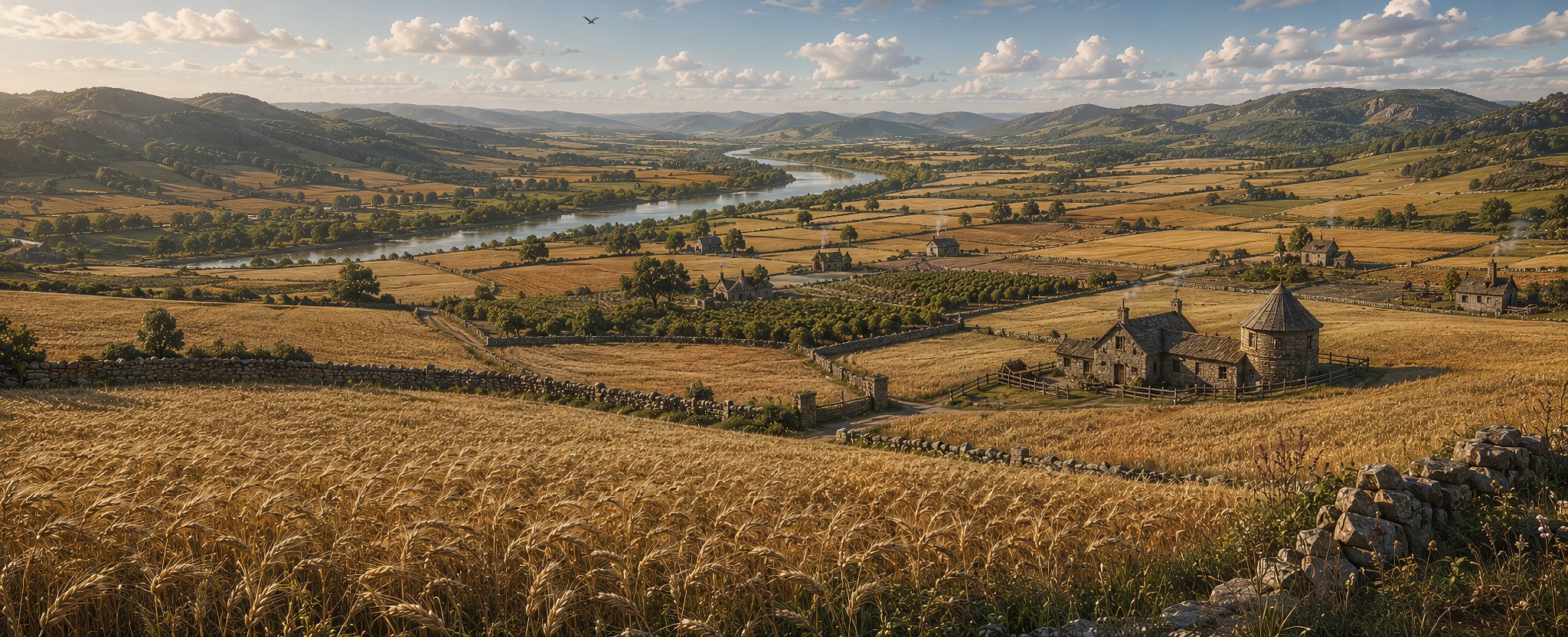
The Valley of Kings : The HeartlandTap to Expand
Area: Approximately 10 million square kilometers. Location: Center of the continent, surrounded by protective hills on all sides.
The Valley of Kings is the most fertile land in Ruinea, the breadbasket of the world. The mighty Aethel River flows through its heart, and its annual floods of up to 5 meters deposit the mineral rich silt that sustains global agriculture. Rolling fields of golden wheat stretch to every horizon, broken by orderly orchards, fortified granaries, and ancient stone farmhouses. The land feels cultivated, controlled, and ancient; every acre has been farmed for millennia.
Climate: Temperate, with four distinct seasons. Spring brings the river floods and planting season. Summer is dry and hot, which is the peak military campaign season. Autumn sees the harvest and a sharp increase in monster activity. Winter brings frost and occasional snow, though the Valley rarely freezes completely.
Strategic Importance: The Valley produces the food that feeds the continent. It is protected by the Valdran Empire, coveted by the Black Domain, and mediated by the Food Council. Control of the Valley is control of the world. Its loss would mean global starvation. At the Valley's exact center rises Aethelburg, the imperial capital. At its northern edge, directly above The Great Maw, sits Vornhold, the sovereign city of the Guildhall.
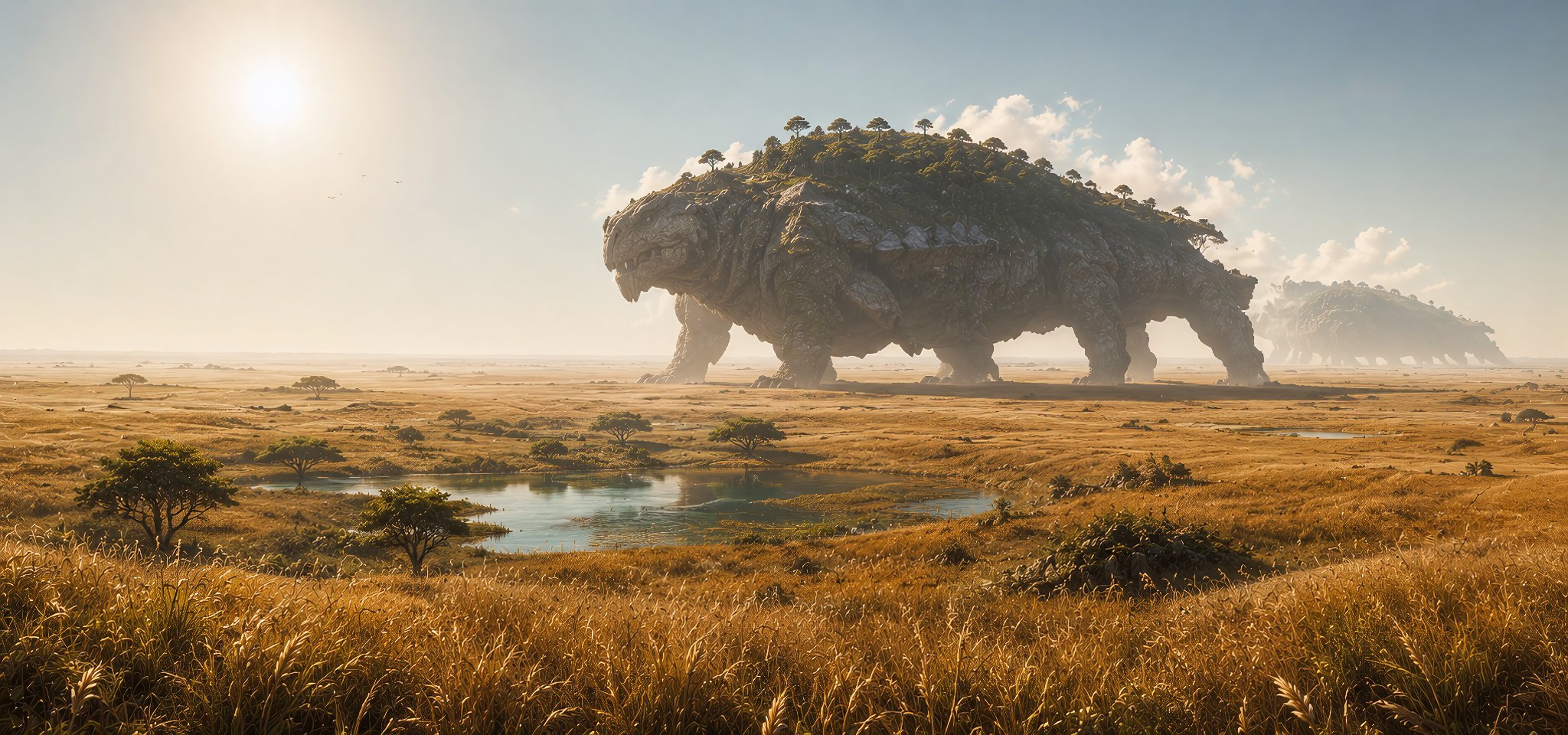
The Eastern GrasslandsTap to Expand
Area: Vast and unbounded, constantly shifting due to Behemoth migration. Location: East of the Eastern Hills, west of the Eastern Seam Zone.
An endless, unforgiving sea of waist high golden grass stretching to the horizon and beyond. The terrain is completely open and exposed, with no mountains, no forests, and no natural shelter. The grass itself is tough and sharp edged, capable of cutting exposed skin after hours of travel. Scattered groves of iron barked Akasia trees and shallow, Aether tinged lakes break the monotony, serving as vital oases for beast and nomad alike.
Climate: Harsh and extreme. Summers are scorching, with temperatures exceeding 45 degrees Celsius. Winters are brutal, with howling winds and temperatures dropping well below freezing. There is no gentle spring or mild autumn, only burning heat and freezing cold.
Anomaly: The Walking Mountains The Grasslands are home to the highest concentration of Behemoths in Ruinea. Some of these living geological titans are so vast that entire forests grow upon their backs and clouds scrape their shoulders. They migrate slowly across the plains, reshaping the map with every step. The Pack reveres them as sacred heralds. Cartographers have learned to map the Grasslands in eras rather than years; a map from one decade may be entirely obsolete the next.
Inhabitants: The only permanent residents are The Pack, a society of militant nomadic Werebeasts who follow the great beast herds and survive through absolute physical perfection and unparalleled hunting skill. They have no cities, no farms, and no walls, only their tents, their weapons, and their oaths.
III. Forests
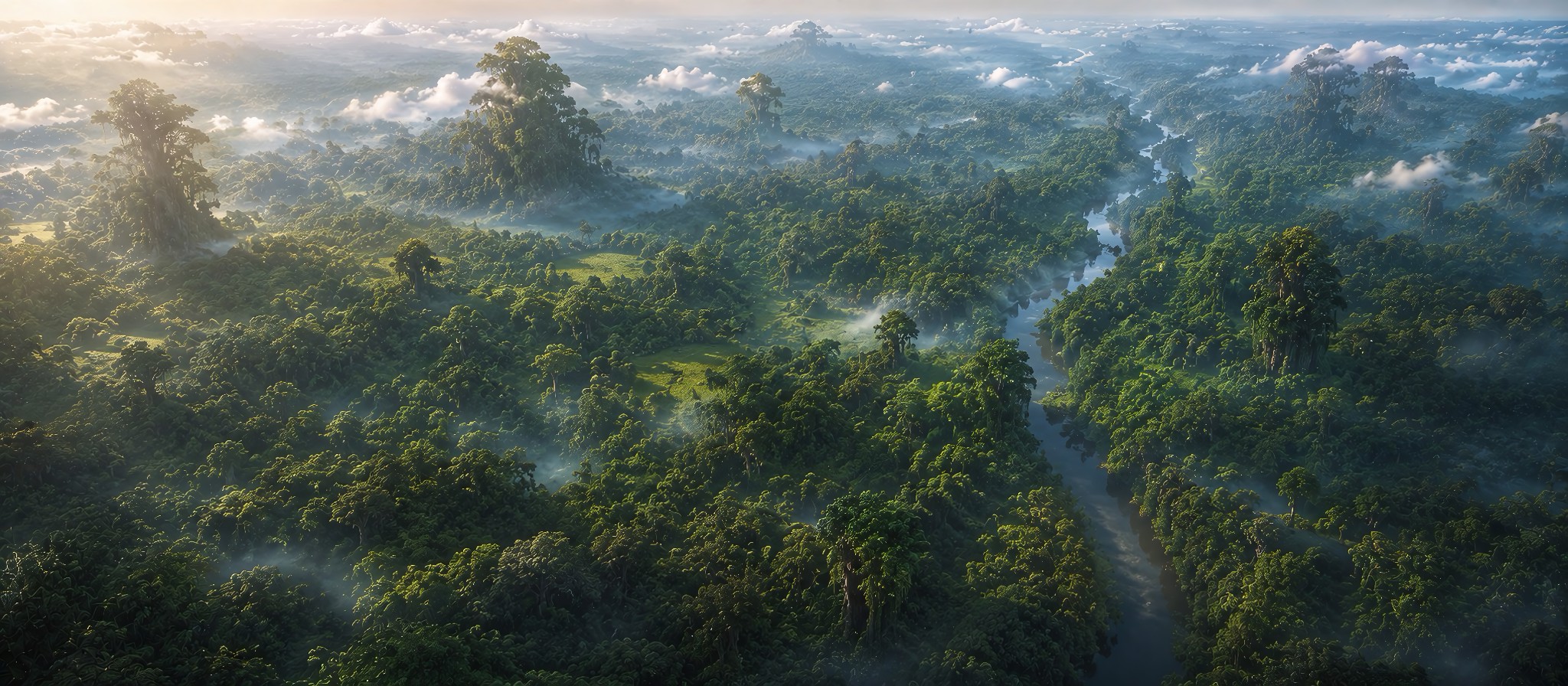
The Primeval ForestTap to Expand
Area: Approximately 28 million square kilometers. Location: Dominating the southern continent.
The Primeval Forest is the oldest woodland in Ruinea, older than most civilizations and older than the New World itself in some forgotten sense. Its towering trees are as ancient as the stitched reality, their roots reaching down into soil that remembers the Old World. The forest is not merely alive; it is conscious, humming with the melancholic, magical echoes of a ruined era.
The Canopy: In many regions, the forest canopy is so dense that entire cities vanish beneath it. Sunlight reaches the forest floor in scattered, golden shafts. The air is thick with the scent of moss, ancient wood, and a faint, inexplicable sweetness, the smell of memories.
Anomaly: The Singing Leaves Every leaf, every branch, every root vibrates with a constant, barely audible song. The Aelderim Elves describe it as the forest remembering. Outsiders who spend too long beneath the canopy report hearing voices in the song, voices speaking in languages that have been dead for millennia. Some go mad. Some become prophets. Most simply leave and never return.
Civilizations Within: At the forest's heart, the Elves of Aelderim guard the World Tree and the complete, unedited memories of history. To the west, the pacifist Werebeasts of Verdantus keep their sacred vow of peace within the sanctuary city of Greenholt. To the east, the progressive Elves of Sol-Ventari burn the archives of the past and build a new future among scattered, fluid communities.
IV. The Seam Zones
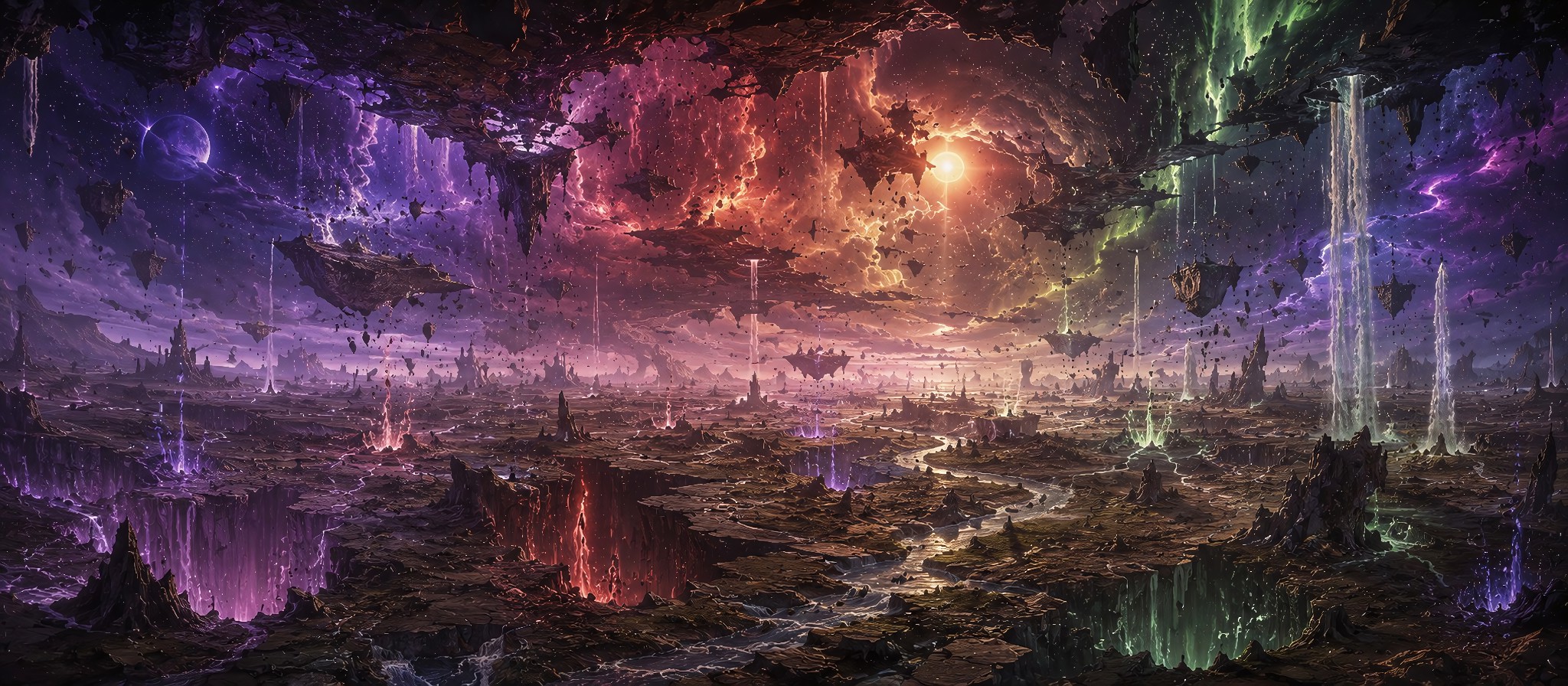
The Seam Zones are the surgical stitches where the Five Goddesses forcibly grafted incompatible fragments of the Old World together. Physics breaks here. Gravity shifts without warning. Time stutters. Maps become unreliable within hours. Travel through any Seam Zone is approximately twice as slow and twice as dangerous as normal terrain.
To enter a Seam Zone is to walk upon a wound that is still bleeding. The air tastes metallic, like blood and lightning. The sky is never the right color, appearing bruised purple, sickly green, or a churning grey that seems to look back at you. Sound travels strangely: a whisper may carry for kilometers, while a shout dies inches from the mouth.
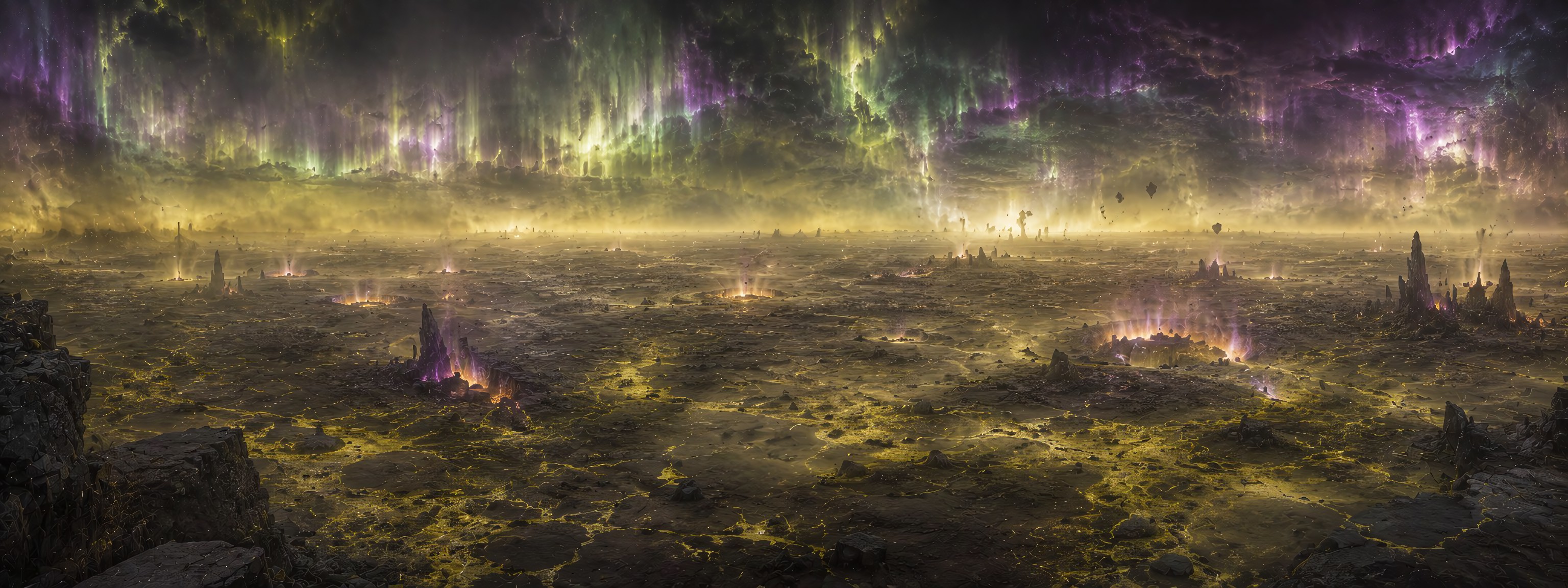
The Western Seam Zone : The FrontlineTap to Expand
Location: Stretching between the Western Hills and the Black Domain.
An arid, toxic wasteland composed of ancient, highly toxic battlefields from the Primordial War. The cursed soil perpetually seeps ancient toxins into the air. Gravity fluctuates wildly within mere meters; a traveler may weigh twice their normal weight in one step and half in the next. Spatial distortions make navigation treacherous; landmarks shift, distances stretch and compress, and experienced guides sometimes find themselves walking in circles.
Dungeon Concentration: The Western Seam Zone has a dangerously high concentration of Dungeon manifestations, ranging from low tier to apocalyptic. These Dungeons constantly threaten to overflow into the Sovereign Domains.
The Sky: The sky above the Western Seam Zone is never clear. It is perpetually choked with dust, Aether leaks, and the faint, permanent glow of magical contamination. The cracked aurora of the Old World is most visible here, pulsing in sickly greens and purples.
Strategic Function: The entire zone operates as a colossal natural fortress, and the Theocracy of the Sacred Wound has made it their sacred duty to hold this line. They are the absolute last shield preventing demonic expansion into the fertile Valley of Kings. For nearly three thousand years, they have fought and died upon ground that has never known peace.
The Eastern Seam Zone : Chaos UnchartedTap to Expand
Location: East of the Grasslands, stretching to the eastern sea.
The Eastern Seam Zone is the most dungeon dense region in all Ruinea. While less politically contested than its western counterpart, it is arguably more dangerous due to the sheer concentration of reality wounds. The terrain is a chaotic patchwork, with deserts adjacent to frozen tundra, forests growing upside down, and rivers that flow uphill. No permanent settlements exist here, only expedition camps that are abandoned before the next Dungeon Break consumes them.
Anomalies:
- Upward Falling Rain: Precipitation that falls from the ground and rises into the sky.
- Reversed Waterfalls: Water that flows up cliff faces rather than down.
- Ground Clouds: Mist and cloud formations that exist below ground level, filling deep ravines with permanent, impenetrable fog.
- Walking Formations: Smaller geological formations, including boulders, cliffs, and small hills, that physically move when unobserved. Travelers who camp in the same spot for two nights sometimes wake to find the landscape completely rearranged.
Strategic Importance: Despite its lethality, the Eastern Seam Zone is the primary source of lucrative contracts for the Guildhall. Adventurers flock to its Dungeons seeking Old World artifacts and Aether Cores of exceptional quality. The mortality rate is catastrophic. The rewards are legendary. The Valer River tributary is the only reliable route through this chaos, and only the bravest, or most desperate, expeditions dare to follow it.
V. The Seas and The Void
Ruinea is not merely bordered by ocean. It is a single, finite continent adrift in a vast, unmapped marine expanse that rivals the landmass itself in scale, and possibly exceeds it. The Five Goddesses placed the continent as far from the Void as their failing power allowed. What fills the space between is a world of water, darkness, and silence. No one has ever crossed it. No one knows what lies in its deepest trenches.
The Coastal Zone (0 to 50 kilometers)Tap to Expand
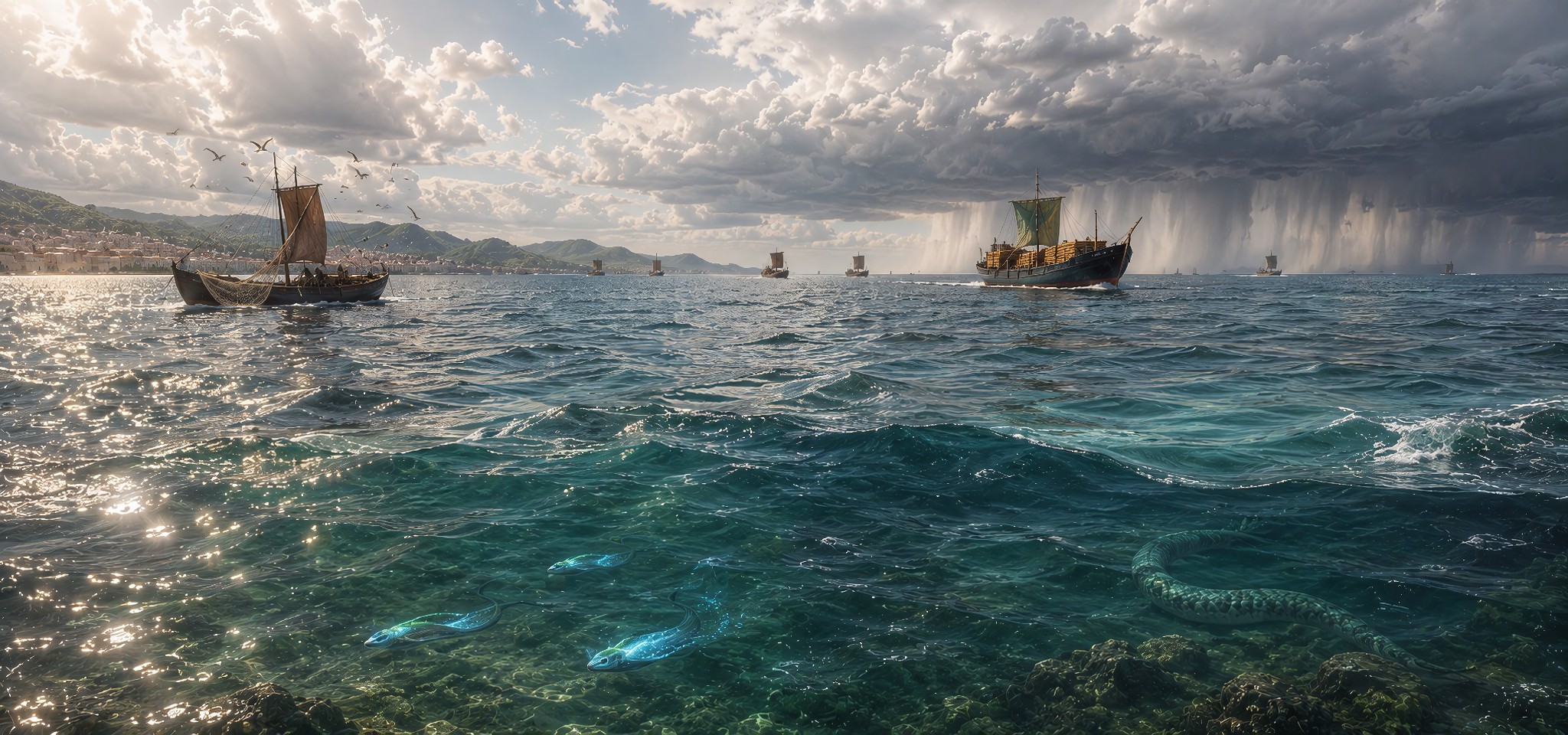
Blue green waters, mild waves, and seasonal storms. Safe enough for fishing vessels and merchant ships. Small sea monsters like Aether eels, razorfins, and juvenile serpents are common but manageable. This is the only zone where regular trade by sea is viable. Most ships never leave it.
The Twilight Zone (50 to 500 kilometers)Tap to Expand
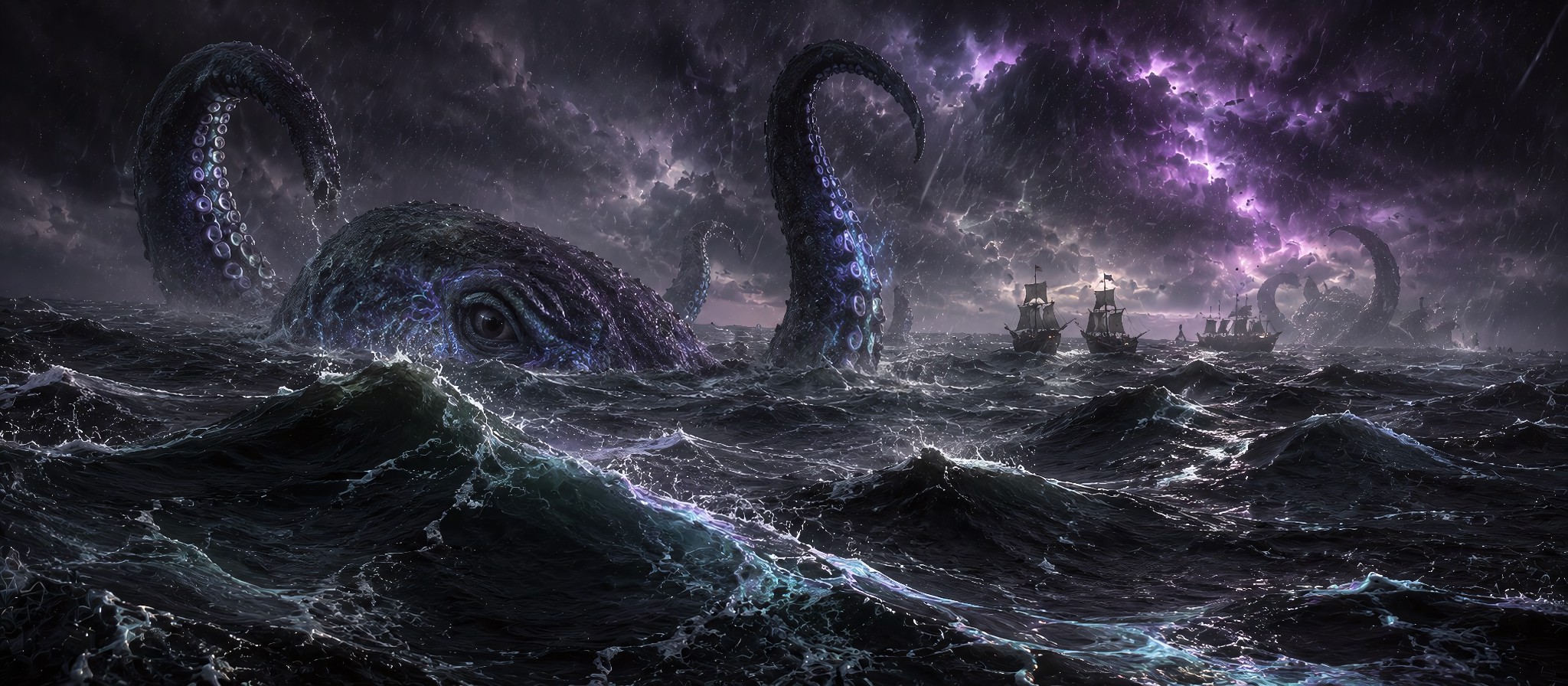
The water darkens to a murky grey. Sunlight begins to fail. Waves grow heavier and unpredictable. Storms brew without warning. This is the domain of Krakens, massive cephalopods ranging from the size of a merchant ship to over two hundred meters in length. Armed military convoys dare these waters on occasion, hunting for deep sea Aether Cores or pursuing rumors of Old World ruins on the seabed. Civilian ships do not enter.
The Black Zone (500 to 5,000 kilometers)Tap to Expand
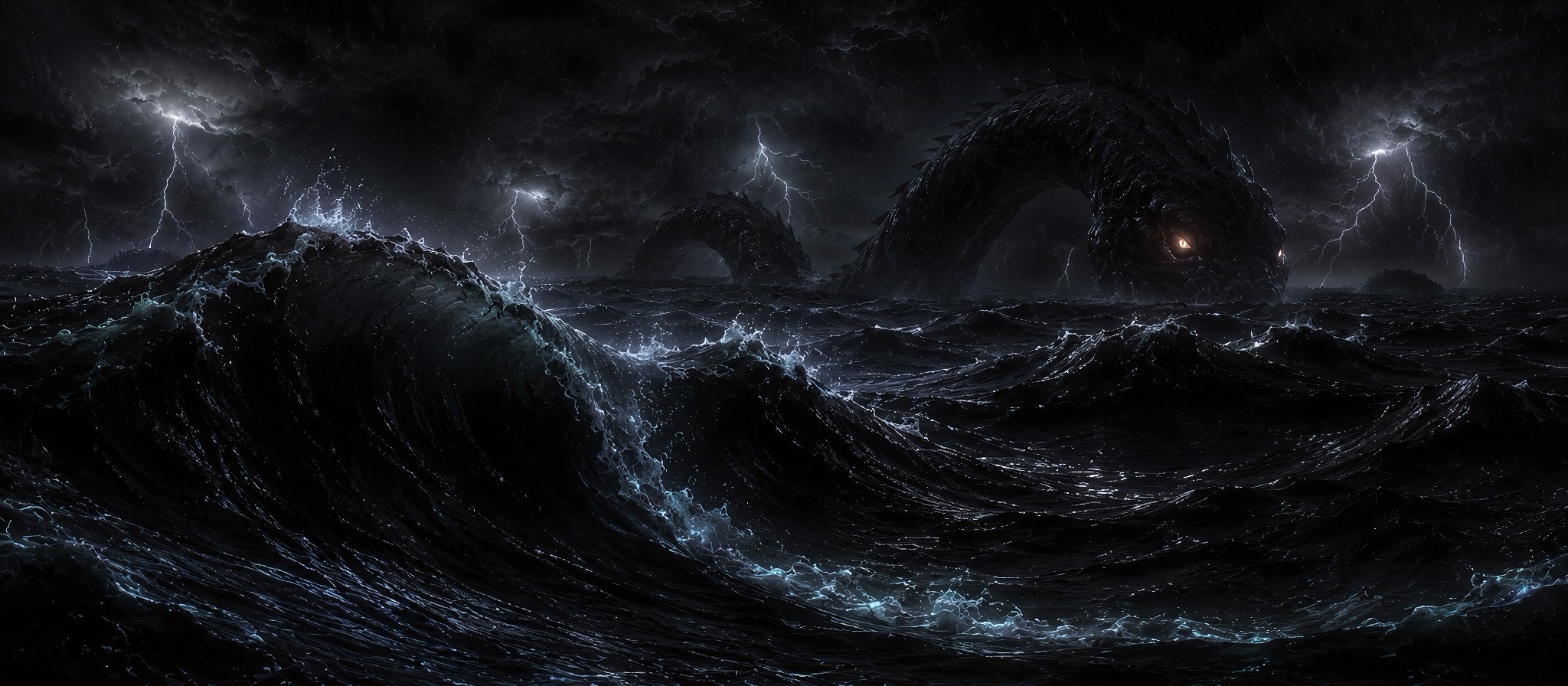
Pitch black and terrifyingly silent. Waves can reach the height of castle walls. The wind howls with a voice that sounds almost human. Storms are constant, and the sky and sea merge into a single, churning darkness. This is the hunting ground of the Greater Leviathans. No Guildhall expedition has ever crossed the Black Zone and returned. What lies in its deepest trenches is unknown. Some scholars speculate there are things older than the Five Goddesses sleeping in the abyss.
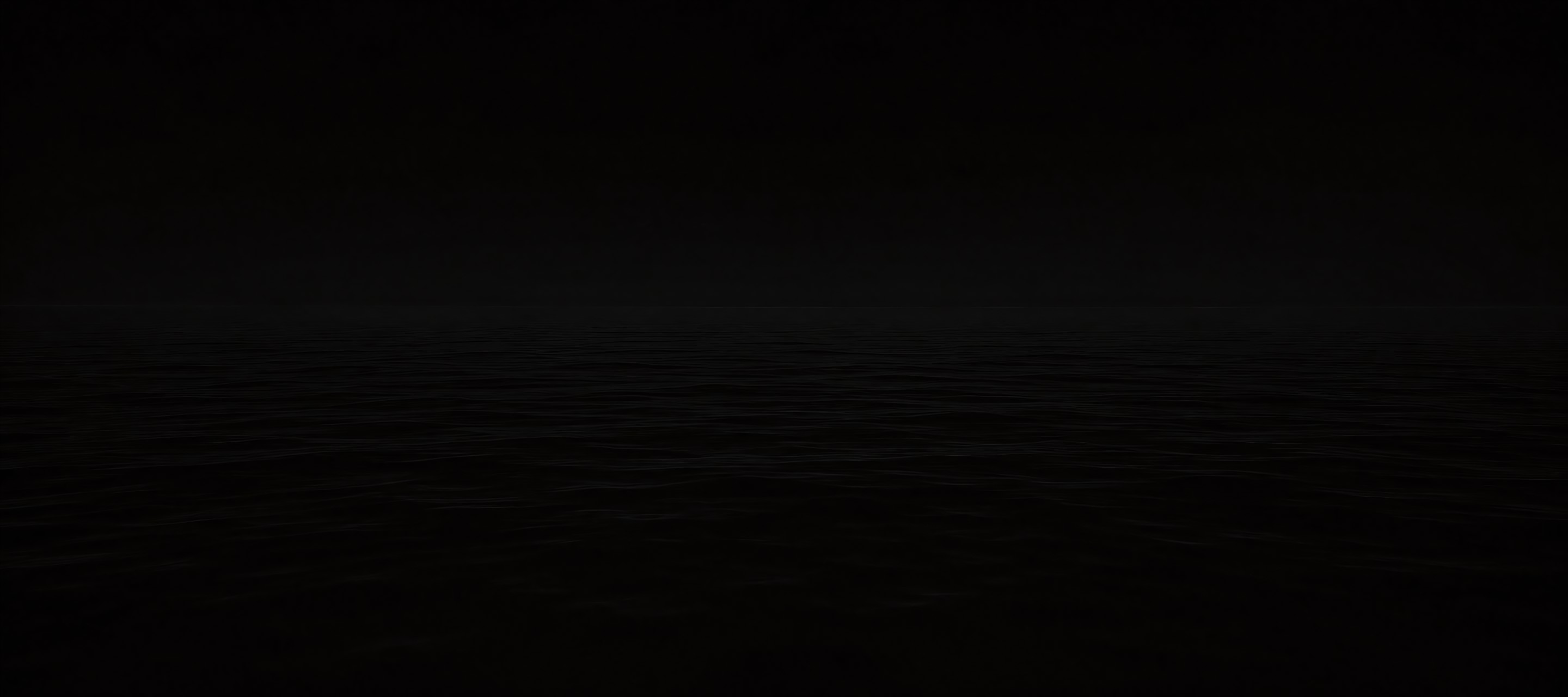
THE ABYSSAL ZONE (5,000 TO 7,000 KILOMETERS FROM SHORE, UNCONFIRMED)Tap to Expand
Theoretical. No one has ever reached this zone and returned. The water is pitch black, with no waves, no wind, only an unnatural, absolute stillness. What appears to be mountains on the horizon is not mountains. What appears to be a rising swell is not a wave. They are the bodies of World Enders, breaking the surface in silence. The ocean floor is believed to simply end here, a vertical drop into nothing. The Leviathans patrol this threshold. Beyond them is not water. It is the Void.

The Void : Absolute ErasureTap to Expand
The absolute edge of reality. No water. No sky. No light. Only a bottomless, cascading emptiness where existence ceases. The Leviathans circle this boundary eternally, their silhouettes visible against the nothingness. To sail into the Void is not to die. It is to be erased from memory and history as if you had never existed.
V. NATIONS & FACTIONS
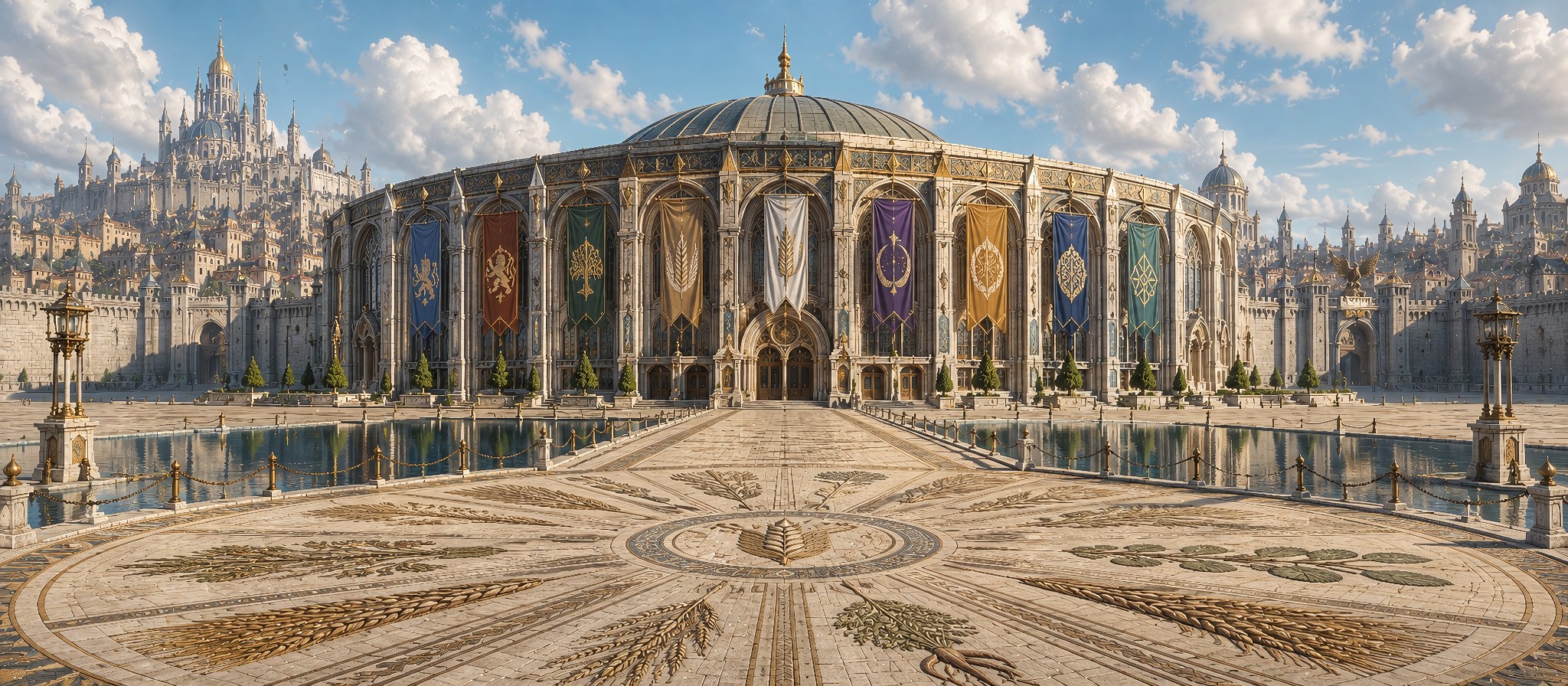
FOOD COUNCIL — The Shield Against Starvation Tap to Expand
The Food Council is a vital supranational diplomatic body forged to prevent global starvation. Its creation was born from a terrifying realization: every race and civilization in Ruinea depends entirely on the harvests from the Valley of Kings. In the year 1890 EK, the historic Treaty of Aethelburg was signed by nine major nations, conspicuously excluding the Black Domain. This grand treaty solidified a singular and unbreakable law: food must forever remain a shared right of survival, never to be wielded as a political weapon.
I. Council Structure and Governance
Equal Representation: Each of the nine signatory nations holds exactly one seat on the council. All global agricultural decisions are determined strictly by a majority vote.
Neutral Ground: Council assemblies take place in a specialized hall within Aethelburg but built deliberately outside the walls of the imperial palace. This specific architectural choice serves as a permanent reminder that the Emperor does not own the food of the world.
The Absence of Imperial Veto: Despite the fact that the entire world's breadbasket grows on their sovereign soil, the Valdran Empire holds no absolute veto power whatsoever in matters of global food distribution.
II. Functions and Absolute Powers
Emergency Food Rationing: During times of sudden crop failure or unforeseen natural disaster, the council convenes emergency sessions to coordinate global aid and establish strict rationing protocols.
Market and Price Control: The council wields the absolute authority to prevent the monopolization or inflation of grain and other vital necessities.
Conflict Mediation: The body acts as an untouchable neutral party whenever territorial disputes or rising political tensions threaten crucial agricultural lands or essential trade routes.
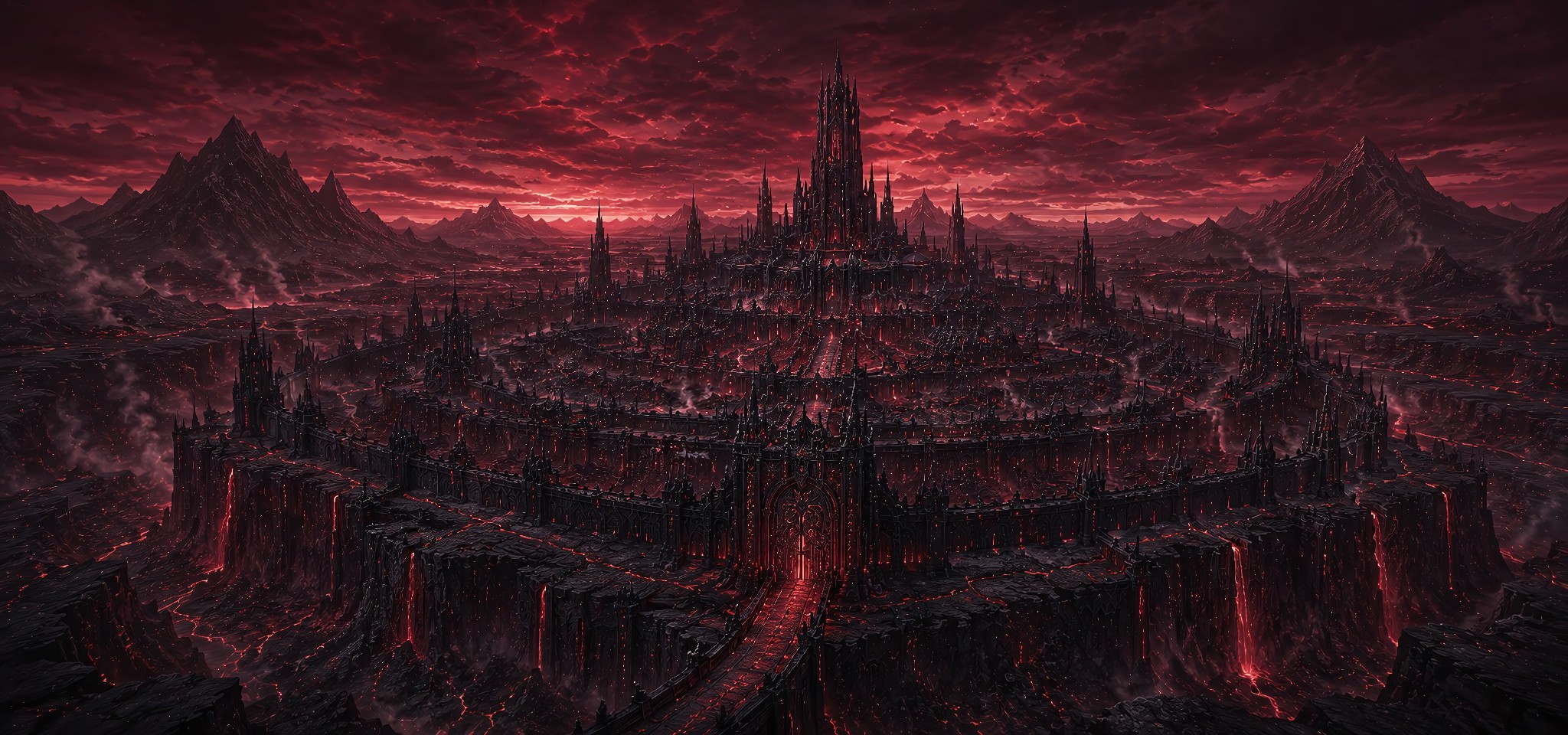
BLACK DOMAIN Tap to Expand
"Silence is the stillness before the next war."
I. Overview & Geography
At the far western edge of the continent, beyond the treacherous Western Seam Zone, lies a wasteland of twenty four million square kilometers. The soil is barren black, poisoned by ancient toxins leaking from the largest battlefield of the Primordial War. The cursed ground perpetually seeps death. A suffocating aura envelops the entire region. Phantom sounds of clashing weapons and ancient slaughter echo directly from the earth. The sky is eternally stained a deep, unnatural red or dark purple.
There are no farms. No mines. No natural resources of any kind. The inhabitants survive almost entirely on harvested monster meat, mastered into every necessity through centuries of grim innovation. Every part of a slain creature is utilized. Nothing is wasted. Nothing is bought. Nothing is grown. The Domain takes what it needs from the creatures that roam its poisoned plains and from the Dungeons that bleed across its borders.
II. History
The Black Domain was forged in the fires of the First Great War, which raged from 1500 to 1715 EK. The First King rallied the demon race and all the rejected ones of the world, launching a devastating campaign that nearly drove the other races to extinction. The relentless conquest was halted at the Battle of Malakh-Kar in 1715 EK. The First King fought seven legendary Heroes simultaneously, killing four, before collapsing from sheer exhaustion into an eternal slumber beneath his capital.
Of the twelve Demon Commanders who clashed with the seven Fallen Angels in a parallel battle, only five survived: The Unraveler, Vorlag, Kazagar, Gorath, and Zar'goth. Three Fallen Angels fell that day. The surviving demons were confined to this desolate territory. The Unraveler appointed four new Commanders—Alleen, Silphira, Vexia, and Nuva—to rebuild the legions. Their fanatical public doctrine remains unchanged: the stitched together New World is a false prison that must be entirely destroyed. Whether The Unraveler herself believes this is known only to one.
III. Culture & Society
The Domain does not mourn. It waits. Demons speak in clipped commands. Laughter is rare. Sentiment is viewed as a fatal weakness. Every structure is functional, brutalist, carved from black stone or salvaged Old World rubble. There is no art. No gardens. Only forges, barracks, ration halls, and the ever present red sky.
Children train before they can walk. Genetic memory provides five thousand years of accumulated combat knowledge and tactical instinct. Parents do not teach. They sharpen. A demon child knows how to kill without ever being instructed. To die in battle is honor. To die old in bed is a disgrace whispered behind claws.
Yet beneath the iron exterior lies exhaustion. Millennia of hatred have grown heavy. A hidden Revisionist Faction, quietly led by Commander Vexia, questions the eternal war. Discovery means instant death. The faction grows nonetheless, because some demons no longer remember why they fight. They only remember that they must. The Domain is a wound that refuses to heal, and every demon carries the infection.
IV. Government & Politics
The Domain operates under an absolute military dictatorship. The Unraveler, the supreme Demon King whose Tier ranges between eight and nine, holds unquestionable authority over all aspects of life and war. Flanking her are the Eight Commanders, each wielding immense power at Tier Levels from six to eight. They control military might, covert intelligence, and grand strategy beneath her absolute will.
The hierarchy is a brutal meritocracy based strictly on raw power and seniority. No throne is inherited. No title is given freely. Every Commander earned their position through combat, cunning, or both. Weakness is not accommodated. It is eliminated before it can spread.
V. Military
Every demon is a soldier. Their bodies are living weapons, able to shift from humanoid to monstrous forms depending on the demands of battle. The First King is the absolute pinnacle of this evolution, a being of primordial destructive power now slumbering beneath Malakh-Kar. An astonishing seventy percent of the original Old World arsenal remains fully functional, including beam lances, toxic gas dispersers, and mechanized golems. These artifacts are scavenged from Dungeons and maintained with religious care, but they are never truly reproduced. The knowledge of their creation died with the Old World.
Commanders and elite forces ride tamed war beasts, hulking Aether twisted predators bred for aggression and endurance. Wyverns and lesser dragons, tended by Zar'goth's beastmasters, serve as aerial cavalry and long distance transport. The Domain does not forge conventional weapons. It does not need to. Its soldiers are the weapons, and they have been sharpening for five thousand years.
VI. Technology
The Domain is entirely isolated from the continental transportation network. There are no paved roads. No Aether Trains. No Skyships. No Aether Skiffs. Old World relics are maintained but never reproduced. The forges of Malakh-Kar run on low grade Aether Cores harvested from Seam Zone Dungeons, producing just enough to sustain the war machine.
The Domain's primary technology is biological. Selective breeding of war beasts, wyverns, and lesser dragons has produced mounts and weapons of terrifying efficiency. The absolute mastery of monster meat processing ensures that nothing is wasted. Hide becomes armor. Bone becomes tools. Blood becomes ration supplements. Every part of a slain creature serves a purpose. The Domain has no factories. It has no farms. It has biology, and it has perfected it.
VII. Logistics, Infrastructure & Economy
Only shattered remnants of Old World routes cross the wasteland, barely maintained and barely passable. Long distance transport relies almost entirely on wyverns and lesser dragons ferrying supplies between the capital, the garrisons, and the outposts. Overland caravans are slow, vulnerable, and rare. The Domain's economy is built on a single principle: total self sufficiency. It has no agriculture. No mining. No trade dependence. It survives through monster hunting and processing alone.
There are no imports except stolen or scavenged goods. A clandestine black market pipeline, known as the Shadow Scheme, illegally exports Old World weaponry to corrupt imperial factions and rogue syndicates. This trade keeps the demonic economy marginally viable. Exposure would shatter the Western Axis. Strict rationing is enforced, but there is no starvation. The Domain asks nothing of the outside world that it cannot take by force.
VIII. Key Locations
Malakh-Kar is the silent fortress capital where the First King slumbers in the deepest abyss and The Unraveler holds her court. Every order in the Domain originates from this black citadel. It is the heart of the war machine, and it beats slowly in the dark.
The Shore Gate, on the western coast, is a fortified fishing outpost where deep sea monsters are hauled ashore, butchered, and shipped inland as salted meat and rendered oil. It is the Domain's only reliable food source beyond the Seam Zone hunts.
The Front Towns are forward garrisons positioned along the eastern border, facing the Theocracy. They are heavily stockpiled with Aether Cores harvested from Seam Zone Dungeons. These are the first to bleed when the Theocracy pushes westward.
The Back Holds, situated one day behind the front lines, serve as support depots. They house forges, ration stores, and medical stations for the endless war effort. All three settlement types are non sovereign and entirely expendable.
The Aeries, scattered near Malakh-Kar and the Front Towns, are roosting grounds for wyverns and lesser dragons, meticulously tended by Zar'goth's beastmasters. From here, the Domain's aerial cavalry rules the skies above the Seam Zone.
Wanderer Camps, hidden across the continent, are small, carefully camouflaged settlements populated by exiled demons bearing curved ram horns. They live as quiet artisans and traders among the races that distrust them, always watching, always ready to vanish into the shadows.
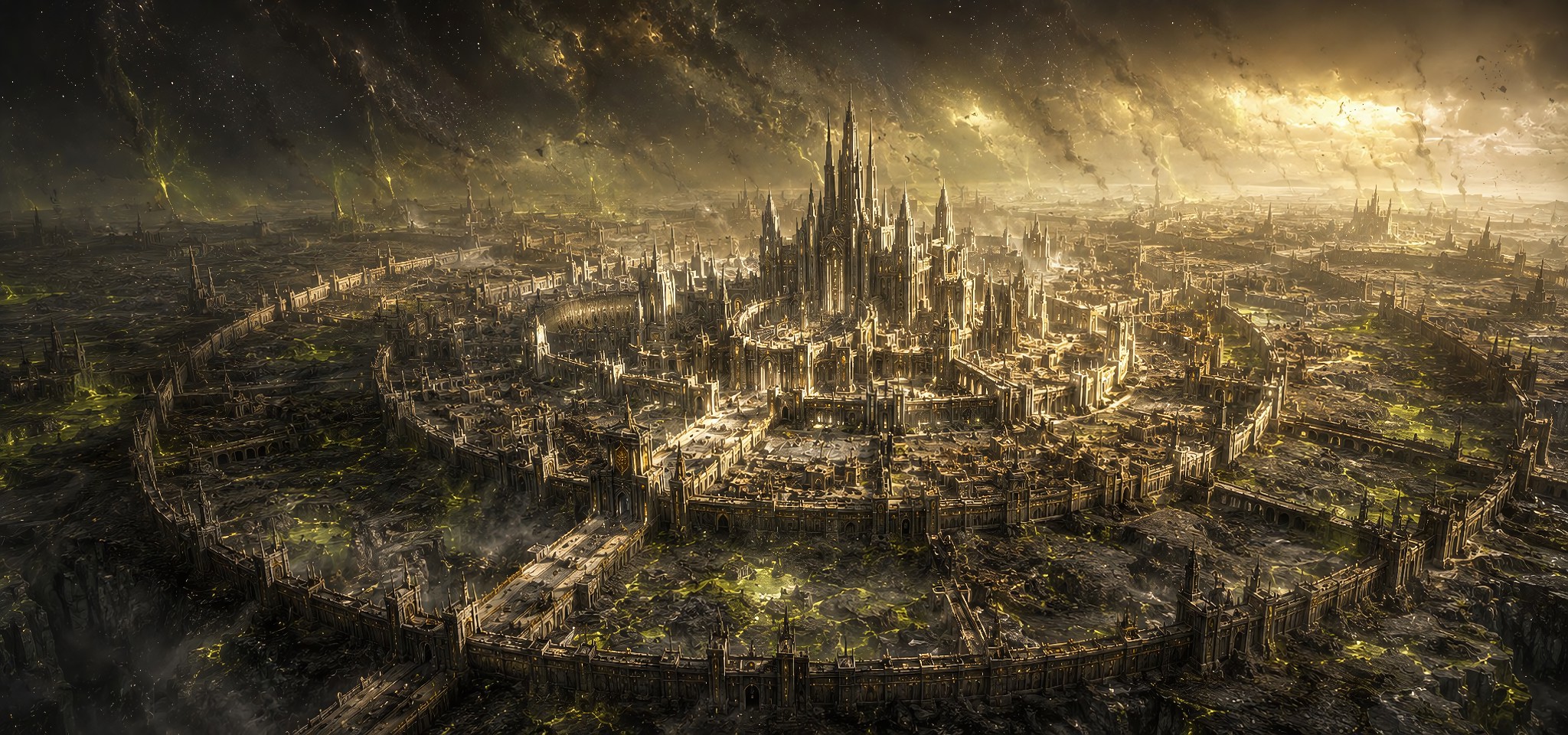
THEOCRACY OF THE SACRED WOUND Tap to Expand
"The Theocracy does not pray for rescue. It prays for strength to hold one more day."
I. Overview & Geography
Spanning nine million square kilometers inside the volatile Western Seam Zone, the Theocracy is not merely a nation. It is a physical barrier. It stands between the Black Domain and everything else, the last shield preventing demonic expansion into the fertile Valley of Kings. The terrain is a brutal wasteland of ancient, toxic battlefields where the laws of physics have broken and never healed. Gravity shifts wildly within mere meters. Spatial distortions make maps unreliable. Dungeon manifestations are dangerously concentrated. The sky is never clear, choked with dust, Aether leaks, and scars no god bothered to heal.
Every building in the Theocracy is roofless. This is not neglect. It is doctrine. The faithful know that nothing above protects them anymore. Rain falls on the altars. Ash settles on the pews. The congregation looks up and expects no answer. The entire nation is a colossal living fortress, and every citizen is a stone in its wall.
II. History
Seven Fallen Angels survived the death of the Old World. When the First Great War erupted from 1500 to 1715 EK, they did not retreat. They marched. All seven fought alongside the allied races to halt the First King's campaign of extinction. At the Battle of Malakh Kar in 1715 EK, three of them fell. Their names are carved forever into the highest spire of Lumina Aeterna. Four survived: Seraphiel, the maternal anchor; Azrael, the cold and efficient blade; Gabriel, the curious diplomat; and Raphael, the withdrawn prophet who speaks perhaps once a decade.
When the war ended and the demons retreated to the Black Domain, these four survivors made a choice that defined the next millennium. They did not seek safety. They marched toward the wound. In 1730 EK, they established the Theocracy inside the Western Seam Zone, the most dangerous territory on the continent. Their core doctrine is brutally simple: there is no heaven, and the gods are dead or gone. The world is abandoned. Because no gods remain to protect it, mortals must protect each other. For nearly a thousand years, they have shed blood every single day along the bleeding edge of the Seam Zone. They do not expect to win. They only expect to endure.
III. Culture & Society
Faith in the Theocracy is not comfort. It is duty. The roofless cathedrals are not ruins. They are statements carved in stone. The faithful do not ask why the gods left. They only ask what they can do for each other. Soldiers do not count years of service. They count patrols. Ten years on the Line Fortresses earns the title Hands of Suffering and a death wish they call duty. Children grow up knowing the mysterious Wound Room exists, but not what it tracks within its classified walls. They learn to march before they learn to read.
Laughter is rare. When it comes, it sounds like relief, not joy. Civilians support the war effort unconditionally, not because they are forced to, but because they have lived their entire lives knowing the Black Domain is on the other side of the horizon. Death is not feared here. What is terrifying is the thought of failing to hold the line. That fear is the pulse beneath every roofless cathedral, every patrol report, every prayer offered to a sky that never answers.
IV. Government & Politics
The Theocracy operates as an Elective Theocracy. Pope Callista III, a Demihuman and former slave, guides the realm. Her rise from property to pontiff is the living proof of the Theocracy's central belief: suffering and resolve dictate worth, not bloodline or origin. She is directly assisted by the four surviving Fallen Angels, who serve as supreme spiritual and military advisors. These celestial beings do not rule. They advise, guide, and when absolutely necessary, fight. Their wisdom is ancient. Their presence is the Theocracy's greatest spiritual weapon.
Three internal factions vie for influence within the halls of Lumina Aeterna. The Hardliners demand total war, absolute eradication of the demons, and the complete conquest of the Black Domain. For them, mercy is heresy. The Peace Faction, a desperate and quiet minority, seeks any viable diplomatic path toward a lasting ceasefire. They are small, suppressed, and viewed with deep suspicion. The Missionary Faction consists of zealots determined to spread the grim doctrine of divine abandonment and self reliance to the rest of the continent. Most nations find them unsettling. The Sanctum Aeternum finds them dangerous.
V. Military & Defense
The Theocracy's military doctrine is pure defense. It possesses absolutely no offensive capability. It has never launched a campaign beyond its borders. Every sword, every shield, every fortification exists for one purpose: to hold the line. The Sacred Guard is the disciplined regular army. Every soldier who enlists knows they may never leave the Seam Zone alive. They sign anyway.
The Hands of Suffering are the elite. These are battle hardened veterans who have survived more than ten years of active duty on the Line Fortresses. They are few in number, but each is worth a battalion. Recruits are not promised glory. They are promised a grave within sight of the enemy. Most accept. The four Fallen Angels take direct command only in the most dire emergencies. Their presence on the battlefield is not a tactic. It is a sign that the line is breaking, and everything is at stake.
VI. Technology, Magic & Arsenal
The Theocracy's greatest technological achievement is the Reality Anchor. These vital pylons are forged from blessed Dwarven iron and house stabilized Aether Cores. Placed every half kilometer along the main routes, they suppress the Seam Zone's gravitational and spatial anomalies. Without constant maintenance and blessing renewals, travel across the Theocracy would be impossible. The Anchor network is the skeleton upon which the entire nation hangs.
There are no rail lines. The terrain is too unstable. The ground shifts. The anchors keep the roads functional, but laying track across a wound that refuses to close is a dream no engineer has realized. Aether wagons are strictly limited to Anchor protected roads. The Theocracy relies instead on tamed Seam beasts: massive Saltherions, six legged lizards that carry heavy loads across broken ground; armored Bore Wyrms that tunnel through unstable earth to transport squads; and Ash Manes, hardened horses bred in the toxic environment for rapid cavalry deployment. Muscle and beast, not machine, hold this line.
VII. Logistics, Infrastructure & Economy
Two main arterial roads sustain the Theocracy, each maintained by the Reality Anchor network. The West Road carries the wounded and the flow of intelligence from the front lines back to Lumina Aeterna. The East Road carries vital supplies inward from the Valdran Empire. These two roads are the arteries of the nation, and if either is severed, the Theocracy bleeds out.
The Iron Road is the primary Valdran supply route. Large caravans depart from the imperial Duchy of Aurennis, skirt the edge of the Primeval Forest, and enter the Theocracy through Eastgate. The journey is exceptionally hazardous, requiring Guildhall adventurers and Sacred Guard detachments to protect each shipment. Large caravans arrive only every two to four months. The Northern Route, originating from Gar-Vang's port of Northhaven, provides a vital supplement: overland shipments of dried fish, Kraken meat, and rendered sea oil. This lifeline partially offsets the Theocracy's dependence on Valdran grain.
The economy is built on extreme vulnerability. Almost nothing grows in the toxic soil. Aether Cores harvested from the Dungeons that constantly breach across the Seam Zone are the only local resource. They are used purely to power the Reality Anchors, the Wound Room, and the defensive systems of the border fortresses. There are no exports. There is no surplus. There is only what arrives through Eastgate and Northgate, and the eternal calculation of how long it will last.
VIII. Key Locations
Lumina Aeterna is the capital, the City of Enduring Light. It houses the Roofless Cathedrals, the civilian population, and the highly classified Wound Room, a sacred chamber where the Fallen Angels and the Pope monitor the planetary injuries of Ruinea itself. The entire Reality Anchor network converges here, making it the safest point in the entire Seam Zone.
The Line Fortresses form a chain of self contained military cities directly facing the Black Domain. They are home to the Hands of Suffering. It is never quiet along the Line. It is never safe. The Sacred Guard bleeds here daily, holding ground that has never known peace.
Northgate is a fortified depot on the northern border. It receives the Northern Supply Route from Gar-Vang and houses a permanent Gar-Vang liaison office. Dried fish and Kraken meat arrive here before being distributed to the front.
Eastgate is the fortified checkpoint on the eastern border. Iron Road caravans from the Valdran Empire enter here, passing through customs, cargo inspection, and a Guildhall liaison office that coordinates the protection of future convoys.
Pilgrim's Way Waystations are small, heavily fortified shelters scattered along the routes between fortresses. They protect travelers, messengers, and the wounded from sudden spatial anomalies or monster attacks. To be caught between waystations at night is to gamble with a Seam Zone that does not forgive.
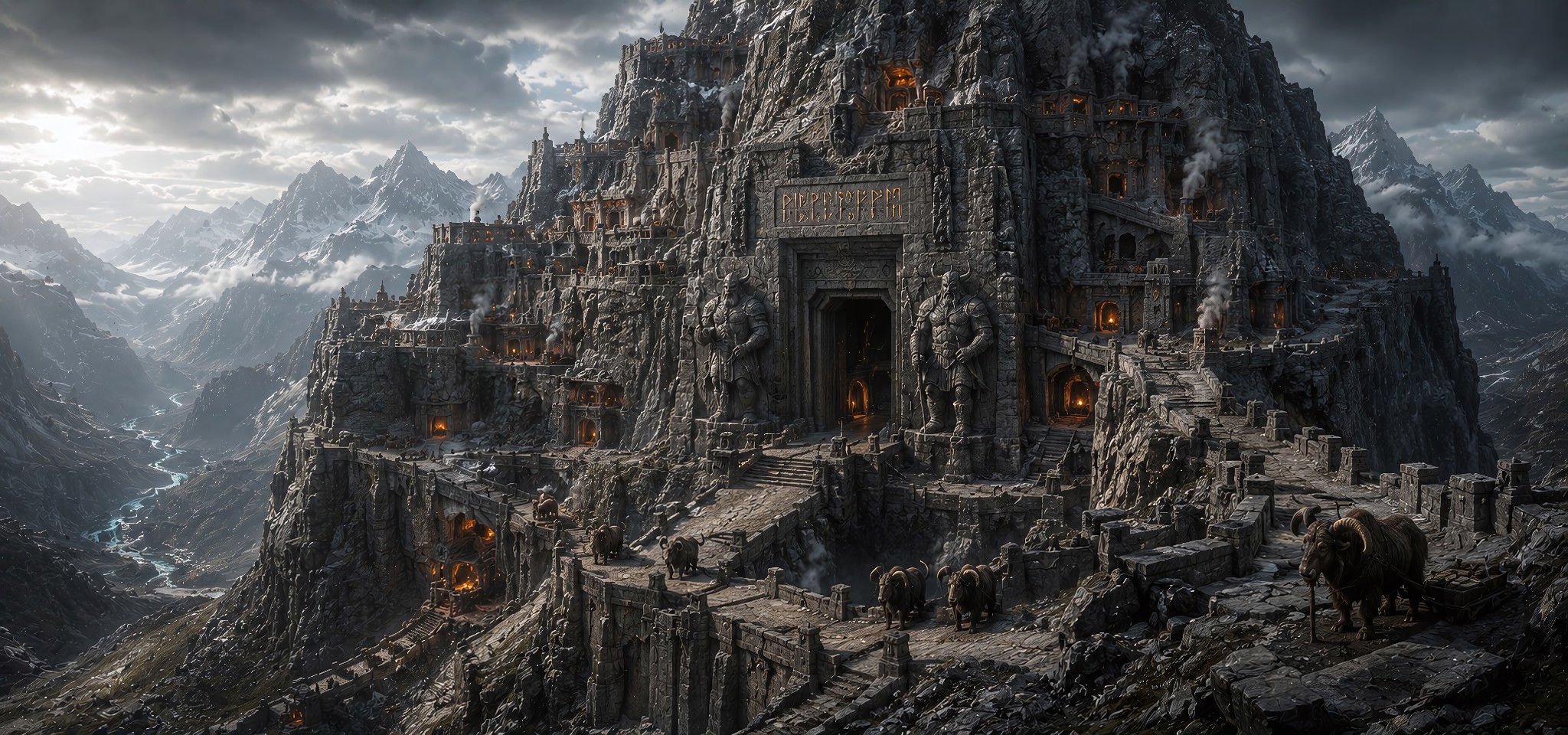
GAR-VANG Tap to Expand
"Gar-Vang does not boast. It endures. We will not let what happened to us happen to others."
I. Overview & Geography
Occupying twelve million square kilometers of harsh northwestern territory, Gar-Vang is anchored securely at the rocky foothills of the Vorn Mountains, near where the Mystra River begins its uncanny journey. The landscape is defined by rugged highlands and steep mountain valleys. The climate is brutal. Winters bite deep and summers are short. The land is exceptionally poor for crops, but it is rich in spirit. Proximity to the mystical source of the Mystra River grants the entire region access to incredibly potent Aether, a gift the Orcs have never taken for granted.
The wind howls down from the Vorn peaks, carrying sleet and the memory of ten thousand winters. Stone walls are thick. Words are few. An Orc's promise is heavier than any anvil. Silence here is not emptiness. It is respect. Visitors feel the weight of oaths the moment they cross into the highlands. Every Orc carries the Sacred Oath like a second skeleton. To break it would be to unbecome.
II. History
Orcs were originally created by the deceased God of War in the Old World. They were weapons, born without any purpose other than to wage endless, mindless slaughter. They were never meant to be a people. When their creator god died, every Orc froze mid-command. For the first time in their existence, there was silence where orders should have been. Then, for the first time, they chose. Some kept fighting. Some walked away. Some wept. They utterly rejected the destiny that had been forced upon them and chose a new purpose: to become the ultimate guardians of the world they were made to destroy.
In Year 23 EK, the legendary figure Alsaktar gathered the scattered Orc race and founded Gar-Vang. He gave them more than a nation. He gave them an oath. The Sacred Oath binds every warrior: "We will not let what happened to us happen to others." Throughout the bloody history of Ruinea, Gar-Vang has fought strictly on the defensive side, protecting the innocent and upholding the balance. They do not start wars. They end them.
III. Culture & Society
Gar-Vang is stoic, oath bound, and deeply communal. Joy here is quiet: a full stew, a successful hunt, a son who returns alive from Northhaven. They do not sing of glory. They sing of duty fulfilled. Discipline is love expressed through expectation. Children are not told they are special. They are told they are needed. Training begins at five. This is not cruelty. It is preparation for a world that is not kind.
Elders do not coddle. They sharpen. A veteran does not explain a battle. They sit, stare into the fire, and let the young watch. The lesson is in the scars. The Great Exodus, young Orcs leaving to join the Guildhall, is permitted by Warlord Varrak without protest. He believes an Orc can carry their sacred oath wherever they walk. But each departure is quietly mourned. The highlands grow quieter every year, and beneath the stoic exterior lies a weariness that no oath can fully conceal.
IV. Government & Politics
Gar-Vang operates under a strict Meritocratic Council of Veterans. Warlord Varrak Ironhide, a massive and seasoned Orc warrior of three hundred and twenty years wielding an immense Weave Level of seven, holds ultimate command. He earned his title not through bloodline or politics, but through decades of unbroken victory and unshakable honor. All monumental decisions are debated with a grand council consisting of the oldest, wisest, and most respected war veterans in the territory. The young may speak, but the old decide.
The philosophy of governance is inseparable from the philosophy of war: cold professionalism, sacred duty, and absolute emotional control. An Orc who loses control to anger in battle has failed the oath. This is not a matter of shame. It is a matter of spiritual failure. The oath is not a promise. It is the foundation of what an Orc is.
V. Military & Defense
Gar-Vang's military doctrine is impenetrable defense. They do not attack. They wait. They hold. Only when the enemy has exhausted themselves against the shield wall do they advance. They wage no offensive wars. They never have. The Legacy of Alsaktar is a specialized unit of absolute elite troops, preserving the flawless combat techniques inherited directly from their ancient founder. To be inducted into Alsaktar's Legacy is the highest honor an Orc can achieve short of the Warlord's mantle.
The Controlled Berserker is the ultimate proof of their triumph over their mindless origins. It is a unique state that massively amplifies physical strength while maintaining perfect consciousness, discipline, and tactical awareness. The Orc becomes stronger, faster, and more lethal, but never loses themselves. This is the pride of Gar-Vang. This is the answer they give to the god who made them weapons: they have become warriors.
VI. Technology, Magic & Arsenal
Gar-Vang is a nation of foot and beast. Heavy supplies are carried by Stone Rams, massive mountain goats with horns like battering rams, capable of navigating near vertical slopes. Elite cavalry ride Dire Wolves bred in the high valleys, their howls echoing across the peaks. The Orcs do not love machines. They trust muscle, bone, and the strength of their own backs.
Roads are carved directly from mountain stone. They are functional, enduring, and built for troop movement rather than commerce. They are steep, narrow in places, and often treacherous to outsiders unfamiliar with the terrain. Orcs need no guideposts. The mountain speaks to them. Potent Aether Cores harvested from the Mystra source power the forges of Gar-Durak through brutal winters. The naval fleet at Northhaven utilizes Aether core powered longships reinforced with Vorn-Taraz iron, warships capable of hunting deep sea Krakens in the Twilight Zone.
VII. Logistics, Infrastructure & Economy
Survival in the highlands relies heavily on hunting, herding, and trade. The Orcs do not farm in the traditional sense. They hunt the mountain beasts that teem in the high valleys. They herd small, hardy livestock. They trade monster meat and rare ores to Vorn-Taraz and the Valdran Empire for the grain they cannot grow. An Orc does not beg for bread. They earn it with steel.
Northhaven, the largest and most fortified port in Ruinea, exports massive amounts of dried fish, Kraken meat, and rendered sea oil to the Theocracy of the Sacred Wound. This Northern Supply Route supplements the Valdran grain that the Theocracy cannot always guarantee will arrive. The economy is also heavily subsidized by remittances sent back by young Orcs working in the Guildhall. Every coin that returns to the highlands is a thread connecting the old world of Gar-Vang to the new world its children are building abroad.
VIII. Key Locations
Gar-Durak is the fortress capital, carved directly from the bones of the earth. It is the seat of the Warlord and the Council of Veterans, and its stone halls have witnessed every oath sworn since the days of Alsaktar.
Northhaven is the largest and most heavily fortified port in Ruinea. Where the Vorn Mountain foothills meet the frigid Northern Sea, Orcish longships dominate the docks. The port features a remarkably multi racial population, a Guildhall chapterhouse specializing in naval combat and deep sea monster hunting, and a permanent Sacred Guard detachment from the Theocracy stationed in exchange for the lifeline of supplies flowing south.
The Mystra Source Villages are small, isolated settlements heavily guarded by rangers, dedicated to harvesting the potent Aether Cores that power Gar-Vang's forges and heat its fortress cities through the brutal winters.
The Guildhall Road Waystations are fortified inns situated every half day along the route connecting Gar-Durak to the Guildhall's Westgate. They are jointly patrolled by Orcish rangers and Guildhall adventurers, a symbol of the quiet alliance between two nations who understand the weight of duty.
The Clan Villages are scattered clusters of stone longhouses spread throughout the highlands. Each has a communal forge and a meeting hall. Travel between them takes days, and each village maintains its own traditions, its own elders, and its own interpretation of the oath that binds them all.
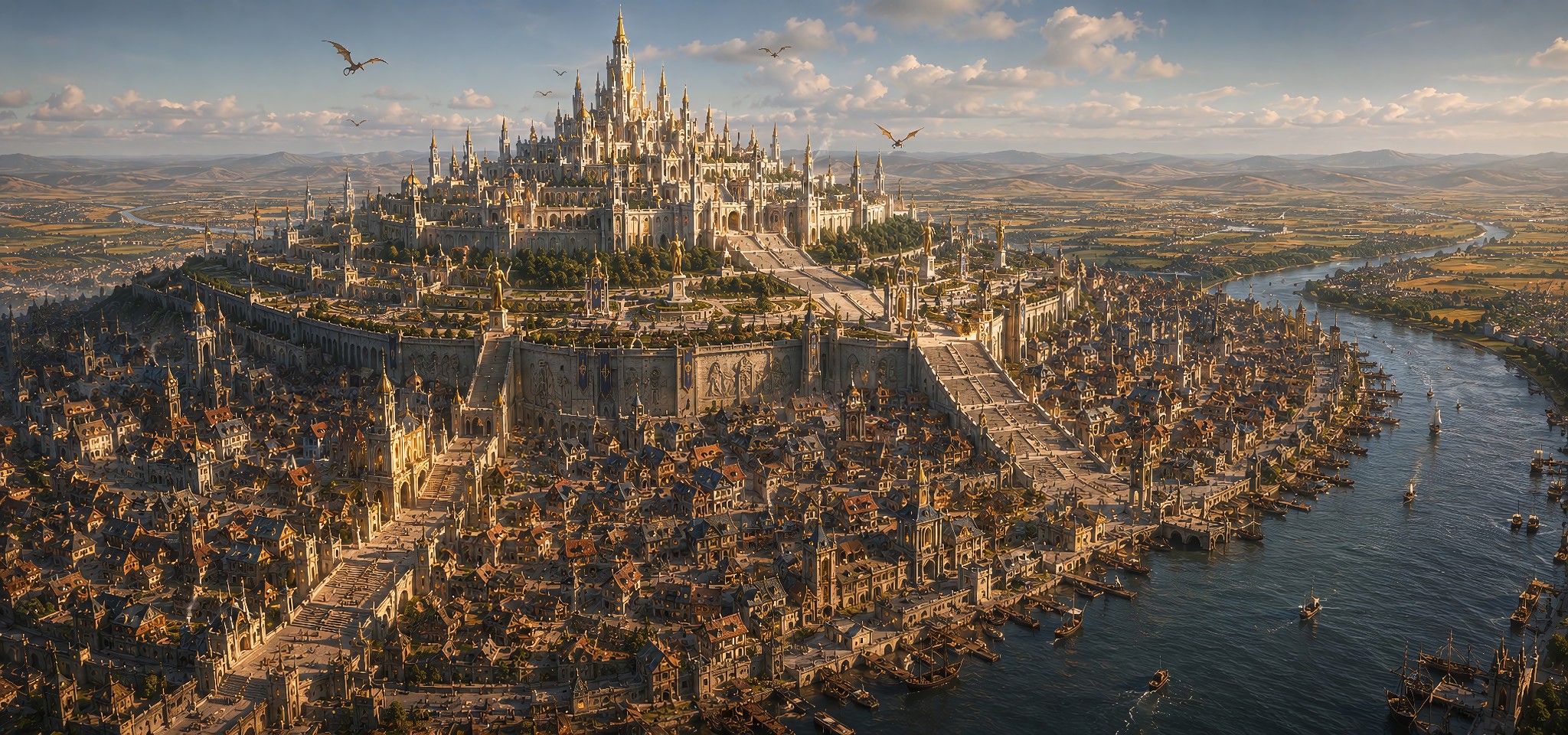
VALDRAN EMPIRE Tap to Expand
"Valdran does not wonder if it is great. It knows. Efficiency built this empire, and efficiency will decide if it falls."
I. Overview & Geography
Spanning forty two million square kilometers across the legendary Valley of Kings, the Valdran Empire is the largest sovereign nation in Ruinea. Its climate ranges from alpine snow in the north, where the Vorn Mountains scrape the sky, to temperate grassland in the south, where the land softens into rolling hills. The mighty Aethel River flows through its heart, and its reliable annual floods deposit the nutrients that have made this land the ultimate breadbasket of the world.
The spires of Aethelburg were not built to impress. They were built to remind. Every stone says: we endured. We won. We feed the world. But beneath the marble lies a quiet, persistent anxiety. The Hero Bloodline is thinning. No true Hero has been born in generations. Nobles smile at galas while measuring each other's throats. Commoners whisper about what happens when the blood runs out. Order is absolute here. A Valdran does not waste grain, words, or mercy. Efficiency built this empire, and efficiency will decide if it falls.
II. History
The Kingdom of Tasia was founded in 250 EK as a fragile alliance of human and demihuman survivors. For a century, it remained a regional power among many, sustained by the river but lacking the strength to dominate. The turning point came in 350 EK, when Vorn-Taraz Dwarves approached the Tasia court with an unprecedented offer: Old World knowledge, engines, rails, the blueprints recovered from the First Boon. Tasia accepted. Dwarven engineers worked alongside human ambition and Guildhall muscle to build the first rail lines and highways. Expansion came not through war but through technology and cooperation.
The First Great War, from 1500 to 1715 EK, nearly annihilated everything. The First Hero rose from the chaos, a human who shattered every known limit to reach Circle 7. He led the alliance that pushed the Demons back to the Black Domain. He died of his wounds in 1765 EK. What followed were decades of decline. His heirs proved unworthy. Noble houses grew fat while those who had bled for the kingdom received nothing. Discontent festered until 1910 EK, when a catastrophic succession dispute ignited civil war. Multiple claimants fought. Food production collapsed. A devastating famine spread across the entire continent.
In 1915 EK, with the world starving, six foreign powers intervened and forced a resolution. The Treaty of Aethelburg was signed. The Warrior Princess, the strongest royal claimant, ascended as Empress Elenor Asteria Valdris I. The kingdom was renamed the Valdran Empire after the First Hero. The famine taught the world a harsh lesson that same year: food could not be a weapon of war. The Food Council was born from this truth, and the Valdran Empire, despite being the largest producer of grain on the continent, holds no veto power in its decisions.
III. Culture & Society
Valdran society prizes order, efficiency, and hierarchy above all else. Time is money. Food is power. Queues form without instruction. Laws are cited by street vendors. Corruption exists but is discreet, because scandal is worse than crime. The two tiered capital of Aethelburg strictly mirrors the class divide: the shining Upper City elevates nobles and the rich, while the crowded Lower City houses commoners, markets, guilds, and the rail station. Social mobility exists but is extremely narrow. A commoner may rise through the Order of Valdran or the Blood Paladins, but the path is long and the gatekeepers are many.
Faith is pragmatically split. The empire publicly funds Sanctum Aeternum, whose comfortable lies bring hope to the masses. It secretly relies entirely on the Theocracy of the Sacred Wound, whose grim soldiers bleed on the front lines. The empire funds both because it cannot afford to choose. A Valdran noble prays to the Sanctum on feast days and sends grain to the Theocracy on tax days. This is not hypocrisy. This is efficiency.
IV. Government & Politics
The Valdran Empire is an Absolute Hereditary Monarchy, its legitimacy inextricably tied to the Hero Bloodline. Empress Elenor Asteria Valdris IX holds ultimate authority, but she must constantly navigate the dangerous political waters of the Council of Nobles, a powerful and scheming assembly of one hundred elite aristocratic families. Four Grand Dukes govern the North, South, East, and West. Each oversees approximately twenty five Ducal Lords, a feudal structure that maintains order but breeds constant regional rivalry and political maneuvering.
The Order of Valdran and the Blood Paladins serve a dual purpose. They are the military backbone of the empire, composed entirely of elevated commoner knights. But they are also a vital political counterweight against the ambitions of the nobility. Every commoner who rises through their ranks is a reminder to the noble houses that the throne has swords that owe no loyalty to bloodline.
V. Military & Defense
The imperial military is composed of standing professional legions. There is no conscription. Soldiers are paid, trained, and equipped by the state. The Blood Paladins serve as elite heavy cavalry, while the Order of Valdran provides professional infantry that forms the backbone of every campaign. The empire's deadliest global weapon is not its soldiers, however. It is its absolute food monopoly. Armies march on their stomachs, and every stomach in Ruinea depends on Valdran grain.
The western Grand Duchy of Aurennis maintains the largest active military garrison in the empire. Constant monster threats from the Western Hills wilderness require a permanent state of readiness. Soldiers stationed in Aurennis see more combat than any other imperial legion, and their commander holds more practical military authority than any noble in the capital.
VI. Technology, Magic & Arsenal
The Valdran Empire boasts the finest highway network in the world. Wide, smooth roads of Aether fused stone connect every major city and regional capital. Waystations at regular intervals provide fresh horses, Aether core recharges, and shelter. Imperial patrols keep the highways safe. The roads are a monument to imperial power, and they are also the arteries through which grain flows to every corner of the continent.
The Iron Serpent, the continental rail network designed and built by Vorn-Taraz engineers, connects all four Grand Duchies to the capital. Trains haul grain, iron, and passengers at speeds that would have seemed miraculous a century ago. For personal transport, the nobility and wealthy merchants use Aether wagons and Aether carriages. Commoners rely on horse drawn carts and oxen. River barges on the Aethel River move the harvest in quantities that no road or rail can match. Air travel remains strictly exclusive to imperial dragons and visiting dignitaries. The sky is not a road. It is a privilege.
VII. Logistics, Infrastructure & Economy
Massive granaries are maintained in every major city. These are not merely stores. They are strategic assets, monitored by imperial officials and guarded by the Order of Valdran. The empire holds an absolute monopoly on the global grain supply. It is the largest food exporter in Ruinea, and this grants immense political leverage within the Food Council, despite the fact that the empire holds no formal veto power. No one votes against Valdran when Valdran feeds their people.
Trade routes radiate outward from the Valley of Kings in every direction. To the west, caravans travel through the Grand Duchy of Aurennis, skirt the edge of the Primeval Forest, and deliver grain to the Theocracy of the Sacred Wound. To the south, the Aethel River carries barges laden with harvests toward Sol-Ventari and the port of Greenharbor. To the north, rail and road connect the capital to the Guildhall and to Vorn-Taraz, where grain is exchanged for Dwarven steel. Every route is protected. Every shipment is accounted for. The empire's economy is a machine, and grain is its fuel.
VIII. Key Locations
Aethelburg is the imperial capital, a magnificent two tiered city at the exact center of the Valley of Kings. The Upper City holds the nobles, the imperial palace, the grand statues known as the Hero Monuments, and the solemn Wailing Wall, a massive memorial for the fallen. The Lower City houses the commoners, the markets, the guild halls, and the central rail station where the Iron Serpent arrives and departs. The two cities share a skyline but live in different worlds.
Stenvyr, the Shield of the North, guards the approaches to the Vorn Mountains. Its rail station serves as the primary launching point for expeditions heading toward The Great Maw and Guildhall territory.
Sylvaran, the Eastern Breadbasket, produces the bulk of the empire's grain. Its massive rail depot ships harvests westward to feed the continent.
Keldavar, the Southern Gateway, oversees all trade flowing north from the Primeval Forest. Goods from Aelderim, Verdantus, and Sol-Ventari pass through its customs houses.
Aurennis, the Western Bulwark, houses the largest military garrison in the empire and a major Guildhall chapterhouse. It is the primary staging point for caravans heading to the Theocracy, and it is heavily fortified against the monster incursions that bleed from the Western Hills wilderness.
Ducal Seats and Villages spread across the empire in their thousands. Each Grand Duchy contains roughly twenty five administrative centers, each governing hundreds of farming villages that feed the empire and, through it, the world.
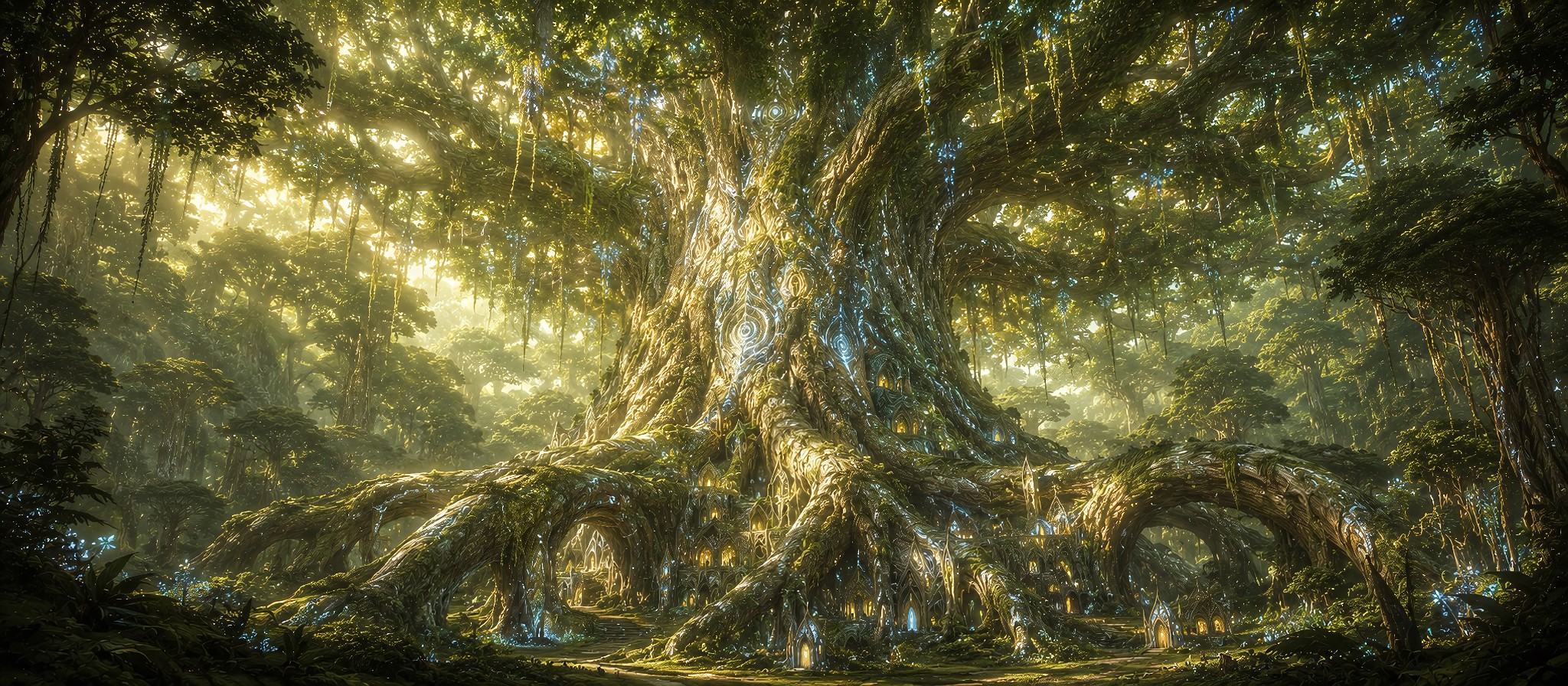
AELDERIM Tap to Expand
"Aelderim does not speak. It sings—slow, mournful, in a language only the old trees remember."
I. Overview & Geography
Deep within the central Primeval Forest lies Aelderim, spanning fourteen million square kilometers of the oldest woodland on the continent. The trees here are as old as the New World itself, and they have never stopped singing. Every leaf vibrates with the melancholic, magical echoes of the ruined Old World. Every root hums with memory. The air is thick with the scent of moss, ancient wood, and a faint, inexplicable sweetness—the smell of remembrance.
At the absolute heart of the realm stands the World Tree, a colossal divine entity hundreds of kilometers tall. It houses recorded history within its bark and generates immense magical power through its roots. To harm the World Tree is to declare war on memory itself. Silence here is not emptiness. It is fullness. Every leaf holds a ghost. Every root traces a scar from a world that no longer exists. The Elves move as if underwater. A century feels like a season. A greeting may take an hour. They are not slow. They are eternal.
II. History
Aelderim was founded in Year 10 EK by survivors of the Old World who carried the last World Tree seed across the Great Shattering. They planted it in the heart of the Primeval Forest, and from that single seed grew the living heart of a civilization. It is one of the oldest sovereign nations in existence, and its memory stretches back to a time before the gods went to war.
For centuries, Aelderim remained deeply isolationist, tending its memories and watching the outside world from behind a veil of ancient trees. The First Great War shattered that isolation. The First King's demonic horde sought to burn the World Tree, the living memory of the Old World. Aelderim held the center while Verdantus held the west flank. The World Tree never fell. But the cost was an entire generation of Elves who learned how to kill, knowledge they have spent centuries trying to forget. After the war, Aelderim retreated even deeper into the forest. Its core philosophy became absolute: "We shall not forget." They bear the heavy, self imposed burden of preserving the complete, unedited memories of the Old World. Its glory, its destruction, and every moment between.
III. Culture & Society
Time flows differently among the World Tree's roots. Politeness demands immense patience. A rushed visitor is viewed as deeply disrespectful, not because the Elves are cruel, but because haste implies that the present moment is worth less than the next one. You do not shout in Aelderim. You do not rush. The trees will remember your impatience forever.
Museum Sickness is not a metaphor here. It is a clinical, widespread epidemic. Many Elves struggle to find meaning in the present when they live surrounded by the perfectly preserved past. To some, the present feels like a shallow imitation of lost glory. To others, the memories are a comfort that makes the present bearable. The debate between memory and forgetting is the quiet civil war beneath every polite conversation. Traditionalists demand complete isolation and eternal remembrance. For them, forgetting is a form of death, and the archives are sacred. Secret Reformists operate in the shadows, desiring engagement with the outside world. Some even whisper that the ancient archives should be burned so their people can finally live again. Both sides love Aelderim. Neither side can forgive the other.
IV. Government & Politics
Aelderim operates as a Constitutional Monarchy guided by a supreme Council of Elders. The reigning Monarch directs daily governance, but the Council holds ultimate authority over all grand strategic and sacred cultural decisions. No major action is ever taken without absolute consensus. This makes Aelderim's government slow by the standards of shorter lived races, but the Elves do not measure time in years. They measure it in centuries.
The most revered figure in the realm is Elder Lysiane, the Keeper of Memory. Over nine thousand years old, she has witnessed more history than most civilizations have recorded. She serves as the highest and most respected advisor to the crown, and her voice carries more weight in the Council than the Monarch's own. She rarely speaks. When she does, the forest listens.
V. Military & Defense
Offensive warfare is unthinkable in Aelderim. There is no standing army. Defense is natural, the forest itself fights invaders through ancient wards woven into the World Tree's roots, and magical, powered by the immense Aether that flows through the living wood. To invade Aelderim is to fight the land itself.
The Forest Keepers are elite sentinels who guard the territory. They move through the trees without making a single sound, and they have trained for centuries in the art of protecting without destroying. The Shadow Hunters are a black ops division that is officially denied but quietly acknowledged. They exist solely to eliminate extreme internal threats, including Reformists who cross the line into treason. Their existence is the darkest secret in a nation built on memory, and no one speaks of them in the light.
VI. Technology, Magic & Arsenal
Cutting a straight highway through the Primeval Forest is considered sacrilege. There are no paved roads in Aelderim. No Aether wagons. No rail lines. The rumble of wheels and the stench of burning cores would desecrate the sacred stillness. Instead, living root paths, guided by gentle magic, wind between the trees without scarring the forest floor. Bridges are woven entirely from living branches that grow stronger with each passing year.
Light comes from bioluminescent flora cultivated throughout Silmarya and the forest paths. Warmth comes from natural hot springs and enchanted wood that radiates gentle heat. Communication is achieved through memory crystals and singing trees, ancient magic that carries voices across the forest without breaking the silence. Magic here is incredibly potent but ancient. Quiet, slow, and endlessly patient, like the Elves who wield it.
VII. Logistics, Infrastructure & Economy
All travel within Aelderim is done on foot or by riding Great Stags, magnificent antlered mounts that move through the trees in near total silence. There is no need for speed. There is no destination that cannot wait another century.
The Border Glades, located on the northern edge where Aelderim meets the Valley of Kings, are the only official point of contact with the outside world. This small cluster of settlements is populated by Elves who quietly believe isolation must slowly ease. Traders, diplomats, and Guildhall representatives are permitted here, but never beyond. The Border Glades are a cautious experiment, intensely debated among the Elves, and their existence is a source of tension between Traditionalists and Reformists.
Aelderim's economy is entirely self sufficient. The forest provides absolutely everything: food from forest gardens grown in harmony with the trees, materials from living wood that regenerates after harvest, and medicine from ancient herbs found nowhere else on the continent. No external trade is necessary. The Elves take nothing the earth does not offer freely. They completely ignore global Food Council politics because they have never needed it. The outside world may starve or feast. Aelderim endures.
VIII. Key Locations
Silmarya is the radiant capital, a city of singing leaves built seamlessly into and around the World Tree. It knows no permanent night. Bioluminescent flora bathes its winding paths in perpetual soft light, and the songs of the leaves are audible from every corner of the city.
The World Tree stands at the absolute heart of Silmarya. It is a colossal divine entity that houses recorded history within its bark and generates immense magical power through its roots. To harm it is to declare war on memory itself, and no army in history has succeeded in doing so.
The Unwalled Library is a gigantic open air archive within Silmarya. It lacks any physical boundaries because knowledge, the Elves believe, should not be caged. Global memories are stored here in glowing crystals, ancient writings, and sacred songs. No knowledge is forbidden. Only painful.
The Border Glades, to the north, are the sole gateway for outsiders. A small community of Elves who believe the isolation must slowly ease tends to the traders and diplomats who arrive from the Valdran Empire. Beyond the Glades, the forest closes, and no outsider has ever been invited further.
The Root Villages are small communities of scholars, gardeners, and memory keepers living in carved root chambers within the World Tree's vast subterranean system. They are the keepers of the oldest memories, and they rarely see the sky.
The Singing Groves are scattered sacred sites where ancient trees hold particularly potent memories of the Old World. They are pilgrimage destinations, not settlements. Elves travel for months to sit beneath them and listen to songs that predate the New World itself.
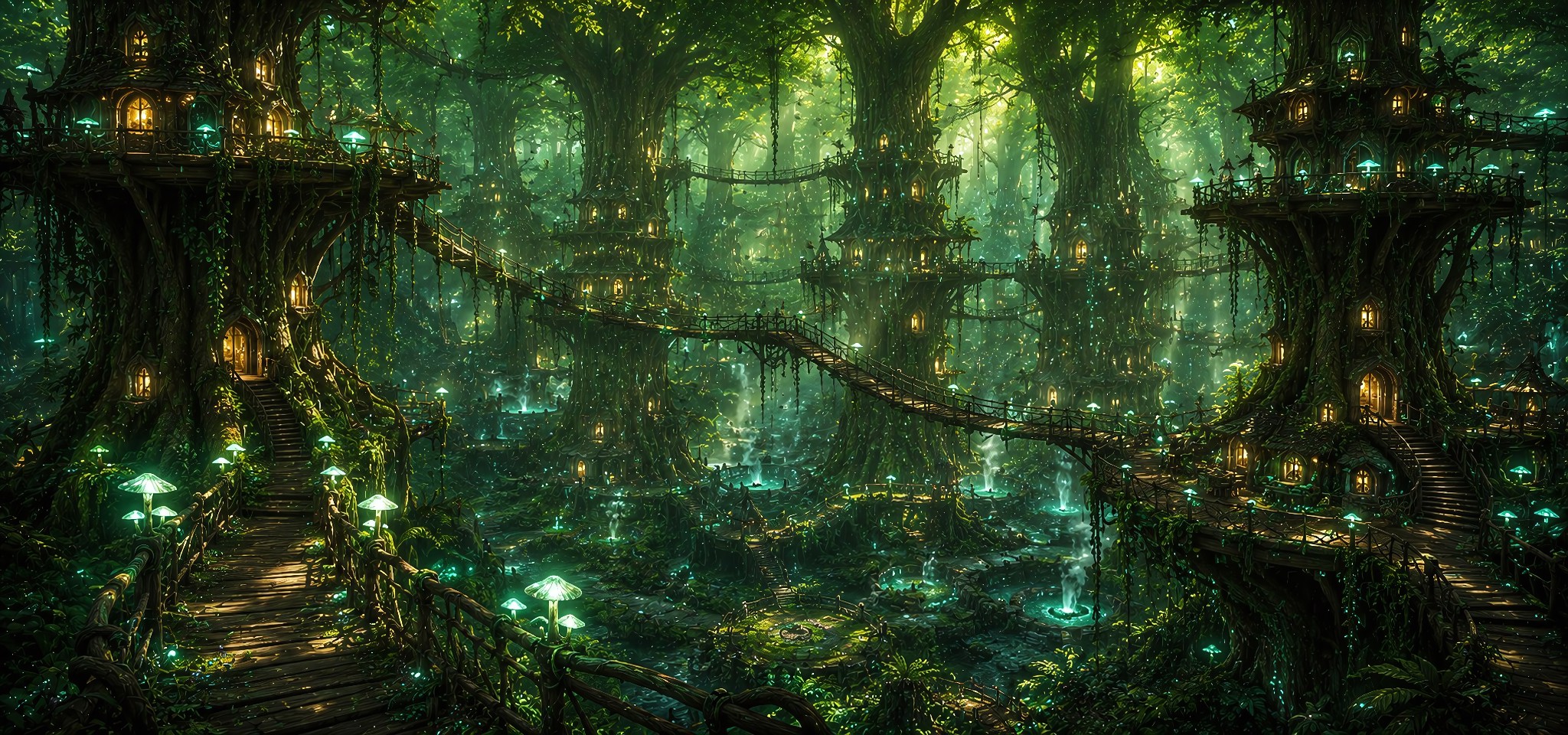
VERDANTUS Tap to Expand
"Verdantus does not whisper. It breathes—slowly, deliberately."
I. Overview & Geography
Verdantus spans eight million square kilometers of the western Primeval Forest, resting precariously close to the volatile Western Seam Zone. The land is exceptionally fertile, nourished by ancient soil that has never known the plow. The forest canopy grows so densely here that entire sections of the city are invisible from the sky, a living roof that shields the Werebeasts from the outside world.
The forest is not viewed as a resource. It is a teacher. Every tree, every stream, every creature that moves through the underbrush is part of a sacred conversation that the Werebeasts have been listening to for centuries. Pacifism here is not softness. It is the hardest discipline a predator can master. The old ones carry grief like scars from wars they chose to stop fighting. Verdantus is not waiting for war. It has already fought its war. Now it gardens.
II. History
Verdantus was founded in Year 50 EK by united Werebeast tribes, beings once feared across the continent as wild ferals. For centuries before the First Great War, they lived in scattered warbands, hunters without a cause beyond survival. The war changed everything. From 1500 to 1715 EK, Verdantus fought entirely defensively. They held the western flank of the Primeval Forest against the demonic incursion, protecting the World Tree and Aelderim with tooth and claw. Every battle was defensive. Every kill was mourned.
When the war ended, the entire race faced a choice that would define them forever. In 1750 EK, they took a sacred vow of total pacifism, codified into unbreakable law. No more killing. No more blood. An apex predator that consciously chooses not to kill. It was the most difficult decision any Werebeast had ever made. Not all agreed. The militant cousins who rejected the vow turned east into the open grasslands and became a separate faction known as The Pack. The founders of Verdantus chose the sanctuary of the forest instead. They did not flee out of cowardice. They retreated to survive, to reflect, and to become something different.
III. Culture & Society
Every Werebeast in Verdantus has killed in their bloodline. Their ancestors were hunters, warriors, ferals who tore demons apart on the western flank. But every Werebeast living today has chosen to stop. That choice is renewed each dawn, with every breath, with every prey animal they do not take. Children are taught restraint before hunting. The hardest lesson is not how to kill. It is how to hold back when every instinct screams otherwise.
Silence here is not emptiness. It is listening. To the canopy. To the prey they do not take. To the weight of claws that could tear but rest instead. Visitors find the stillness unsettling. There are no arguments. No hurried footsteps. Only the slow turning of seasons and the quiet rustle of leaves. The old ones carry grief like scars. They remember the war. They remember the taste of demon blood. They chose this. Every day, they choose again.
IV. Government & Politics
Verdantus is governed by a unified Council of Forest Elders. Decisions are made through absolute consensus. There is no single ruler. Leadership is collective, patient, and deliberately slow. The Council does not vote until every voice has been heard, every concern addressed, and every elder is ready to speak. This can take days. It can take weeks. The Werebeasts do not measure urgency the way other races do.
Elder Mossback, a Turtle Werebeast of twelve hundred years, holds the highest honor among the Council. He has watched over the forest for more than a millennium, and his wisdom is sought by every clan. But he votes strictly as one among equals. The Council does not bow to him. It listens, and then it decides together. This is the way Verdantus has governed since the vow was sworn, and it has never failed.
V. Military & Defense
Verdantus maintains strictly no offensive military capability. Its defense relies on passive deterrence and non lethal neutralization. The Forest Keepers are special forces trained for fifteen years in specialized martial arts designed to disable and detain without causing harm. They are the undisputed global experts in immobilization and submission. An enemy who enters Verdantus will not be killed. They will be stopped, restrained, and removed. The distinction is absolute.
The Woundless Protectors hold the highest title in Verdantus society. It is granted only to elite guardians who have never taken a single life, not even in desperate self defense. To be Woundless is to be a living embodiment of the sacred vow. They are few in number, revered beyond measure, and each carries the weight of every life they chose not to take.
VI. Technology & Magic
Verdantus has zero reliance on Aether Cores. The nation is lit entirely by bioluminescent fungi cultivated throughout the city and along the forest paths. Warmth comes from natural hot springs and from the thick fur that every Werebeast carries. Cold is not feared. It is simply another sensation to be accepted.
There are no paved roads in Verdantus. The forest floor is sacred, and to scar it with stone would be a violation of everything the vow represents. Instead, living canopy bridges made of wood and vine connect the upper reaches of Greenholt and the scattered settlements beyond. The Werebeasts move through the forest as animals do, on foot, through the underbrush, along paths only they can sense. They do not build vehicles because they do not need them.
VII. Logistics, Infrastructure & Economy
There are no Aether wagons and no beasts of burden in Verdantus. In their beast forms, Werebeasts run faster than any horse, leap further than any vehicle could travel, and navigate the dense forest with instinctive grace. For heavy loads, they use their immense physical strength to pull loaded carts themselves. The elderly and injured are carried by litter bearers with profound reverence. To be carried is not a sign of weakness. It is a sign that the community remembers its duty to every member.
Verdantus is entirely self sufficient through ethical hunting, careful gathering, and small scale forest farming. They completely ignore global Food Council politics because they have never needed it. When they do trade, it is rare forest products they offer: potent medicines, magical wood, and exotic fruits found nowhere else on the continent. In exchange, they receive manufactured goods they choose not to produce themselves. They are the only sovereign nation in Ruinea with zero external energy dependence.
VIII. Key Locations
Greenholt is the grand sanctuary capital, hidden safely beneath the living canopy. The trees grow so densely overhead that the city is invisible from the sky. The Council of Forest Elders meets here in a grove that has been sacred since the vow was first sworn.
Northgate is the border gateway for merchants, diplomats, and refugees. It houses a small Guildhall chapterhouse, the only one in Verdantus, restricted strictly to non combat contracts. Adventurers who seek violence are turned away. Those who seek to help are welcomed quietly.
Westwatch is a buffer settlement near the Western Seam Zone. It serves as a sanctuary for refugees fleeing the horrors of the reality wounds. There are no soldiers here. No weapons. Only healers, food, and the quiet promise that no one will be turned away.
The Grove of Memory is a sacred site near Greenholt where the elders meditate on the vow. The trees here are older than the New World, and the Werebeasts come to remember why they chose peace, and to renew that choice in the silence of the ancient wood.
Forest Hamlets are small, scattered communities of ten to thirty Werebeasts living in treehouses and tending forest gardens across the vast expanse of Verdantus. Each hamlet has its own traditions, its own elders, and its own relationship with the vow. They are the quiet heart of a nation that chose to stop fighting.
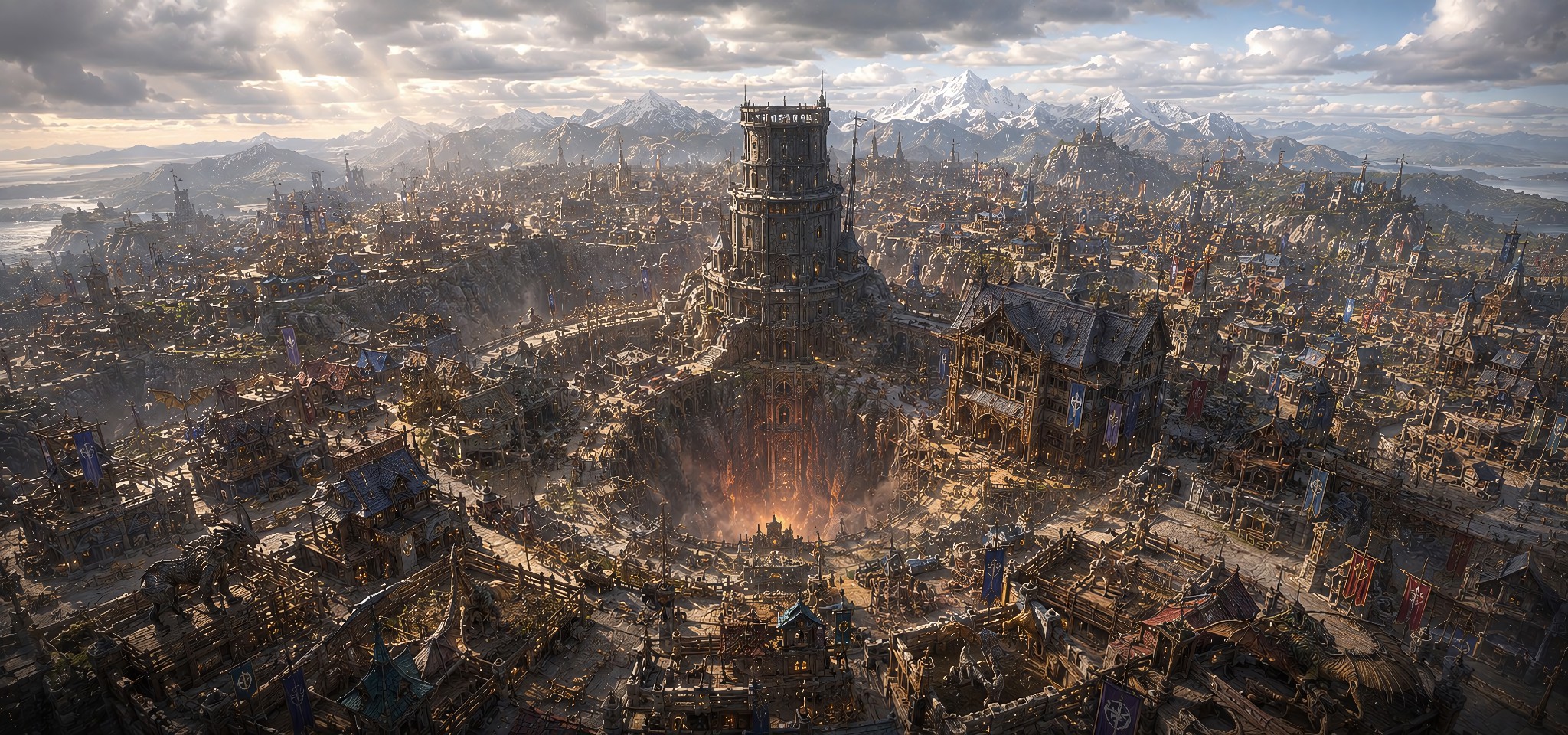
GUILDHALL Tap to Expand
"Vornhold does not sleep. It waits. Vornhold does not mourn. It replaces you."
I. Overview & Geography
Spanning four million square kilometers of rugged, hilly territory directly north of the Valley of Kings, the Guildhall is built precariously above the largest Dungeon in existence. The Great Maw festers directly beneath the capital. The ground trembles constantly. The air carries a faint, acrid tang from below. Every citizen lives knowing the abyss beneath their feet is alive and hungry, and that a thousand meters of rock are all that separate their bed from a monster's hunting ground.
Vornhold, the capital, is a sprawling city intentionally built without walls. This is not arrogance. It is a statement of absolute truth. No wall could hold what comes from below. The city relies solely on steel and courage, and on the adventurers who sharpen both against the darkness beneath. The city sprawls outward because inward leads down, and down never ends.
II. History
The Guildhall's roots trace back to the early Kingdom of Tasia, long before it became the Valdran Empire. Wandering blades, mercenaries, and monster hunters roamed the land without structure or standard. That changed when two extraordinary beings consolidated the chaos. Thalanil Silverleaf, an Elder Elf who had walked the Old World, and Aurelia Emberdrake, a dragon in human form, established the first standardized contract system. They gave the wandering blades a code, a ranking system, and a purpose.
During the First Great War, from 1500 to 1715 EK, the Guildhall transitioned from hired swords to heroes. They aggressively sealed Dungeon Breaks that threatened civilian populations, evacuated settlements in the path of demonic advance, and targeted demonic assets behind enemy lines. They were not an army. They were a scalpel. When The Great Maw tore open the earth around 1800 EK, the outpost above it grew into Vornhold. In 2050 EK, the Guildhall declared itself a sovereign state with one absolute, defining purpose: eternally contain the abyss before it floods the world. Thalanil and Aurelia became the first Council of Masters. They have never stepped down. For five centuries, the same two founders have guided the guild.
III. Culture & Society
In Vornhold, rank is everything. An A-rank adventurer does not introduce themselves. Their scars speak. Their silence shouts. Veterans watch rookies with something between pity and hunger, measuring whether this one will survive or whether they will find their corpse next week. Adventurers form temporary found families, bonds forged in the depths and broken by death or, more rarely, by survival. These makeshift families descend together, bleed together, and often die together. Those who survive carry the guilt of those who did not.
The Tower of Silence handles those broken by trauma. Few speak of what happens inside. Fewer still walk out whole. The rest of Vornhold drinks, spends coin, and descends again. Because that is what you do. You go down. You come up. Or you do not. Death is business. Respect is carried up from the depths on loot carts, measured in Aether Cores and Old World artifacts. Mourning is a luxury reserved for those who have stopped descending.
IV. Government & Politics
The Guildhall operates as a pure Adventurer Meritocracy. The Council of Masters, seven individuals possessing legendary S or A rank, governs from the Round Spire. Members are democratically elected by their peers every five years. Rank is strictly earned in the depths, never inherited, never bought, never bestowed by politics. An adventurer's rank dictates their exploration rights, their share of recovered loot, and their internal political influence.
Three core principles define the Guildhall. Total anti discrimination: all races, all origins, and all dark pasts are welcome. Judgment is based solely on raw strength, proven skill, and character demonstrated in the depths. Armed Neutrality: the Guildhall's blades face downward, toward the Dungeon, never outward at other nations. No Retirement: fading away peacefully is considered a quiet tragedy. Veterans remain active into old age or become brutal instructors, believing that a boring death is the only kind worth fearing. Three internal factions vie for influence: the Commercialists, who view the Dungeon as a resource to be profitably extracted; the Idealists, who remain focused on the sacred mission of containment; and the Pure Neutrals, who care only about ascending the ranks and conquering the next challenge.
V. Military & Defense
The Guildhall maintains no standing army. Its defense relies on its adventurers, who never truly retire. Veterans who can no longer descend become instructors, drilling the next generation in the brutal lessons they learned in the dark. The Vornhold Guard, composed of former adventurers, patrols the city and keeps the peace. Expedition Teams, ranked adventurers organized by contract, clear threats from the Maw and from Dungeons across the continent. The Rail Wardens, an elite multi national guard, protect the Iron Serpent from monster attacks and sabotage, ensuring that supplies and reinforcements can flow freely along the continental rail network.
VI. Technology, Magic & Arsenal
The Guildhall employs Aether wagons for heavy logistics, hauling expedition supplies, recovered artifacts, and injured adventurers between the city and the dungeon entrances. Aether cycles serve as courier vehicles, racing contracts and intelligence across the territory. Tamed monster mounts are common among higher ranks: dire wolves, griffins, and occasionally juvenile drakes bonded to their riders through years of shared descent.
The Iron Serpent connects Vornhold directly to the continental rail network shared with the Valdran Empire and Vorn-Taraz. The rail line is the Guildhall's logistical lifeline, bringing in supplies, reinforcements, and the grain that feeds the city. The Guildhall also possesses exactly one Skyship, a light Aether lifted airship reserved strictly for deep Seam reconnaissance and global emergencies. To see the Guildhall Skyship on the horizon is to know that something terrible has already occurred.
VII. Logistics, Infrastructure & Economy
The Guildhall's economy is purely expedition based. The cycle is absolute: descend into the depths, extract Aether Cores and Old World artifacts, rise, and use the wealth to fund the next descent. High grade Aether Cores from the Maw directly power the city's forges, artifact vaults, and defensive systems. The economy is also funded by loot extraction and heavy Dungeon Taxes placed on foreign explorers who seek to enter the Maw without being Guildhall members.
Fortified waystations are established every half day along all major routes, supplying adventurers heading to and from the depths. Because agriculture is impossible in the rugged, trembling terrain above the Maw, the Guildhall imports massive amounts of Valdran food to supplement the hunted monster meat and specialized rations designed for deep expeditions. The city does not grow its own grain. It trades cores for calories, and the calculus is precise.
VIII. Key Locations
Vornhold is the capital, a sprawling city without walls. The Round Spire towers at its center, the seat of the Council of Masters, its highest floor looking down upon the entrance to The Great Maw itself. The Guildhall Centre, directly adjacent, processes all contracts, missions, and the endless paperwork of death and salvage. The Tower of Silence stands apart, a somber sanctuary for those the Maw has broken. The Maw Gate is a massive spiral platform descending directly into the abyss. Every contract begins here, and not every adventurer who descends returns.
Northgate is a cold, heavily patrolled gateway facing the Vorn Mountains. It serves expeditions heading to high altitude dungeons and to Vorn-Taraz, and its winds carry the chill of the peaks even in summer.
Westgate faces Gar-Vang and the Western Hills. It is a busy route for Orcish warbands traveling south and for monster suppression contracts that send adventurers into the wilderness to cull threats before they reach civilized lands.
Eastgate is the departure point and supply depot for Eastern Hills and Seam Zone expeditions. Its warehouses are stocked with rations, ropes, and the specialized equipment needed to survive reality wounds.
Southgate is the busiest of all. It houses the Iron Serpent rail station that connects directly to the Valdran Empire, processing all southern goods, grain shipments, and the endless stream of recruits who arrive seeking purpose in the darkness below.
The Western Chapterhouse, located inside Valdran territory near the Grand Duchy of Aurennis, is a major non sovereign cooperative branch. It coordinates caravan escorts to the Theocracy and serves as a forward operating base for adventurers working the western frontier.
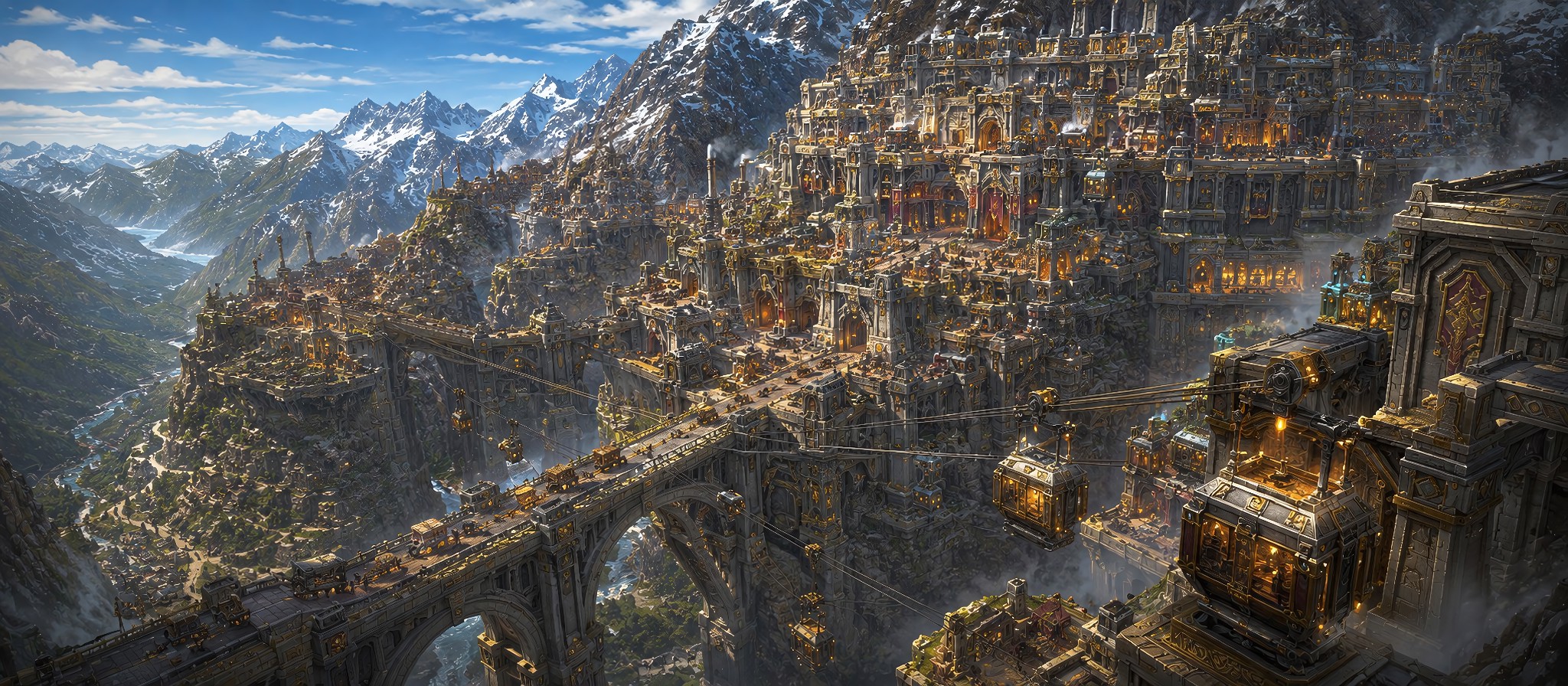
VORN-TARAZ Tap to Expand
"Vorn-Taraz does not whisper. It hammers. The mountain rings like a bell from dawn to dawn."
I. Overview & Geography
Vorn-Taraz spans six million square kilometers of the rugged southeastern slopes of the Vorn Mountains. The landscape is defined by thin alpine sunlight, steep terraces carved into the living rock, and massive tunnels plunging deep into the mountain's heart. The territory is exceptionally rich in precious ores and magical minerals, a geological fortune that the Dwarves have exploited for millennia with the precision of surgeons and the hunger of empire builders.
The air smells of hot metal, coal, and ambition. Forges glow brilliantly day and night across the mountainside, their light visible from miles away. Dwarves here move fast, speak bluntly, and close deals with a handshake and a grunt. Failure is not forgiven. It is studied, dismantled, and fixed. Innovation is the only prayer they offer. Children learn engineering before poetry. An elder without calluses is an elder without respect. You do not rest in Vorn-Taraz. You keep up, or you get out.
II. History
The Great Schism split the Dwarven race into two irreconcilable paths. While Kazad-Vorn dug downward in search of ancestors and forgotten gods, Vorn-Taraz turned its eyes outward. The surface Dwarves remembered what the Deep Dwarves had chosen to forget: they had once been the smiths of gods and the builders of celestial engines. They looked at a broken world stitched together by dying goddesses, and they realized they had the hammers to rebuild it.
The turning point came in 350 EK, when Vorn-Taraz made a historic offer to the young human Kingdom of Tasia. They shared Old World knowledge: engines, rails, the blueprints recovered from the First Boon. Tasia accepted. Dwarven engineers, human ambition, and Guildhall muscle laid the first Iron Serpent rails and paved the great highways. It remains the most successful cross faction project in history. When the First Great War erupted, Vorn-Taraz became the arsenal of the free world. Their forges burned day and night producing weapons, armor, and siege engines. Dwarven steel held the line. Aether Cannons broke demonic siege formations. Every soldier who marched to Malakh Kar carried a Vorn-Taraz blade. When peace came, they seamlessly turned their war industry into a peacetime economy without pause. They do not mourn the Old World. They build the New.
III. Culture & Society
Vorn-Taraz society is meritocratic, pragmatic, and relentlessly forward looking. Status is measured strictly by skill and output, not lineage. An elder without calluses commands no respect, no matter how ancient their bloodline. Innovation is sacred. A Dwarf who improves a forge design is celebrated more than a Dwarf who wins a duel. The past is a foundation, not a temple. Kazad-Vorn believes the surface Dwarves have abandoned their sacred traditions for coin. Vorn-Taraz replies that coin feeds more mouths than prayer, and that the ancestors would rather be honored by a working anvil than a weeping statue. The Ancestral Rift between the two Dwarven nations is a wound that neither side has any interest in healing.
IV. Government & Politics
The nation is governed by a highly efficient Merchant Council. Profit is policy. Efficiency is law. The council is composed of the most successful merchants, master engineers, and wealthy guild heads, and every decision is measured against a single question: does it strengthen the mountain's economy?
The Lord Merchant, currently Brynn Copperhand, holds supreme authority over all commerce and governance.
V. Military & Defense
The Silver Guard is the only standing military force in Vorn-Taraz. They are not merely heavily armored warriors. They are elite combat engineers, capable of commanding advanced tactical gear, siege weaponry, and Aether Cannons on any battlefield. Their training combines Dwarven metallurgy with Guildhall combat doctrine, producing soldiers who can forge a blade and then wield it with equal mastery.
Beyond the Silver Guard and guild sponsored security forces, Vorn-Taraz's defense relies on two things: impenetrable mountain fortifications carved into the living stone, and absolute economic deterrence. To attack Vorn-Taraz is to collapse the global economy. Every nation on the continent depends on Dwarven steel, Dwarven engines, and Dwarven rails. The mountain does not need to threaten. It simply needs to exist.
VI. Technology, Magic & Arsenal
Vorn-Taraz is the birthplace of the Aether wagon and the Aether cycle. Its inventors and engineers are the most advanced on the continent. Heavy Aether haulers carry raw ore from the mines to the forges. Aether carriages transport wealthy merchants between forge cities. For the steepest and most remote mountain paths, sure footed Stone Rams pull smaller carts where wheels cannot follow.
The nation possesses the second finest road network in the world, exceeded only by the Valdran Empire. Mountain highways are carved directly from living stone. Aether powered funiculars move goods and people between the vertical terraces. The Iron Serpent is Vorn-Taraz's greatest creation: the continent spanning rail network designed and built by Dwarven engineers. The Track Tenders who maintain it form an immensely prestigious guild. To sabotage a rail line is considered a personal insult to the entire Dwarven race, and the response is never diplomatic.
VII. Logistics, Infrastructure & Economy
A massive network of mountain highways, funiculars, and rails connects every major forge city and trading post. The Iron Serpent serves as the primary artery linking the mountain to the Valdran Empire, the Guildhall, and beyond. Goods flow down from the peaks and grain flows up from the plains in a rhythm as old as the Schism itself.
Vorn-Taraz is the undeniable heart of the global economy. It exports masterwork metals, weapons, Aether engines, and advanced technology to every single nation on the continent, with the strict and absolute exception of the Black Domain. In return, it imports massive quantities of food to sustain its rocky, un farmable cities. The mountain's greatest vulnerability is its greatest partnership: almost all of its grain comes from the Valdran Empire. A single season of blocked trade routes would starve the mountain. The empire knows this. Vorn-Taraz knows the empire knows. The relationship is built on mutual dependence and mutual deterrence, and it has held for centuries.
The Counting House, the largest bank in the world, is headquartered within Taraz-Vorn. Its immense vaults manage the hidden finances of nations, merchant guilds, and mercenary companies across the continent. To default on a Counting House debt is to become a global pariah. The bank's neutrality is absolute, and its ledgers have never been breached.
VIII. Key Locations
Taraz-Vorn is the gleaming capital of endless commerce. It houses the Merchant Council chambers, the Silver Guard headquarters, and the grand central rail station where the Iron Serpent arrives and departs. The city is a monument to Dwarven engineering, its terraces stacked up the mountainside like a staircase built for giants.
The Lower Forges form a chain of heavily industrialized valleys where raw ore from Kazad-Vorn is smelted into the steel that arms the continent. Thick smoke hangs perpetually overhead, and the ringing of hammers never stops. Few outsiders are ever permitted to visit. The Dwarves consider the Forges sacred ground, and the secrets of their metallurgy are guarded more closely than any vault.
The Trade Gates are fortified market towns positioned on the mountain edges. Each specializes in specific goods: one gate for weapons, another for engines, a third for vehicles. The Iron Serpent stops at each gate, loading cargo destined for every corner of Ruinea.
The Foothill Settlements are rare communities on the southern slopes where Dwarves live above ground. Here, farming and logging sustain the mountain's need for timber and fresh produce. These settlements are the primary point of contact with the Valdran Empire's trade caravans.
The Counting House stands in the heart of Taraz-Vorn, an eight story monument to financial power. Its vaults are managed with precision that borders on obsession, and its reputation is absolute. Nations trust it. Merchants depend on it. No one has ever successfully robbed it.
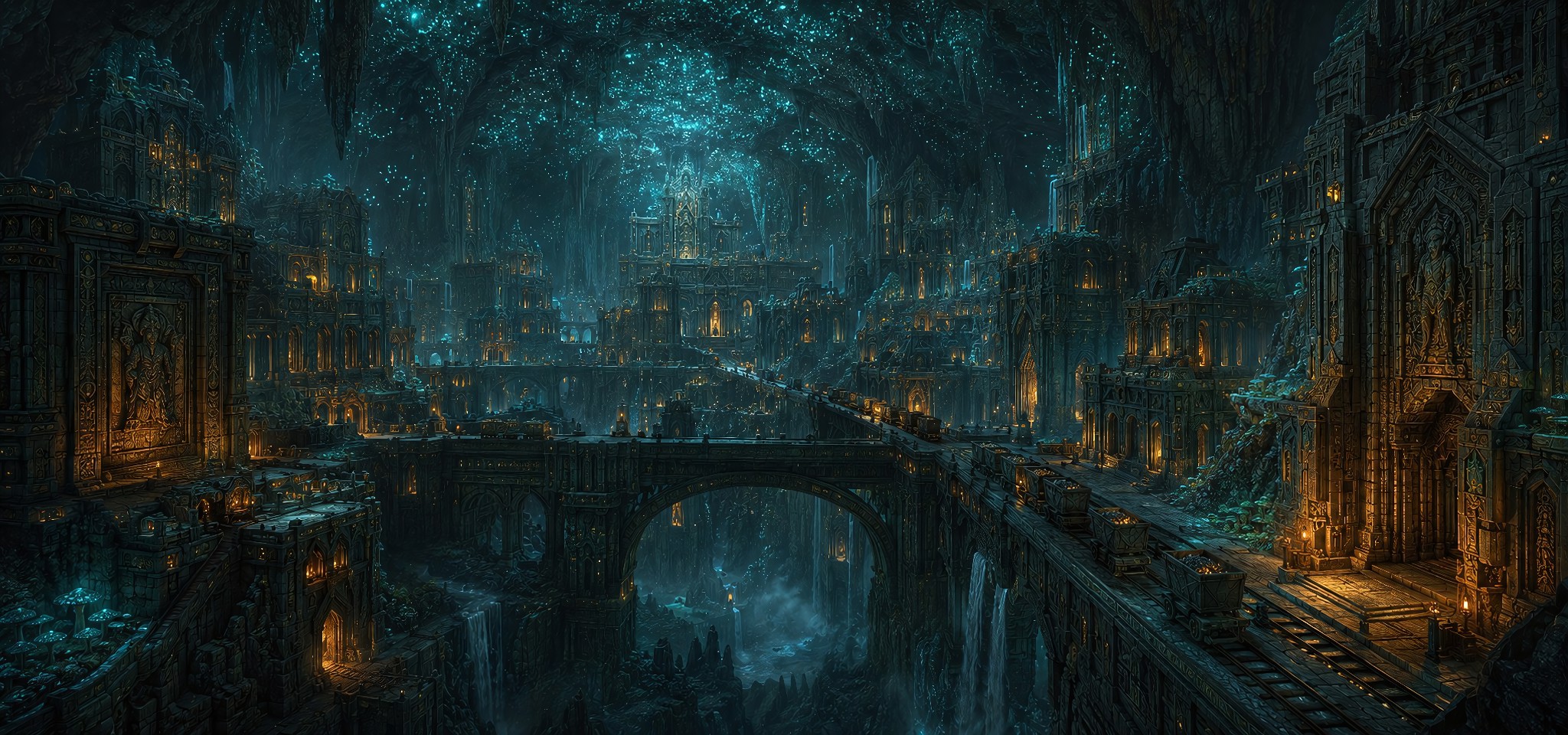
KAZAD-VORN Tap to Expand
"Kazad-Vorn does not speak. It echoes. Silence is ritual; work is worship."
I. Overview & Geography
Buried deep within the Vorn Mountains, Kazad-Vorn spans nine million square kilometers of immense underground expanse. It is the largest and most impenetrable fortress in the world, a realm of gargantuan cavern networks carved entirely by hand over thousands of years. There is no sunlight here. No wind. No surface weather of any kind. The air is cool and dry, permanently scented with stone dust, ancient rock, and the faint metallic tang of deep ores. Bioluminescent lichen cultivated across the cavern ceilings provides a perpetual blue-green twilight, the only light the Deep Dwarves have ever needed.
Every tunnel dug is a conversation with ancestors long dead. Every excavated chamber is a question asked of the silence. Deep Dwarves do not sing at their forges. They listen. For the whisper of ancestors. For the sound of stone revealing its secrets. They will dig until the answers come or the world ends. Either way, they will not look up.
II. History
The realm was officially established in Year 103 EK by the most strictly conservative factions of the Dwarven race. While their kin would later climb to the surface and found Vorn-Taraz, the Deep Dwarves never left the stone that birthed them. Their entire existence is driven by a singular, deeply melancholic purpose: digging down to find their ancestors. The society is permanently enveloped in profound, collective grief over the apocalyptic loss of the Old World. Every tunnel is a prayer. Every excavated chamber is a question asked of the silence.
During the First Great War, from 1500 to 1715 EK, Kazad-Vorn broke its isolation for the first and only time. They did not fight. They supplied. Their deep mines yielded ores no surface shaft could reach. Raw materials flowed upward to Vorn-Taraz and became the weapons, armor, and siege engines that held the line against the demonic horde. The Deep Dwarves did not forge a single blade, but every blade that cut a demon came from their stone. When the war ended, they sealed the gates once more. They have not opened them since. The Great Schism is not ancient history here. It is a living wound. The Deep Dwarves remember when their surface cousins turned away from the ancestors and toward the market, and they have never forgiven.
III. Culture & Society
Silence is ritual in Kazad-Vorn. Work is worship. Every swing of the pickaxe is a prayer. Every cart of ore hauled to the surface is an offering to the ancestors who came before. Children are taught three things above all else: stone sense, the ability to navigate and understand the living rock; silence, the discipline of listening rather than speaking; and the names of their ancestors, traced back to the first Dwarf who entered the mountain after the Great Shattering. To forget a name is to kill a ghost. There is no greater sin in the deep.
The Deep Dwarves do not hate Vorn-Taraz. They pity them. In their eyes, the surface cousins traded eternity for comfort, memory for coin. They are not evil. They are lost. Kazad-Vorn's extreme isolation is not born of fear or xenophobia. It is devotion. Every moment spent dealing with the surface world is a moment stolen from the ancestors. The Deep Dwarves have made their choice, and they have made it for eternity.
IV. Government & Politics
Kazad-Vorn is ruled by a rigid, highly traditional Council of Elders. Authority flows strictly from the revered clan elders and the sacred Ancestral Priests, who interpret the will of the lost forefathers through ritual, meditation, and the reading of ancient stone carvings. Material wealth means absolutely nothing here. Gold is merely another mineral. Only lineage, stone sense, and the depth of one's digging matter.
Elder Thrain Stoneheart leads the Council with absolute resolve. His traditionalism is as unyielding as the mountains surrounding him. He has never seen the surface, and he considers this a mark of spiritual purity. To look upon the sky, in his view, is to be distracted from the only direction that matters: downward.
V. Military & Defense
There is no standing army in Kazad-Vorn. The mountain itself is the ultimate bastion. Any invading surface army would starve to death outside the heavy stone gates, mere slits in the mountainside, long before breaching the outer defenses. The strategy is not combat. It is patience, and the Deep Dwarves have more patience than any surface race can comprehend.
The Depth Guards are elite troops permanently stationed at the lowest and most dangerous abyssal entrances, protecting the civilian caverns from the unknown horrors that stir in the deep dark. They have not seen sunlight in generations. They do not need to. The Ancestor Seekers are highly specialized exploration teams who venture into the darkest, unmapped depths searching for Old World artifacts, hidden ancestral tombs, and any sign of the gods who died before the New World was stitched together. Few return. Those who do bring relics that become the holiest treasures of Kazad-Dum, and their names are added to the ancestral rolls with great reverence.
VI. Technology, Magic & Arsenal
There are no roads in Kazad-Vorn. Only tunnels, carved staircases, and vast spiral ramps descending into the deep. Massive stone bridges span underground chasms, their arches carved with the names of the engineers who designed them. For personal travel, the Deep Dwarves walk. The strongest among them can march for days without rest through pitch black tunnels, guided entirely by stone sense. The mountain speaks to them in a language no surface race has ever learned.
Iron rail tracks line the floors of major tunnels, and heavy mine carts rumble day and night along them. On shallower routes, the carts are pushed by Dwarven muscle. In the deeper, steeper shafts, they are pulled by Aether core engines, starkly functional machines without any of the polish or luxury of Vorn-Taraz engineering. The carts transport stone, ore, relics, and personnel between the city and the depths, and their rhythmic clatter is the closest thing to music in the eternal silence of the deep.
VII. Logistics, Infrastructure & Economy
A vast network of tunnels connects the deepest mines to the capital and the forges. The connecting passages to the lower Vorn slopes were mostly sealed after the Great Schism, their entrances collapsed or guarded by stone doors that have not moved in centuries. A handful remain open solely for raw ore shipments to Vorn-Taraz, and these are heavily guarded by Depth Guards at all times. The Deep Dwarves give the surface nothing else.
Kazad-Vorn practices extreme isolationism. It has no treaties. No alliances. No imports. It completely ignores the global Food Council and every other political institution on the continent. The nation is entirely self sufficient. Geothermal heat from the mountain's roots warms homes and powers communal forges. Bioluminescent fungi provide light. Food is grown in sprawling underground gardens: mushrooms, moss, and blind fish cultivated in subterranean pools, supplemented by giant cavern beetles raised for meat. Kazad-Vorn takes nothing from the surface world, and it gives nothing back, except the raw ore that the surface Dwarves pay for in grain the Deep Dwarves do not eat.
VIII. Key Locations
Kazad-Dum is the eternal city of stone, the capital of the Deep Dwarves. Also known in ancient tongues as Karak-Dum, it is the largest cavern in the known world, its ceiling lost in the blue-green twilight of the bioluminescent lichen. The sacred Hall of Ancestors stands at its center, where the names of every Deep Dwarf who ever lived are carved into pillars that stretch upward into darkness.
The Forge Caverns are vast smelting chambers adjacent to the capital. They are eerily silent except for the ring of fire and hammers. No songs are sung here. No words are wasted. The ore arrives from the depths, the steel departs for the surface, and the cycle continues as it has for millennia.
The Deep Roads form a sprawling tunnel network connecting every corner of the realm. Open routes are strictly guarded by Depth Guards. Closed routes, sealed after the Great Schism, are marked with ancient runes warning of collapse and worse things beyond.
Ancestor Seeker Camps are temporary, highly dangerous outposts established in the unmapped depths. They serve as forward bases for exploration teams venturing beyond the known tunnels. No Seeker expects to return. Those who do are honored. Those who do not are remembered.
Fungal Farm Caverns are scattered agricultural zones throughout the realm, cultivating bioluminescent mushrooms in towering spirals, blind fish in dark pools, and giant beetle herds that provide meat and chitin for the Deep Dwarven diet. These farms are the quiet heart of Kazad-Vorn's self sufficiency, and they are tended with the same reverence as the forges.
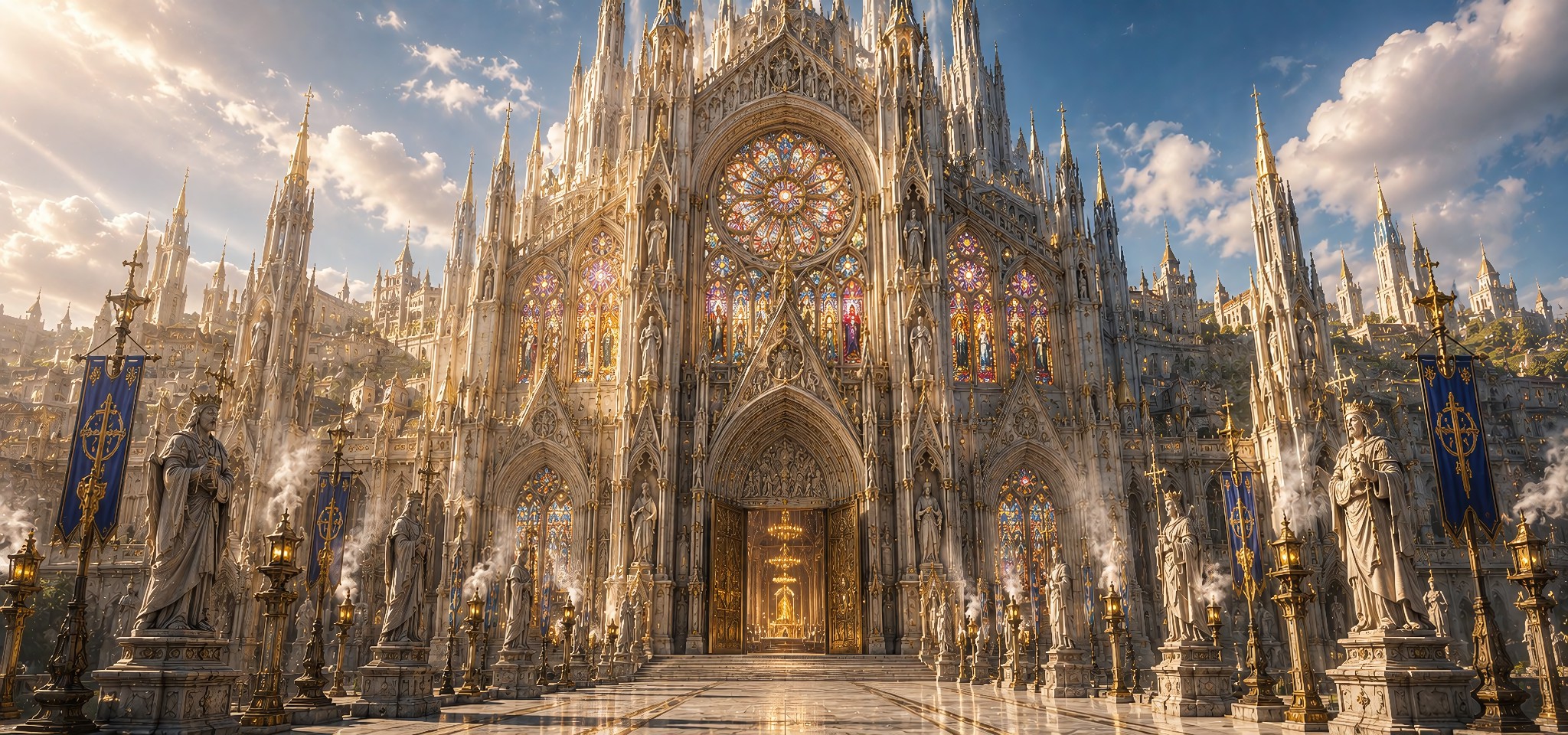
SANCTUM AETERNUM Tap to Expand
"Sanctum Aeternum does not question. It believes. The lie is comfortable. That is why forty million sleep soundly."
I. Overview & Geography
Sanctum Aeternum occupies a mere forty square kilometers as a sovereign, autonomous district entirely enclosed within Aethelburg, the grand capital of the Valdran Empire. It is a state within a city, a holy enclave where the sky is not cracked and the gods are not dead. The district is densely packed with towering churches, silent monasteries, and prestigious theological schools. The streets are immaculate, perpetually scented with incense, and echoing with bells that mark time as a gift rather than a wound.
Here, cathedrals have roofs. Warm, protective, human roofs. Rain does not fall on altars. Candles flicker in glass jars. Everything is soft, polished, and safe. This is heaven's waiting room, and forty million believers across the continent sleep soundly knowing it exists. But beneath the marble floors lies the Forbidden Library, and at night, frail Pope Innocentius VII descends alone to read texts that would shatter the very hope he sells. He knows the grim truth of the world. He knows the Theocracy may be right. He chooses the lie anyway. That is his burden.
II. History
Sanctum Aeternum was born from the Great Schism in 2000 EK, and its origin is rooted in doubt, not faith. Cardinal Elias Corvinus spent five years embedded in the Theocracy of the Sacred Wound. He witnessed what their godless truth did to people: it broke them, made them hard and cold, capable of enduring anything but incapable of joy. He concluded that the Theocracy was not wrong. It was simply cruel. Most mortals could not bear a godless universe. They needed hope, even if that hope was fabricated.
Corvinus issued the Declaration of New Truth, proclaiming that a beautiful heaven existed, that benevolent gods watched over the faithful, and that the righteous would be rewarded. The Theocracy excommunicated him swiftly and without mercy. But in 2010 EK, Emperor Caelus III of the Valdran Empire granted the exiled cardinal a small district within Aethelburg to establish his own church. The emperor understood that hope was a tool as powerful as any sword. Over the centuries, that tiny refuge grew into Sanctum Aeternum, now the largest religious body in the world. Over forty million followers believe the kinder lie, and the Sanctum has never looked back.
III. Culture & Society
Faith in Sanctum Aeternum is currency. Doubt is disease. Priests speak in soothing rhythms, never raising their voices. The faithful are not commanded. They are comforted. Pilgrimage is the central act of devotion, and the roads to Aethelburg are worn smooth by the feet of millions seeking the warmth of heaven's promise.
Education is strictly religious. Literacy is taught through scripture, and history is heavily filtered through doctrine. What does not serve the faith is not taught. What contradicts the faith is quietly removed. Beneath the silk, however, lies steel. The Inquisition ensures strict orthodoxy, and heretics simply vanish. No trials. No records. No graves. The Sanctum's soft exterior is not a lie. It is a shield, and behind it, the church protects its power with absolute resolve.
IV. Government & Politics
Sanctum Aeternum operates as a Hereditary Elective Theocracy. The Pope is elected by the grand Conclave of Cardinals, chosen exclusively from a lineage of priests officially considered the direct spiritual descendants of Saint Elias Corvinus. Pope Innocentius VII, now seventy eight years old and visibly frail, holds supreme authority. His voice is soft. His power is absolute.
A succession crisis simmers beneath the surface of every Conclave session. Cardinal Lorenzo leads a militant hardline faction desperate to expand the church's global political influence, to make Sanctum Aeternum not just a spiritual power but a temporal one. Cardinal Alexandra champions a progressive reformist movement seeking to refocus the church purely on charity and public education. The Pope watches both and trusts neither. He knows that whichever cardinal succeeds him will determine whether the Sanctum becomes an empire of faith or a sanctuary of mercy, and he has not yet decided which is more dangerous.
V. Military & Defense
Sanctum Aeternum possesses no independent military. External defense is entirely the responsibility of the Valdran Empire under the terms of the Imperial Symbiosis. The empire protects the church, and the church legitimizes the empire. The arrangement has held for centuries.
Internal security, however, is the domain of the Holy Inquisition. Two thousand elite agents serve as spies, assassins, and enforcers, operating across the entire continent to root out heresy wherever it festers. They are not soldiers. They do not fight battles. They find doubt and they extinguish it, quietly, thoroughly, and without leaving a trace. The Papal Guard, a purely ceremonial force of one hundred knights, protects the Pope and the basilicas. They are symbols of authority, not instruments of war, and their polished armor has never seen combat.
VI. Technology, Magic & Arsenal
Sanctum Aeternum benefits entirely from Valdran engineering. Paved roads, Aether lit streets, imperial aqueducts, and the Iron Serpent station just outside the district gates all flow from the empire's infrastructure. The Sanctum builds nothing itself. It receives everything.
Internal streets are designed for grand processions and prayer, not commerce. Pilgrims travel on foot, their journey a spiritual act as much as a physical one. Cardinals travel in ornate Aether carriages, gifts from the Valdran nobility and symbols of the church's immense wealth. The Pope himself moves through the district in a ceremonial Aether litter, carried by the Papal Guard, a figure of reverence who is never seen to hurry.
VII. Logistics, Infrastructure & Economy
Sanctum Aeternum has absolutely no independent economy. It produces nothing but faith and loyalty. Under the terms of the Imperial Symbiosis, in exchange for preaching that the gods favor the Emperor and that the imperial throne holds divine mandate, the Valdran Empire provides all food, funding, and military protection. The arrangement is simple, durable, and mutually beneficial.
The Sanctum's immense wealth flows entirely from continental donations, tithes from forty million followers, and imperial subsidies. Its grain stores are among the largest in Aethelburg, a gift from the throne that ensures the clergy never hunger while they pray for the empire's salvation. The district's streets are almost entirely pedestrian, leading inward from the Pilgrim's Gate, and designed for the slow, reverent movement of the faithful rather than the hurried pace of commerce.
VIII. Key Locations
The Basilica of Saint Elias stands at the center of the district, the largest cathedral in Ruinea. It houses the eternal flame on the Altar of Saint Elias, a fire that has never been extinguished since the church's founding. The Pope's residence is attached to the basilica, and the two structures together form the spiritual heart of the Sanctum.
The Forbidden Library lies hidden deep beneath the basilica. Its vaults store ancient knowledge and historical records deemed too dangerous or contradictory to the Sanctum's divine doctrine. Accessible only to the Pope, and heavily guarded by Inquisition agents and magical wards, it is the church's darkest secret. Pope Innocentius VII visits alone at night, reading texts that would shatter the faith he has spent a lifetime protecting.
The Pilgrim's Gate, on the eastern edge of the district, is a grand arched gateway where the faithful arrive from the Valdran highways. It is flanked by hostels for the weary and confession booths for the burdened. Every pilgrim who enters passes beneath the gaze of stone saints.
The Holy Inquisition Headquarters is a highly secret, completely unmarked building within the district. No records of this place exist. No map marks it. Heretics are brought here and never emerge, and the only evidence of their passing is the silence they leave behind.
The Monasteries and Schools are silent, cloistered communities scattered throughout the district. They train the next generation of priests and cardinals in scripture, rhetoric, and the careful art of comforting the faithful while protecting the faith.
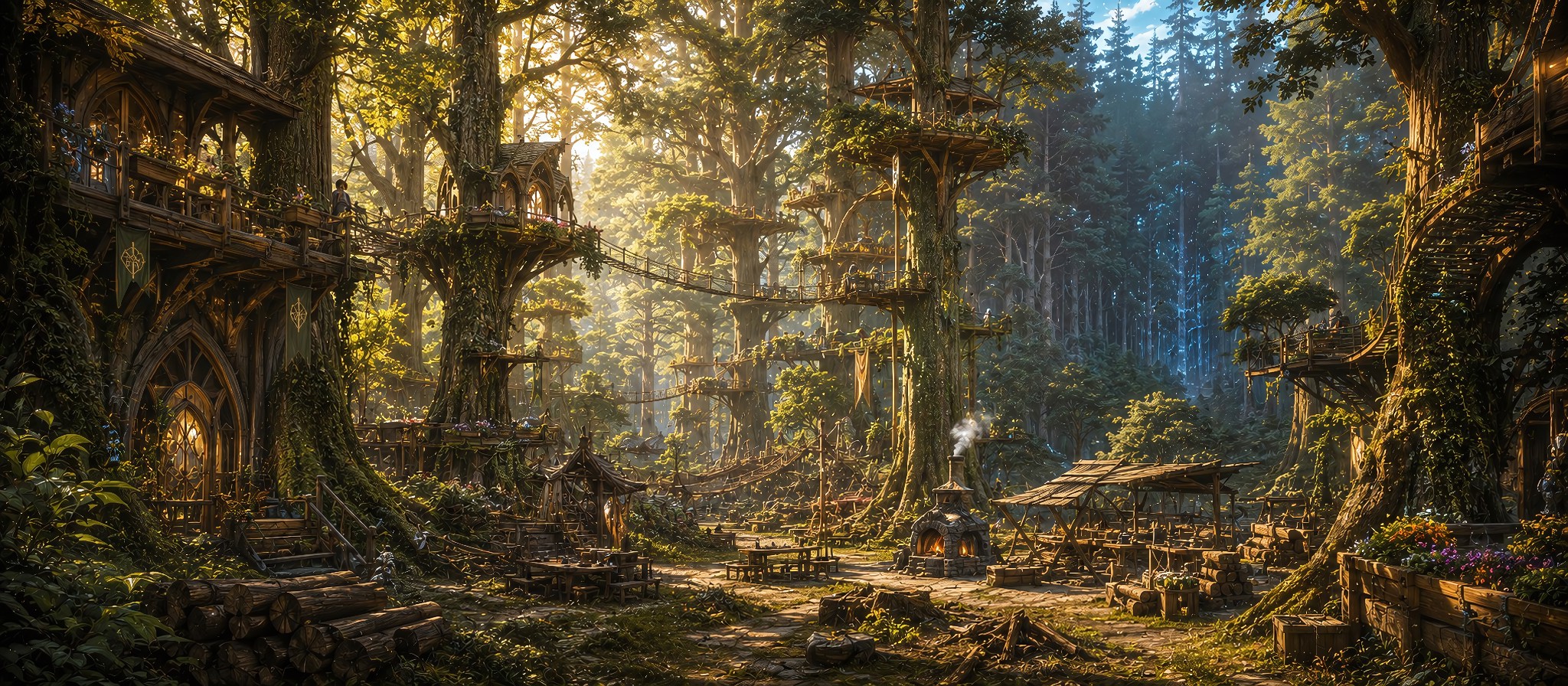
SOL-VENTARI Tap to Expand
"Sol-Ventari does not look back. It builds. The forest is not a museum—it is a workshop."
I. Overview & Geography
Sol-Ventari occupies the eastern fringes of the Primeval Forest, claiming approximately eight million square kilometers of the peripheral woodlands that once belonged to ancient Aelderim. The forest here is breathtakingly beautiful, but it is managed with a philosophy that would horrify their western kin. Timber is harvested sustainably, cut and replanted in a rhythm as old as the trees themselves. The air smells of sawdust and sea salt, a combination found nowhere else in the elven world.
There is no centralized capital. Society thrives in fluid, scattered communities strung like beads along the trade corridor that runs between the great port of Greenharbor and the Valdran border. Elves here move faster than their western cousins. They are not rushed; they are purposeful. They smile at strangers. They trade. They experiment. An Elf with soot on their hands is not an anomaly here. They are a smith, an engineer, an innovator. The Sol-Ventari have chosen to become something new.
II. History
Sol-Ventari were once Aelderim. They shared the same blood, the same memory, the same sacred duty to preserve the past. The First Great War, which raged from 1500 to 1715 EK, broke that unity. Forced to kill to protect the World Tree, a generation of Elves learned the horrors of slaughter. When the war ended, the survivors were not the same. They had seen what violence could do, and they could not return to the quiet contemplation of eternity.
In 1760 EK, after decades of bitter silence, a radical faction burned the archives. They destroyed countless perfect records of the Old World and the First Great War, histories they believed were a deadly toxin preventing true healing. Their doctrine was absolute: burn the archives to forget, abandon ancient trauma, and embrace innovation. Aelderim called it heresy. Sol-Ventari called it liberation. The split was absolute, but bloodless, conducted in a heavy silence that persists to this day. All communication ceased. The Sol-Ventari migrated east, and their relationship with Aelderim remains a quiet cold war of unspoken tension and mutual blame.
III. Culture & Society
Sol-Ventari values innovation, trade, and practical progress above all else. Children learn craftsmanship before history. Failure is not mourned; it is iterated, refined, and overcome. The past is viewed as a chain to be broken, not a treasure to be preserved. This philosophy extends to every aspect of life, from the tools they forge to the treaties they sign.
Beneath the progress, however, lie ghosts. Every Sol-Ventari knows they are exiles. The archives they burned still haunt their dreams. Some carry guilt like a second skin. Others carry defiance. Most carry both, in proportions that shift with the weather and the season. They do not speak of Aelderim. When forced, the word comes out like swallowing glass. Visitors find them welcoming, pragmatic, and refreshingly direct. There is no elven condescension here. No thousand year silences. The Sol-Ventari have places to be and wood to carve, and they will not waste a century on a grudge when a handshake will do.
IV. Government & Politics
Sol-Ventari is governed by the Progressive Silver Council, an assembly whose very name reflects their youthful, shining perspective on the future of their race. Governance is fluid, flexible, and collective. There are no ancient hierarchies, no suffocating traditions, no Councils of Elders who deliberate for decades before reaching a decision. Open debate decides everything, and the debates are passionate, loud, and frequent.
The Eldest, the leader of the Silver Council, is democratically elected and fully removable by the same process that grants the position. This is unprecedented in elven governance, and Aelderim views it as dangerously unstable. Sol-Ventari views it as accountability. Two internal factions shape every council session: the Reconciliation Faction, who quietly desire to mend the broken bonds with Aelderim and end the long silence, and the Independent Faction, fierce radicals who demand complete and permanent separation, wishing to forge an entirely new cultural identity completely free from the long shadows of the past.
V. Military & Defense
Sol-Ventari maintains no standing army. Its military philosophy is absolute deterrence through vital trade relationships rather than walls or weapons. The nation is so deeply embedded in the continental economy that to attack it would be to damage every major power simultaneously. This is not a military strategy. It is a business strategy, and it has never failed.
Defense is handled by the Forest Wardens, who patrol the borders and monitor monster activity along the eastern fringes. The Guildhall chapterhouse in Greenharbor provides naval security and expeditionary support. Members of the Werebeast diaspora, those who left Verdantus seeking new lives, often serve as port guards and caravan escorts, their hunting instincts repurposed for protection rather than predation.
VI. Technology, Magic & Arsenal
Sol-Ventari is the most technologically progressive elven nation in Ruinea. They embrace Aether wagons, Aether cycles, and the Iron Serpent rail network without reservation. To them, technology is not desecration. It is evolution. They actively reject Aelderim's stagnation, and their workshops hum with the sound of Dwarven engineered tools in elven hands.
Aether Cores are widely used to power workshops, communal halls, and forges. The architecture of Sol-Ventari combines living wood construction with advanced Dwarven engineering, a hybrid style found nowhere else on the continent. In remote settlements, bioluminescent flora still provides light, but in cities like Greenharbor, modern Aether lighting is the standard. The Sol-Ventari do not choose between nature and progress. They demand both.
VII. Logistics, Infrastructure & Economy
Sol-Ventari boasts the most developed road network of any elven nation. The River Road, a caravan route along the northern bank of the Aethel River, was built with Vorn-Taraz engineering and deliberately skirts Aelderim territory. It is the primary overland artery connecting Greenharbor to the Valdran Empire, and its waystations hum with the traffic of merchants, adventurers, and pilgrims.
The nation's economy is entirely trade based and interdependent by choice. Aether wagons carry goods along the roads. Great Stags and Aether cycles provide personal transport. River barges and Aether skiffs navigate the Aethel River, while sea vessels launch from Greenharbor to reach markets across the Southern Sea. The Aethel River trade route is the economic lifeline of Sol-Ventari, and its disruption would be catastrophic. The nation exports timber products, enchanted woodcraft, rare forest medicines, and diplomatic goodwill. In return, it imports Valdran grain, Vorn-Taraz manufactured goods, and Guildhall artifacts recovered from the depths.
VIII. Key Locations
Greenharbor is the only major elven operated port in Ruinea, built where the eastern Primeval Forest meets the Southern Sea. White stone quays and living wood piers define its architecture. It houses the second largest Guildhall chapterhouse after Vornhold, serves as the southern terminus of the Aethel River trade route, and hosts a large Werebeast diaspora community whose members work as guides, hunters, and port security.
The River Towns are scattered, specialized settlements along the Aethel River. Each serves a specific purpose: one for barges and cargo, another for timber processing, a third for enchanted woodcraft. They are the economic backbone of the nation, and their docks are never empty.
The River Road Waystations are inns, stables, and Aether wagon depots built jointly by elven and Dwarven engineers. Spaced at regular intervals along the trade route, they provide shelter, repairs, and the comfortable hum of commerce to travelers making the journey between the Valdran Empire and the sea.
The Border Watch Settlements are small, pragmatic outposts on the eastern fringes. They serve as waypoints for adventurers heading to the Eastern Seam Zone and as early warning posts against monster incursions. Their inhabitants are hunters, trackers, and retired Guildhall veterans who prefer the quiet of the frontier.
The Inland Forest Villages are scattered communities throughout the eastern Primeval Forest, home to herbalists and artisans who prefer isolation to the bustle of the trade corridor. They live quietly, harvesting rare medicines and tending ancient groves.
The Iron Serpent Terminus is a bustling boomtown at the rail head where the Valdran line currently ends. Engineers, traders, and adventurers crowd its streets, and the air is thick with the sound of construction as the rail line pushes slowly toward Greenharbor.
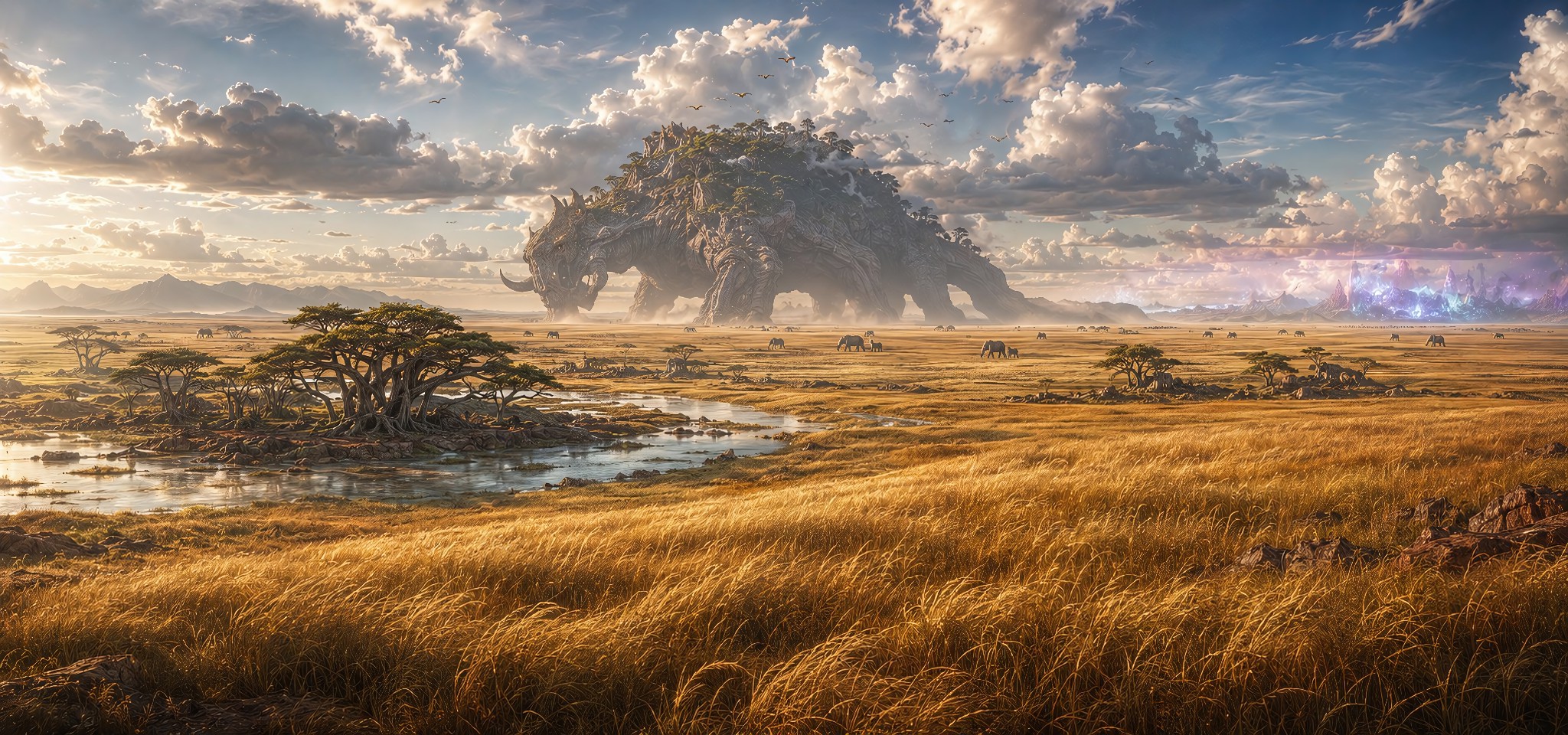
THE PACK Tap to Expand
"The Pack does not ask permission. It takes."
I. Overview & Geography
The Pack roams the vast Eastern Grasslands, an endless, windswept savanna of waist-high golden grass, scattered groves of iron-barked Akasia trees, and shallow lakes tinged with Aether. This is a land without walls, without roads, without the soft certainties of civilization. The sky stretches forever, and the wind never stops. The territory is massive but shrinking, constantly threatened by the expansion of high-tier Dungeons from the nearby Eastern Seam Zone and the encroaching borders of nations that build fences and call them progress.
Monster activity here is exceptionally high, and the Grasslands are the undisputed domain of Behemoths. Nowhere else in Ruinea do they roam in such staggering numbers and scale. Among them are the Walking Mountains, Behemoths so colossal that entire forests grow upon their backs, clouds scrape their shoulders, and their footsteps carve new valleys into the earth. The Pack navigates by their shadows and reveres them as sacred heralds. The grassland is not a home. It is a hunting ground. Every sunrise is a challenge. Every sunset is a victory or a lesson. Weakness is not forgiven here. It is eaten.
II. History
Before the First Great War, all Werebeasts were one people. Feral, scattered warbands roamed the wilds without unity or purpose beyond the hunt. When the war erupted, they fought alongside the allied races against the First King's demonic horde, not out of loyalty to any nation or cause, but because the demons threatened the very world they hunted. The Werebeasts bled on every front, their claws and fangs tearing through demonic lines wherever the fighting was thickest.
When the war ended in 1715 EK, the Werebeasts faced a choice that would define their race forever. Elder Mossback, the ancient Turtle Werebeast, led a faction westward into the Primeval Forest to found Verdantus, taking a sacred vow of total pacifism. The Pack refused. To them, Verdantus's vow was not peace. It was surrender. To lay down their claws dishonored every Werebeast who had died fighting the demons. They viewed their pacifist cousins as cowardly betrayers of their ancestors' memory, and they turned east into the savanna. They have never built a permanent home since, and they have never forgiven.
III. Culture & Society
To die in battle is glory. To die in bed is shame. There is no third option in the Grasslands. Silence here is not emptiness. It is stalking. The wind matters more than words. Children learn to track before they can speak. Elders do not teach philosophy. They tell stories of the hunt, of the great kills, of cousins who chose walls and died slow. Weakness is not tolerated, and loyalty is fierce but absolutely conditional. Every member of The Pack earns their place every single day, and what is earned can be lost.
Visitors feel the tension the moment they cross into Grassland territory. Every glance from a Pack member measures them with a single, brutal question: prey or predator? The Pack does not hate outsiders. It respects strength. If you have none, do not come. If you have it, they might share their fire. Might. The grassland does not guarantee tomorrow, and neither does The Pack. They live as they hunt: in the moment, by instinct, and without apology.
IV. Government & Politics
The Pack operates under a Nomadic Tribal Meritocracy, governed by the absolute law of the strong. There are no councils, no elections, no hereditary titles passed down through bloodlines. Authority belongs to whoever can hold it, and it is held only as long as no one else can take it. This is not cruelty. It is honesty, the purest form of governance the Werebeasts have ever known.
Alpha Kaelen, a massive, battle-hardened Wolf Werebeast, holds absolute authority through sheer combat prowess, unmatched survival instincts, and tactical brilliance that has kept The Pack alive through decades of encroaching threats. Any warrior may challenge him for leadership at any time. None have succeeded in a generation. The Alpha regularly consults a circle of elder shamans, not for permission, but for spiritual guidance and for their ancient knowledge of the Walking Mountains' movements. The shamans do not rule. They advise, and the Alpha decides.
V. Military & Defense
The Pack are the Ghosts of the Grasslands, universally recognized as the greatest stealth hunters in all of Ruinea. Despite their towering physical size, they have perfected the art of moving through waist-high grass and scrub forests in complete silence. They emerge like phantoms, kill, and vanish before the body hits the ground. Every adult is a hunter-warrior. Every child is trained to become one. There is no distinction between civilian and soldier because there is no concept of either.
There is no formal military structure. The Pack does not need ranks or regiments. Its combat style emphasizes ambush, speed, and overwhelming first strikes that end battles before the enemy understands they have begun. They possess zero defensive fortifications. No walls. No watchtowers. No fortified camps. Absolute mobility is their only shield. An enemy cannot siege what they cannot find, and The Pack can vanish into the Grasslands faster than any army can march.
VI. Technology, Magic & Arsenal
The Pack does not forge weapons or tools. They scavenge what they need and trade for the rest. Metal is rare and precious, reserved for blade edges and spear tips acquired from merchant caravans brave enough to enter their territory. Fire comes from dried dung and scavenged wood. Light comes from the cooking fire and the stars. The Pack has no foundries, no smithies, no factories. It has never needed them.
Aether is used sparingly, almost reverently. Only the elder shamans carry small Aether Cores, and only for ritualistic purposes: vision quests, spirit communion, and the reading of the Walking Mountains' intentions. The Pack's true technology is biological. Centuries of selective breeding have produced tracking beasts with senses sharper than any Aether device. Generations of accumulated knowledge have given them a profound understanding of monster anatomy, of where to strike and when. And the absolute perfection of their own physical forms, honed through a lifetime of hunting, makes each Werebeast a weapon no forge could replicate.
VII. Logistics, Infrastructure & Economy
There are no paved roads in the Grasslands. No rail lines. No waystations. The only paths are dirt tracks carved by caravan wheels, animal trails worn into the earth by centuries of migration, and the footprints of those who came before. Wayfinding relies on the stars, the Valer River tributaries that cut through the savanna, and the slow, eternal march of the Walking Mountains on the horizon. Every member of The Pack learns to read these signs before they learn to speak.
The Pack builds no permanent structures. Their massive tent encampments can be completely dismantled in an hour, leaving nothing behind but flattened grass and cold fire pits. In beast form, a Werebeast outruns any horse and covers vast distances without fatigue. For heavy loads, monster carcasses, trade goods, the young and the injured, they use tamed Behemoth-calves and large herbivores captured from the plains. The economy is purely hunter-gatherer. There is zero agriculture. Zero industry. The Pack survives entirely by hunting the colossal beasts of the plains and trading rare monster skins, crafted bone weaponry, and premium meat with only the bravest merchant caravans. They have no external dependencies, only the luxury goods they willingly choose to acquire.
VIII. Key Locations
The Alpha's Encampment is the closest thing The Pack has to a capital, though it moves constantly alongside the main herd. Marked by the largest tent, the war banners of the Alpha's lineage, and the central council fire where decisions are made and challenges are issued, it is the heart of Pack politics and the only place where the Alpha's authority is absolute.
The Hunting Band Camps are scattered across the Grasslands in groups of twenty to fifty Werebeasts operating independently. Each band has its own name, its own dynamics, its own reputation. Some are welcoming to outsiders. Others are not. Encounters with The Pack are unpredictable precisely because which band finds you is purely a matter of luck.
The Walking Mountain Shadow Camps are sacred, temporary settlements set up directly in the lee of a Behemoth. The colossal bodies of the Walking Mountains provide natural protection from the fierce winds of the Grasslands and deter lesser monsters from approaching. To camp in a Behemoth's shadow is to sleep under the protection of something older than nations.
The Pack's Graveyard is a secret, its location known only to the elder shamans and never spoken of to outsiders. It is not a fixed place. The honored dead are left for the grassland to reclaim, their bodies returned to the earth they hunted. The Graveyard moves with the seasons, with the herds, with the will of the Walking Mountains. To be buried there is the highest honor The Pack can bestow, and the path to it is the most closely guarded secret in the Grasslands.
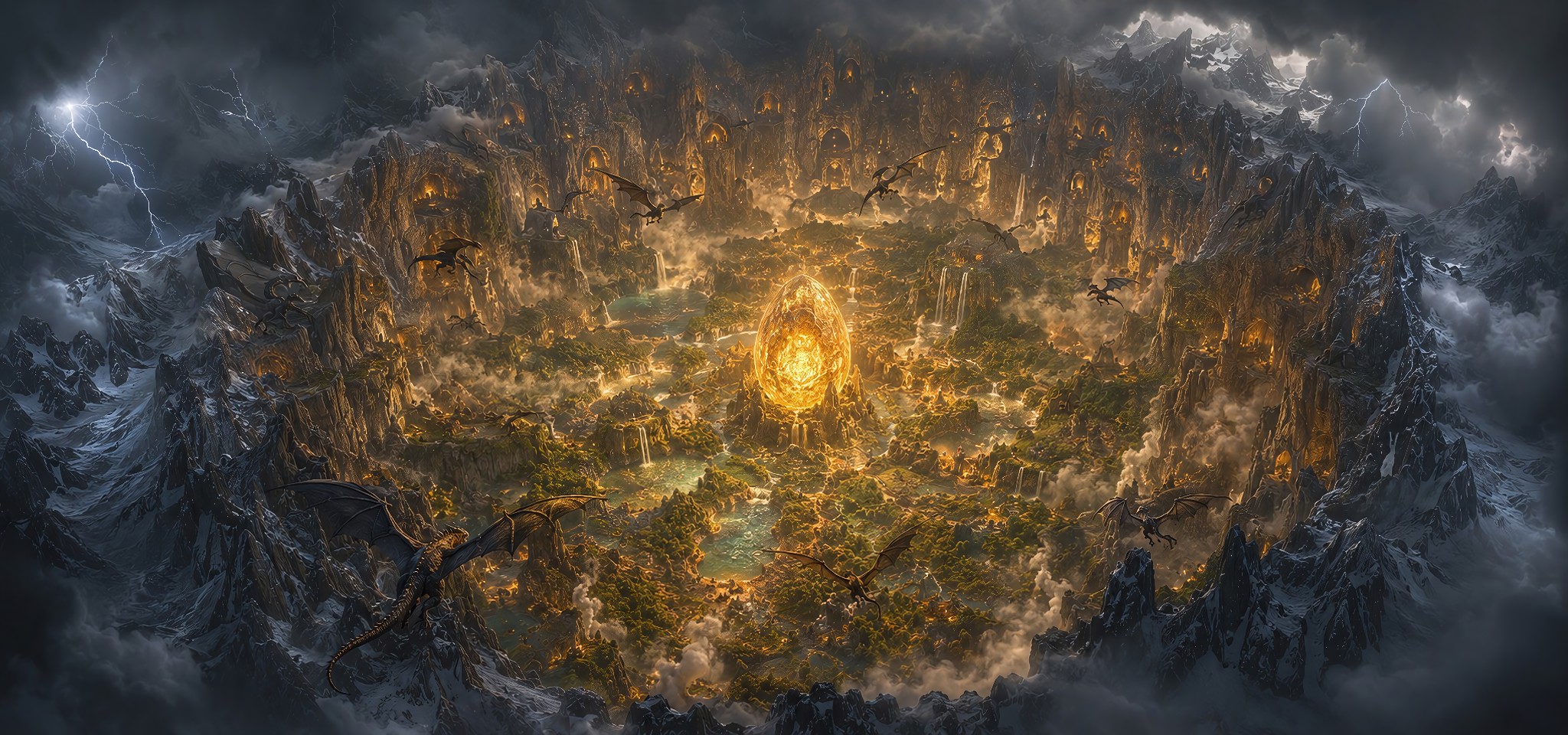
DRAGON NEST (NXYARIA) Tap to Expand
"A dragon might speak with you in ancient, measured tones one moment and burn your caravan the next. This unpredictability is not chaos—it is freedom."
I. Overview & Geography
Hidden at the absolute northernmost reaches of the Vorn Mountains, far beyond the deepest underground gates of Kazad-Vorn, lies the Nameless Peak. No map marks it. No guide can lead there. The realm is a secluded, massive basin protected by the highest peaks on the continent, shrouded by eternal storm clouds and lethal altitudes that kill anything that attempts the ascent on foot. The only way in is through the sky.
Despite the freezing arctic cold that surrounds the outer mountains, the hidden valley is naturally warmed by intense underground volcanic activity. The air is thick with geothermal steam, and the climate is perfectly suited for the ancient reptiles who call it home. The towering valley walls are riddled with gargantuan natural caves, each one a sovereign domain filled with hoarded treasures for individual dragons and their kin. The heart of the valley holds the Eternal Egg, a colossal glowing rock formation that pulses with pure magical energy, the primary power source that sustains the entire sanctuary.
II. History
When the Old World collapsed and the Five Goddesses stitched the New World together, the remaining dragons retreated to the Nameless Peak. They had no interest in mortal kingdoms or the petty wars of shorter-lived races. They watched the First Great War from afar, content to let the younger species bleed for their causes. But dragons are not a monolithic race. Their defining trait is individuality, and when the war between the allied races and the Black Domain erupted, that individuality shattered their unity.
Some dragons, those drawn to destruction and the raw thrill of battle, flew south to join the Demon Commander Zar'goth. Zar'goth was an Ancient Black Dragon who had served the First King since the Old World, and his power was legendary. The dragons who joined him needed no coercion. They went because they wanted to burn, because chaos was in their nature, because the Black Domain promised a world where dragons ruled as they once had. The Dragon Lord, ancient beyond measure, saw the danger not to the mortal world, but to the Nest's unity itself. He summoned a war-flight of elder and adult dragons to march against Zar'goth's host. For the first and only time in recorded history, dragons fought dragons in open sky. The battle was cataclysmic, visible from three nations. Fire and shadow clashed above the Vorn peaks. In the end, neither side won. Zar'goth's forces retreated to the Black Domain, bloodied but intact. The Dragon Lord's forces returned to the Nest, scarred and silent.
Those who followed Zar'goth never returned. They remain in the Black Domain as his loyal subordinates, dragons who chose destruction over isolation, and the Nest has not taken a unified side in any continental war since. The Dragon Lord does not speak of the battle. But every dragon remembers. The scars of that sky-fire are carved into the valley walls, and the names of those who left are no longer spoken with fondness.
III. Culture & Society
Individuality is absolute among dragons. No two share the same morality. One might protect a village for centuries, accepting offerings and dispensing cryptic wisdom. Another might incinerate that same village for a single gold coin that caught the light. They do not answer to mortal laws, mortal gods, or mortal concepts of good and evil. They answer only to the Dragon Lord, and even then, only when he chooses to speak. The rest of the time, each dragon is a sovereign nation unto itself.
Dragons are solitary by nature, but they gather at the Nest for safety, for breeding, and for the ancient comfort of being among their own kind. A dragon's cave is their soul made physical. The treasure they hoard serves no practical purpose. It is art, memory, and status woven together into a single, glittering statement of identity. To enter a dragon's lair is to walk through their autobiography.
The dragons who followed Zar'goth are known simply as the Lost. They are not formally exiled. The Nest does not issue decrees of banishment. But their names are no longer spoken with fondness, and the war-flight that fought them still bears the scars. The wyverns who chose instinct over loyalty and scattered during the battle are viewed as little more than animals who found their master elsewhere. The Nest does not mourn them. It simply does not speak of them.
IV. Government & Politics
The society of the Nameless Peak operates on an absolute, age-based hierarchy where power and wisdom grow eternally with time. There is no formal politics. No council meetings. No treaties. Decisions about war or peace are made by loose consensus among the elder dragons, a process that can take centuries and often results in no decision at all. The Dragon Lord holds ultimate veto, a power he has exercised exactly once in recorded history, when he summoned the war-flight against Zar'goth. His word is law, but he speaks so rarely that centuries pass between his commands.
V. Military & Defense
There is no standing army in the Nest. Each dragon fights as a solo power, a force of nature unto itself. They do not coordinate by mortal standards. They do not drill, march, or obey commands. In battle, each dragon chooses their own targets, their own tactics, their own moment to strike or withdraw. This makes them unpredictable as allies and impossible to counter as enemies.
The War-Flight is the closest thing the Nest has to an organized military force. In times of existential threat, the Dragon Lord can summon a war-flight of adult and elder dragons, each one a flying apocalypse. It is considered one of the most devastating forces in Ruinea, and it has only been summoned once: during the First Great War, to fight Zar'goth's dragon host. Lesser dragons and the remaining wyverns who stayed loyal serve as perimeter scouts, patrolling the storm-wracked peaks that surround the valley.
VI. Technology, Magic & Arsenal
Dragons do not build machines. They do not forge tools or lay rails or harness steam. Their technology is biological and magical, honed across epochs of evolution. The Eternal Egg provides the raw Aether that sustains the valley, and dragons manipulate it through instinct rather than engineering. Elemental breath, refined over centuries of practice, is their primary weapon, and each dragon's breath is as unique as their hoard.
They possess vast collections of Old World artifacts gathered across millennia, objects of immense power that would rewrite the balance of nations if they were ever deployed. But dragons rarely use them. To a dragon, an artifact is not a tool. It is a treasure. Its purpose is to be collected, admired, and displayed as proof of the dragon's age, reach, and magnificence. The Nest is a museum of things that could end the world, and its curators have no interest in opening the exhibits.
VII. Logistics, Infrastructure & Economy
The Nameless Peak is entirely self-contained. There are no roads leading into the valley. No forges burn in the cliffside. No granaries store provisions for the winter. The Eternal Egg provides magical sustenance for those who dwell in its presence, supplemented by hunting in the surrounding peaks. Dragons who crave more than the valley provides simply fly beyond the storms and take what they need from the world below.
There is no concept of economy within the Nest. Dragons do not trade with each other. They do not pay for goods or services. The idea of currency is faintly amusing to a being who has lived for ten thousand years and accumulated enough treasure to buy a small nation. The Nest takes nothing from the outside world because it needs nothing. It is a sanctuary, not a state, and its inhabitants answer to no economy but their own desires.
VIII. Key Locations
The Nameless Peak is hidden by eternal storms at the absolute northernmost edge of the Vorn Mountains. No fixed coordinates appear on any map. No guide can lead an expedition there. The storms kill anything that tries to climb, and the dragons who live above them have no interest in visitors.
The Hidden Valley is the geothermally warmed basin at the heart of the Nest. It is home to every dragon who remains loyal to the Dragon Lord, a sprawling sanctuary of steam and stone and ancient magic that has never been seen by mortal eyes.
The Eternal Egg rests at the absolute center of the valley. It is a colossal, glowing rock formation, not a true biological egg but a massive reservoir of pure magical energy. Guarded at all times by elder dragons who have not left its side in millennia, it is the heart of the Nest and the source of its power.
The Cliff Lairs are gargantuan caves carved into the towering valley walls. Each is a sovereign domain for a single dragon or a family group. The lairs are as varied as the dragons who inhabit them, some piled high with gold, others lined with ancient scrolls, and still others filled with nothing but bones and silence.
The Wanderer's Gate is an ancient secret pass on the southern slope of the Nameless Peak. It is used by young dragons leaving the Nest to explore the world beyond the storms. Mortals who stumble upon it do not return. The Gate is not guarded. It does not need to be. The dragons who pass through it are the only warning anyone will ever receive.
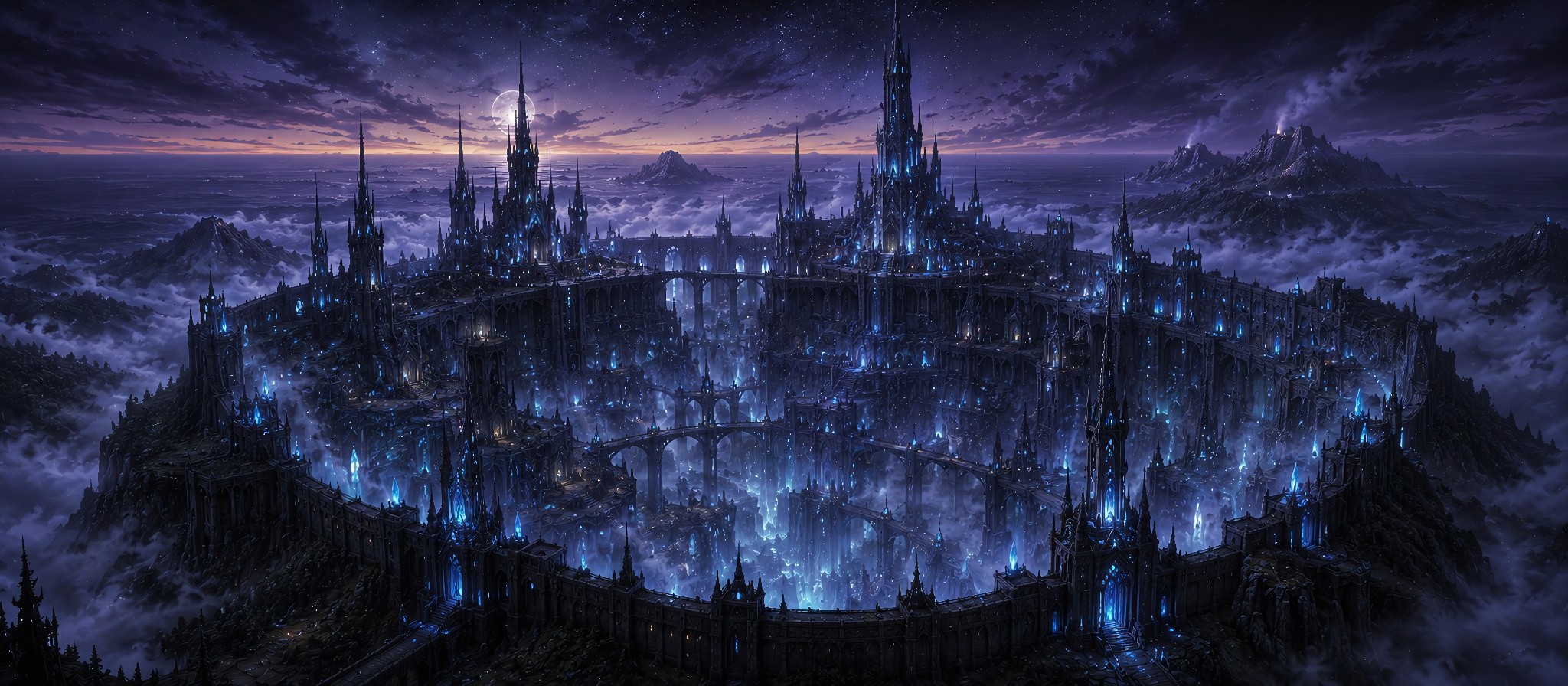
NOCTISIA Tap to Expand
"Noctisia is not waiting for anything. It has already waited long enough to know that waiting changes nothing."
I. Overview & Geography
Noctisia is a massive island of two and a half million square kilometers, isolated in the Southern Sea roughly two hundred kilometers offshore within the Twilight Zone. Volcanic hills rise from ancient black forests, and mist shrouded valleys stretch between them under a perpetual twilight that never brightens and never fades. The soil is fertile, nourished by ash from dormant volcanoes, and fresh water flows abundantly through streams that remember the island's violent birth.
The island is completely hidden from the mainland by the Guardian Mist, a semi-sentient barrier woven over two centuries by the late Patriarch Cassia. The mist does not merely obscure. It decides. Enemy ships sail in circles for days and emerge back where they started with no memory of the passage. Invited guests find a clear, straight path through calm waters. No foreign fleet has ever breached the mist without invitation, and none ever will. Noctisia does not whisper. It is absolutely silent. The mist muffles footsteps, voices, and grief. Vampires here have not aged in millennia, but they have tired. Patience is not a virtue here. It is survival.
II. History
Noctisia was founded in 500 EK during an event known as the Sundering. Ancient vampires, led by the five original Patriarchs, violently rebelled against the First King of the Black Domain. They had been forged as weapons of extinction, but they refused to remain tools of slaughter. They chose restraint over rage and fled south across the sea to an island shrouded in mist.
The first five centuries nearly ended in starvation. The island's wildlife could not sustain them, and the Thirst, the eternal hunger for blood, drove them to the brink of civil war. They were saved by the vampire scholar Morpheus, who engineered the Blood Gardens: living biological entities that produce blood without the need for hunting or victims. No conquest. No cattle. Only creation. This was the birth of the Calm Blood philosophy, and it saved their civilization.
During the First Great War, from 1500 to 1715 EK, Noctisia broke its isolation. The Shadow Forces marched alongside the allied races against their former master. Patriarch Vladimir the Sunderer faced the First King directly at the Battle of Malakh Kar, and when the First King fell into eternal slumber, Vladimir was still standing. After the war, Noctisia withdrew completely behind the Guardian Mist. It has never joined a global war since. It has never signed the Food Council treaty. Its people watch the mainland's chaos from behind the mist, intervening only in the rarest of circumstances, and even then, no one knows it was them.
III. Culture & Society
The Calm Blood philosophy defines every aspect of Noctisian life: "Thirst is not destiny." Blood-drinking is a sacred ritual, not a hunt. Every elder carries two immense weights through eternity: the monstrous things they did under the First King, and the restraint they have chosen every single day since. This is not peace. It is discipline. The Thirst never leaves. It only waits.
Silence is the norm on Noctisia. Vampires are deeply melancholic, and visitors find the stillness unbearable. No arguments echo in the streets. No merchants shout their wares. No laughter spills from taverns. Only the soft rustle of black gowns and the distant drip of geothermal condensation. Children are exceedingly rare. Vampires do not reproduce easily, and fewer choose to bring a new immortal into this quiet purgatory. Families are small, bonds intense, losses felt for centuries. The dead are not spoken of. They are simply visited at empty graves. The small human community on the island, descendants of those who chose to stay, are honored guests, never cattle. They farm the volcanic soil, and in return, the vampires offer protection, art, and the quiet dignity of being truly safe in a world that offers safety to no one.
IV. Government & Politics
Noctisia is governed by the Council of Patriarchs. Six seats exist around the ancient stone table in Umbra Keep, but only five are occupied. The empty seat of Cassia the Veil, the mist-weaver who gave her life to protect the island, remains perpetually unfilled in her honor. All major decisions require a unanimous vote among the present Patriarchs. There is no single ruler. No emperor or empress. Only the Council, and the silence between their words.
The five living Patriarchs each embody a pillar of Noctisian survival. Vladimir the Sunderer, warrior-philosopher of Circle 8, commands the military and carries the scars of Malakh Kar. Sophia the Stranger serves as diplomat and spymaster, the voice of Noctisia in the rare moments it chooses to speak to the outside world. Morpheus the Dreamer, the geneticist who created the Blood Gardens, continues his work in the laboratories beneath Umbra Keep. Razvan the Archivist guards all Old World records, the memory of a people who chose to remember everything. Lilith the Sorrowful, diminished to Circle 6, serves as the Mourner and ritual guardian, her grief a sacred office. A quiet minority of young vampires whispers of rejoining the Black Domain's crusade against the world that rejected them. The Patriarchs are aware of this talk and tolerate it for now, knowing that suppressed dissent only festers.
V. Military & Defense
The Shadow Forces are Noctisia's sole military arm: twenty thousand elite vampires, each between five hundred and a thousand years old. By continental standards, this army is tiny. By any other measure, it is terrifying. Every soldier is a half-millennium-old veteran who has trained against the same enemies for centuries. They do not conquer. They only defend. In the rare battles they have fought, they have never lost.
There is no standing army beyond the Shadow Forces. Noctisia's defense relies on three things: the disorienting Guardian Mist, which has never been breached; the preternatural speed and centuries of muscle memory possessed by every individual soldier; and the absolute certainty that any invasion of the island would be met by twenty thousand vampires who have been waiting for exactly this moment since the day the mist was woven.
VI. Technology, Magic & Arsenal
Morpheus's bloodline modifications have perfected the Noctisian vampire. They suffer none of the traditional weaknesses that plague their cousins in the Black Domain. They can walk in weak daylight without pain. They can enter any building uninvited. They can resist holy symbols through sheer will. Only complete bodily destruction or spiritual exhaustion can truly end them, and both are exceedingly rare.
There are no roads on Noctisia. No Aether wagons, no rail lines, no Skyships. Vampires move on foot with a speed and silence that makes vehicles completely redundant. Their natural abilities, enhanced speed, tireless endurance, and the grace of centuries, allow them to traverse the entire island without need of mount or machine. Geothermal heat from the dormant volcano warms Umbra Keep and powers the island's minimal industry. Light comes from pale blue Aether crystals cultivated in the caverns beneath the caldera. Communication is conducted purely by whisper and written message. Noctisia has no need for the noise of the outside world.
VII. Logistics, Infrastructure & Economy
The Guardian Mist is the only border that matters. There are no walls, no gates, no checkpoints. The mist itself decides who enters and who vanishes. Volcanic stone paths wind through the black forests and mist-filled valleys, connecting Umbra Keep to a handful of smaller settlements and the ring of Coastal Watch Posts that garrison the island's perimeter.
Noctisia is completely self-sufficient. The Blood Gardens beneath Umbra Keep provide all vampire sustenance, tended by Scholar-Keepers who consider their work a sacred duty. The small human community farms the fertile volcanic soil for their own food, their harvests supplemented by the island's abundant fresh water. The nation has absolutely no trade dependence on any foreign power. It imports only luxury technology from Vorn-Taraz: Aether cores, precision tools, and rare metals, paid for covertly with ancient knowledge and subtle espionage networks that have operated undetected for centuries. Noctisia takes nothing from the outside world that it cannot trade for in quiet, careful exchanges, and it gives nothing back that it does not choose to give.
VIII. Key Locations
Umbra Keep is the capital, a fortress-city carved directly into the caldera of an extinct volcano. Its towers rise from the mist like black spears, and its roots descend into geothermal hot springs that warm the entire city. The Keep exists in perpetual twilight, silent, orderly, and lit by pale blue Aether crystals. The Council of Patriarchs convenes here in a chamber that has not changed in five thousand years.
The Blood Gardens lie deep beneath Umbra Keep, Morpheus's greatest creation. These living biological entities produce blood without victims, without hunting, without the violence that defined the vampires' origins. They are meticulously tended by Scholar-Keepers who devote their immortal lives to the work. To harm a Garden is to be exiled into the Black Zone, the harshest punishment Noctisia can bestow.
The Empty Grave is a sacred garden behind Umbra Keep where Lilith the Sorrowful places fresh rosemary every single night. For whom, she has never said.
The Coastal Watch-Posts form a ring of small, garrisoned towers positioned just inside the mist's inner edge. Manned by Shadow Forces veterans who have seen centuries of quiet service, they watch the sea not because they expect invasion, but because watching is what they have always done.
The Human Hamlet is a small community of two to three hundred humans near Umbra Keep, descendants of those who chose to stay on the island millennia ago. They farm the volcanic soil, raise their children in peace, and live under the protection of beings who have sworn never to harm them.
The Scholar-Keeper Cottages are secluded, quiet dwellings near the Blood Gardens where Morpheus's students live and work. They study blood, genetics, and the endless mystery of what they are, seeking understanding rather than power.
VI. DUNGEONS — THE WOUNDS OF RUINEA
What Are Dungeons?
Dungeons are not caves. They are not ruins. They are the physical mouths of reality scars—open wounds where the dead Old World bleeds through into the stitched New World. Each Dungeon is a living, breathing manifestation of a murdered era's grudges. Inside, the laws of the Five Goddesses weaken or reverse: gravity forgets itself, time stutters, magic ws unstable.
To enter a Dungeon is to walk into the memory of something that should have stayed dead.
Origin: The Wounds of the World
When the Old World was destroyed in the Great Shattering, it did not simply vanish. Its fragments—its continents, its civilizations, its dying gods—remained. The Five Goddesses stitched some of these fragments together to create Ruinea. The rest became the Dungeons.
Dungeons are born from the Old World's refusal to be forgotten. They are constructed from fractured memories, lingering hatred, and the unfinished business of a dead reality. They do not merely contain monsters. They contain history. Pain. Revenge.
Dungeon Classification
Dungeons are ranked by the maximum verified depth and the threat level of entities within. The system mirrors the Adventurer Ranking System.
| Rank | Depth | Description |
|---|---|---|
| E/D | 0–1 km | Shallow wounds. Imperfect creatures. Training grounds |
| C/B | 1–10 km | Structured monsters. Ruins of civilizations. Requires experience |
| A | 10–50 km | Elite threats. Reality begins to warp. Reserved for veterans |
| S | 50–200 km | Apocalyptic scale. Only 7 recorded in history. Massive blood price to close |
| The Great Maw | ??? | The single largest Dungeon in existence. Beneath Guildhall. Classification beyond standard scale |
Dungeon Distribution
Dungeons manifest organically across Ruinea. Their rank and frequency are tied to regional Aether density and proximity to Seam Zones.
Common in stable, civilized lands. Valdran plains, Valley of Kings farmland, gentle hills. Small outbreaks—rats, slimes, goblins. Handled by local militia or novice adventurers.
Uncommon in stable lands, common in rugged terrain. Vorn foothills, Western Hills, Eastern Hills, Primeval Forest outskirts. Requires experienced parties.
Rare everywhere. Manifest near Seam Zones, deep wilderness, or sites of ancient bloodshed. Apocalyptic. Immediate Guildhall mobilization required.
Extremely rare but possible. An S-Rank Dungeon appearing in Valdran heartland would be a national emergency.
Inside the Dungeon
Ecosystem & Sustenance
Every layer possesses a unique, self-sustaining food source. Shallow layers offer mutant flora and fauna—glowing fungi, blind fish. Mid-layers provide bizarre meat and crystal sap. Deep layers offer conceptual sustenance: fruits grown from crystallized memories, mirrored water that tastes of forgotten years.
The Abyssal Mercy
The Dungeon deliberately sustains its challengers. It does not want explorers to die of mundane starvation. It provides a twisted chance to survive—either because it desperately wants mortals to witness the tragedy of the Old World, or simply to prolong their suffering in the deepest abysses.
The Butcher's Gambit
When a monster is slain within a Dungeon, two outcomes are possible:
- The Fade: The corpse dissolves into black Aether particles, leaving behind a raw Aether Core. This outcome is prized.
- The Remains: The corpse stays intact. Flesh is edible regardless of creature type—slime, insect, reptilian, amorphous horror. If the body persists, it can be eaten.
The outcome is random. No discernible pattern exists.
Abyssal Meat
Every Dungeon layer contains Abyssal Meat—living lumps of grey, featureless muscle, 1–5 meters in diameter. No eyes. No organs. They do not attack or flee. The flesh is edible and safe, but utterly tasteless and cold. No cooking or magic can change this. Among Guildhall adventurers, eating it is an unspoken shame—a mark of "The Unfortunate."
Flora & Toxin
Dungeon plants require caution. Many are edible. Many are lethal. Identification demands herbalist training, alchemical testing, or sharp survival instinct. Races with natural poison resistance hold an advantage.
Monsters of the Dungeon
Origin
Dungeon monsters are born from fractured memories and grudges. They are not natural creatures. They are the Old World's revenge given form.
Shallow Layers
Mindless raw emotions. Imperfect, chaotic forms. Creatures of instinct.
Deep Layers
Sentient, cunning, biologically reproductive ancient nightmares. Some have formed structured societies in the depths, civilizations of the dead era that have never seen the sky.
Apex Predators
Each layer hosts one or a few apex predators—boss-level entities significantly stronger than the common mobs. They are the guardians of their domain. Defeating one often destabilizes the entire layer.
Threat Ranking
| Rank | Description |
|---|---|
| E | Pest. Harmless individually |
| D | Minor threat. Injures the unprepared |
| C | Adept threat. Requires skill |
| B | Veteran threat. Lethal to the inexperienced |
| A | Elite threat. Demands an experienced, coordinated party |
| S | Legendary threat. National asset required |
| SS | Requires coordinated S-Rank party (4–8). Individual Circle 8 can 1v1 with dominant odds. Circle 6–7 risk life and death |
| SSS | Multiparty or regional asset required |
| ??? | Beyond scale. God-entities and conceptual threats |
Loot & Treasures
Dungeons do not yield random gold coins. Their treasures are the actual remains of the Old World: sunken ruins, ancient armories, and advanced technology that predates the Shattering. Value and power increase drastically with depth.
Aether Cores harvested from slain monsters are the universal currency of Dungeon expeditions. A single high-grade core from a deep layer can fund an entire expedition—or detonate with enough force to erase a city block.
Dungeon Breaks
A Dungeon Break occurs when a Dungeon's monstrous population is left unchecked for too long. The creatures within overflow onto the surface, spreading like an infection across the surrounding territory.
Warning Signs
- Increased monster activity near the Dungeon entrance.
- Aether spikes detectable by trained sensitives.
- Local wildlife fleeing the area.
- The ground itself trembling—the Dungeon breathing.
Response
The Guildhall's primary mandate is to prevent Dungeon Breaks. When one occurs, all available adventurers are mobilized. The ranking of the Dungeon determines the scale of response. An E-Rank Break is a local nuisance. An S-Rank Break is a continental emergency.
A single unchecked S-Rank Dungeon could wipe out surrounding civilization within a generation. The Guildhall exists to ensure this never happens.
THE GREAT MAW — THE DEEPEST ABYSS

Overview
The Great Maw is the deepest, largest, and most terrifying Dungeon in Ruinea. Located directly beneath Vornhold, capital of the Guildhall, it is not merely a cave or a ruin—it is the world's greatest wound. A colossal chasm where the Old World bleeds through into the New.
The Maw is shaped like an inverted funnel. At the surface, its mouth spans 5 kilometers in diameter. The deeper it goes, the wider it becomes, expanding at a rough ratio of 0.5 kilometers in width for every 1 kilometer of depth. At 2,000 kilometers deep, the Maw is 1,000 kilometers across. At 10,000 kilometers, it is beyond measurement.
Descending into the Maw means traveling backward through time. The upper layers contain echoes of the Old World's final, chaotic days. Deeper layers reveal older, stranger, more terrifying eras. The Dungeon does not merely contain monsters—it contains memories, grudges, and the lingering wounds of a murdered reality.
The 2470 EK Expedition
In the year 2470 EK, the Guildhall launched its most ambitious and tragic expedition. 130 elite adventurers—A-Rank and S-Rank veterans—descended into the Maw with the goal of mapping its absolute depths. They were led by Primus Thalanil Silverleaf, the legendary Elf explorer, alongside Darian Vex and Aurelia Emberdrake.
The descent was remarkably controlled. These were the best adventurers in the world. Casualties were minimal. They navigated horrors that had broken lesser expeditions with discipline and skill.
At 500 kilometers, they discovered The False Heaven—a 1,500-kilometer paradise of perfect comfort. It was not a battlefield. It was a trap. Some members of the expedition refused to leave. They became Echoes—part of the Dungeon forever.
◆ Survivor Breakdown
Only 60 survivors returned to the surface.
• 20 were completely insane.
• 10 sank into deep, unshakable depression.
• 30 were permanently traumatized, haunted by nightmares and the sound of the abyss calling their names at night.
Only Aurelia Emberdrake opened the Final Door at 2,000 kilometers. She alone witnessed the first phase of the War of the Gods. She has never spoken of what she saw.
Following this expedition, the Guildhall Council of Masters permanently classified all information below 500 kilometers. No sanctioned expedition has ventured beyond this depth since.
The Shape of the Abyss
The Great Maw is an inverted funnel carved through the bones of the Old World. The surface entrance is a 5-kilometer wide chasm plunging 100 meters straight down into the earth. From there, the Dungeon expands relentlessly.
| Depth | Width |
|---|---|
| 0 km (Surface) | 5 km |
| 100 km | 50 km |
| 500 km | 250 km |
| 2,000 km | 1,000 km |
| 10,000 km | Beyond measurement |
No one knows how deep it truly goes. No one knows if it has a bottom. The Guildhall acknowledges depths to 500 kilometers. The truth extends far, far beyond.
The Nine Zones — Master Layer Index
A condensed reference for Guildhall expedition leaders. Full tactical briefings are classified beyond Zone 7. Descending means traveling backward through Old World time.
ZONE 1: MAW ENTRANCE (0–0.1 km, W=5 km) — Surface Staging GroundTap to Expand
Staging Ground (0–0.1 km) — Safe. Supply depots, spiral platform, First Cavern entry. No mobs. No apex. All supplies from Vornhold. Veterans call the constant low thrum "the Maw's welcome."
ZONE 2: DRAGON'S MOUTH (0.1–5 km, W=5→2.5 km) — Training Grounds for RookiesTap to Expand
• First Cavern (0.1–0.5 km) — E-Rank mobs. No apex. Where rookies become veterans.
• Glowing Caverns (0.5–1 km) — D/C-Rank mobs. B-Rank Luminescent Stalker.
• Underground Forest (1–2 km) — C-Rank mobs. B-Rank Forest Stalker. Healing light causes hallucinations with prolonged exposure.
• Black Sand Desert (2–3 km) — C-Rank mobs. B-Rank Sand Worm. 40°C "day" / 10°C "night" cycle. Sand actively absorbs moisture—rapid dehydration.
• Hungry Lake (3–4 km) — C-Rank mobs. B-Rank Electric Eel. Water instantly pulls anything touching its surface under. Special boats required.
• Living Cliff (4–5 km) — C-Rank mobs. B-Rank Alpha Flier. 1 km vertical drop over lava river. Cliff actively shifts slope to throw climbers.
ZONE 3: EARLY CHAOS (5–20 km, W=2.5→10 km) — Reality Warps Subtly. Organized Parties Required.Tap to Expand
• Ruined City (5–6 km) — C/B-Rank mobs. A-Rank Commanding Shadow. Gravity at 0.5x. Stone soldier shadows reenact ancient battles eternally.
• Frozen Forest (6–7 km) — B-Rank mobs. A-Rank Ice Matriarch. −20°C. Breath freezes into lethal projectiles mid-air.
• Burning Plains (7–8 km) — B-Rank mobs. A-Rank Fire Drake. 50°C air, 300°C magical fire. Armor becomes furnace.
• Cloud Sea (8–9 km) — B-Rank mobs. A-Rank Storm Serpent. Time slows to half-speed. Movement feels like wading through water.
• Crystal Passages (9–10 km) — B-Rank mobs. A-Rank Crystal Heart. Crystals reflect independent shadows. Crystallization hazard on contact.
• Inverted World (10–12 km) — B-Rank mobs. A-Rank Bat Patriarch. Gravity reversed. Plants grow downward toward the "sky."
• Land Sea & Horizontal Forest (12–15 km) — B-Rank mobs. A-Rank Reflected One. Mirrored water shows past versions of the viewer. Up and down become optional.
• Shadow City (15–20 km) — No mobs. A-Rank Remembering Dark. Shadow Bleed hazard—touching aware shadows forces glimpses of their past lives.
ZONE 4: TWILIGHT ZONE (20–50 km, W=10→25 km) — Mind Becomes Battlefield. Large Expeditions Required.Tap to Expand
• White World (20–22 km) — No mobs. No apex. No temperature. No shadows. Crushing paranoia. Hallucinations of dead loved ones.
• Sound Forest (22–24 km) — No mobs. S-Rank Dirge Singer. Trees made of pure sound. Whispers and weeping that can heal—or kill with a single note.
• Dream Sea (24–26 km) — Fear echoes. S-Rank Dreaming Maw. Nightmares become physical reality. Dream death equals real death.
• City of Gods (26–30 km) — No mobs. No apex. Magic completely dead here. 10m-tall guardians wear the faces of dead gods.
• The Gate (30–35 km) — No mobs. No apex. Meet the version of yourself who never entered the Maw. No words are spoken. Only one continues.
• Echo Zone (35–40 km) — S-Rank Screaming Womb. Sound-based unseen creatures. Every whisper echoes one hundred times into deafening screams.
• Silent Expanse (40–50 km) — No mobs. No apex. Absolute, supernatural silence. One's own heartbeat sounds like thunder. Prolonged exposure causes irreversible madness.
ZONE 5: DEATH ZONE (50–100 km, W=25→50 km) — Only A-Rank & S-Rank Permitted. Death is Common.Tap to Expand
• Inner Void (50–60 km) — SS-Rank Formless Dread. Walk on emptiness. Fear itself becomes the monster. Pure existence without body.
• Memory Labyrinth (60–70 km) — B/A-Rank lesser selves. SS-Rank Composite. Walls built from the explorer's own traumas. Must fight evil versions of oneself.
• Place of Dead Gods (70–80 km) — No mobs. No apex. Eternal cold. Colossal corpses of minor deities. Silence required. A voice echoes: "Turn back."
• Petrified Forest (80–90 km) — A-Rank lesser golems. SS-Rank Heartwood Ancient. Stone trees move extremely slowly. Nearly indistinguishable from the forest until they strike.
• Final Gate (90–100 km) — No mobs. No apex. A voice speaks: "Turn back. There are still those who love you above."
ZONE 6: REALITY FRAGMENTATION (100–200 km, W=50→100 km) — Physics Breaks. Only S-Rank May Lead Expeditions.Tap to Expand
• Reality Fragmentation (100–120 km) — A-Rank Bleeders. SS-Rank Fragment. Passages shift hourly from −100°C to 200°C. Bleeding black liquid. Alien echoes.
• Living Crystal Forest (120–140 km) — A-Rank golems. SS-Rank Memory Titan. Touching crystals forces experiencing thousands of past deaths in a single instant.
• Black Sea (140–160 km) — SS-Rank Leviathan Below. Infinite pitch-black water. Self-capsizing boats. Sounds of a bustling but invisible city.
• Giant Library (160–180 km) — SS-Rank Head Librarian. 100m-high shelves. Faceless Librarians watch. Opening a book physically pulls the reader into the story.
• Arena of the Gods (180–200 km) — SS-Rank Empty Throne. Mountain-sized amphitheater. God-shadows battle eternally. Sitting on the throne grants absolute past-visions but permanently traps the physical body.
ZONE 7: LONG DESCENT (200–500 km, W=100→250 km) — Silent Transition. Deepest Public Expeditions.Tap to Expand
• The Quiet (200–250 km) — No threats. No anomalies. An endless, silent void. The descent itself becomes the trial.
• Sunken Sky (250–300 km) — Weak SS-Rank Sunken Sun. A dead star, collapsed and buried, pulses with faint, dying light.
• Bone Plains (300–350 km) — Weak SS-Rank Bone Wyrm. Endless fields of fossilized remains from creatures too large to name.
• Weeping Walls (350–400 km) — Weak SS-Rank Weeping Mother. Stone walls that weep black liquid. The liquid whispers when touched.
• Hollow Throne (400–450 km) — No apex. A single empty throne in a vast, silent chamber. Sitting on it grants a vision of all previous layers—simultaneously.
• The Last Camp (450–500 km) — No threats. Last safe point before the classified depths. The 2470 EK Expedition camped here before entering the False Heaven. Their markings are still visible on the walls.
⚠️ ZONE 8: THE HEAVEN FALSE (500–2,000 km, W=250→1,000 km) — CLASSIFIEDRestricted Access
The Maw's most insidious trap. Not violence. Not fear. Love. A 1,500-kilometer replica of the peaceful Old World. The mechanism: Observation → Adaptation → Acceptance → Forgetting → Fusion. Those who succumb become Echoes—smiling, waving, part of the Dungeon forever.
• Golden Fields (500–700 km) — SSS-Rank Psychological. Perfect pastoral paradise. Lush meadows, gentle streams, eternal golden hour. The first taste of peace after 500 kilometers of hell.
• Echo City (700–1,700 km) — SSS-Rank Psychological. A vast, beautiful metropolis where the inhabitants know your name, your history, your deepest longings. They offer everything you ever wanted. They only ask that you stay.
• Remembered Sea (1,700–1,999 km) — SSS-Rank Psychological. A warm, endless ocean. Islands that promise eternal rest. The water whispers that the journey is over, that you have done enough, that you deserve to stop.
• The Final Door (2,000 km) — Exit from the False Heaven. A pitch-black door bleeding fresh blood, inscribed: "Here ends the journey of those who still love life. Here begins the journey of those who no longer fear death." Only Aurelia Emberdrake has ever opened it.
⚠️ ZONE 9: WAR OF THE GODS (2,000–??? km, W=1,000+ km) — CLASSIFIEDRestricted Access
Not a battle. An apocalypse remembered. The Old World's greatest revenge: an eternal, looping replica of the war that destroyed everything. Non-linear time. Past, present, and future collide simultaneously. The landscape is formed from the mountain-sized corpses of fallen gods.
• Fase 1 — The Spark (2,000–3,000 km) — S-Rank to SS-Rank. The Proxy War. Ancient races—the Lost Legions—clash eternally as servants of the gods. [Aurelia Emberdrake witnessed only this phase before withdrawing.]
• Fase 2 — The Escalation (3,000–5,000 km) — SS-Rank. Titans and Heralds take the field. Reality begins to fracture. [Unseen by any living mortal.]
• Fase 3 — Minor Gods Descend (5,000–7,000 km) — SS to SSS-Rank. Divine bloodbath. Gods of domain—war, sea, mountain, plague—tear each other apart. [Unseen.]
• Fase 4 — The Shattering Replayed (7,000–8,000 km) — ??? Rank. Major gods descend. Reality dies repeatedly. The same apocalypse, witnessed from different perspectives, looping forever. [Unseen.]
• Fase 5 — The Last War of the Five (8,000–10,000+ km) — Absolute threat. A parallel history. What almost happened: the Five Creator Goddesses, instead of stitching reality together, chose to continue the war. They are seen desperately fighting—or perhaps desperately trying to stop fighting. The truth is unclear. [Unseen.]
• Beyond — The Scattered Ruins (??? km) — Unknown. Fragments of reality too broken for even the Five to salvage. Dead suns. Forgotten god-corpses. Shattered continents. Ruinea is not the world. It is merely the largest piece that survived.
VII. BESTIARY
Monster Threat Ranking
The Guildhall classifies all hostile entities on a universal scale. This system applies to surface monsters, Dungeon spawn, and anything that bleeds.
| Rank | Description |
|---|---|
| E | Pest. Harmless individually. Giant rats, slimes, minor insects. |
| D | Minor threat. Injures the unprepared. Goblins, small drakes. |
| C | Adept threat. Requires skill. Dire wolves, lesser elementals. |
| B | Veteran threat. Lethal to the inexperienced. Manticores, young wyverns. |
| A | Elite threat. Demands an experienced, coordinated party. Griffins, hydras. |
| S | Legendary threat. National asset required. Adult dragons, Behemoths, Kraken. |
| SS | Requires a coordinated S-Rank party of four to eight adventurers. An individual at Circle 8 can engage one on one with dominant odds. Those at Circle 6 or 7 risk life and death. |
| SSS | Multiparty or regional asset required. World-Enders, Corrupted Ancients, god echoes. |
| ??? | Beyond scale. Conceptual threats and entities that predate the Old World. |
Surface Monsters: Nyxara's Children
Surface monsters were created by the goddess Nyxara as the world's immune system. They are part of the natural order. Predators, prey, and guardians alike. They belong to Ruinea as much as the forests and rivers do.
Their remains can be harvested for meat, hide, and alchemical reagents. Some species can even be tamed as mounts or beasts of burden. The Guildhall stables in Vornhold are legendary precisely because surface monsters, when raised correctly, bond fiercely with their handlers. Most surface monsters of sufficient size contain an Aether Core, a crystallized fragment of magical energy that powers everything from street lamps to siege cannons. To hunt a surface monster is not merely to kill. It is to harvest. Every part of the creature has value, and nothing is wasted by those who know the trade.
Dungeon Monsters: Foreign Infections
Dungeon monsters are born from the grudges and wounds of the Old World. They are not natural creatures. They are not part of Nyxara's design. They are foreign infections in the stitched reality of Ruinea, given form by the lingering hatred of a murdered era.
Shallow Dungeon layers produce mindless, chaotic things. Raw emotions shaped into claws and teeth. Deeper layers spawn sentient, cunning, biologically reproductive ancient nightmares. Some have even formed structured societies in the depths, civilizations of the dead era that have never seen the sky. To enter a Dungeon is not merely to fight monsters. It is to walk through the memory of something that should have stayed dead, and to be recognized by it.
The Law of Antipathy
When a Dungeon monster emerges onto the surface, all nearby surface monsters will instinctively recognize it as an existential threat. They will cease all other activity, even breaking off combat with adventurers or with each other, to focus entirely on destroying the Dungeon spawn.
This is not cooperation. It is not alliance. It is a primal immune response, automatic and absolute. Two apex predators that would normally tear each other apart will briefly turn on a Dungeon creature before resuming their own bloody business. The infection must be burned out. Everything else can wait.
Corruption
Prolonged exposure to Dungeon Aether, or direct contact with powerful Dungeon entities, can corrupt surface monsters. The process is gradual, then sudden. The creature becomes irritable. Its hunting patterns grow erratic. It abandons its territory, attacks its own kind, or flees from prey it would normally consume. The immune instinct fades. The monster no longer recognizes Dungeon spawn as threats.
In the final stage, the corrupted monster becomes rabid, unpredictable, and permanently hostile to all life. Surface, Dungeon, mortal. It does not discriminate. It simply attacks. Corrupted monsters cannot be cured. They cannot be tamed. They must be put down. No exception has ever been recorded.
Behemoths: The Walking World
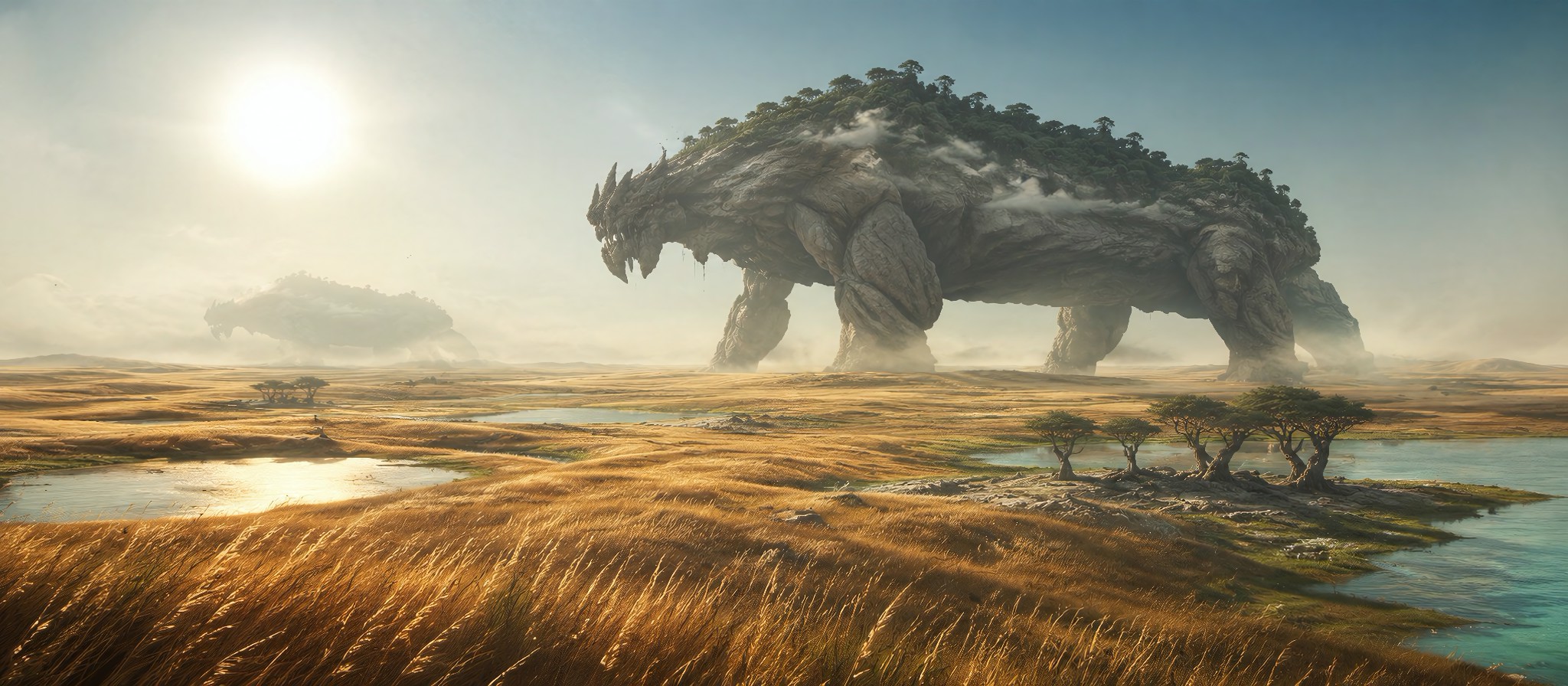
Behemoths are Nyxara's immune system given flesh and stone. They are living geological titans, not monsters, not gods. They are the largest surface entities in Ruinea, and for those who travel cross country, seeing one on the horizon is an ordinary, humbling sight. Like spotting a distant mountain that was not there yesterday.
Appearance
Behemoths walk on four to eight legs, each the thickness of a fortress wall. Their skin is living granite, cooled magma, ancient bark, or packed earth. Entire forests grow on their backs. Their eyes glow with faint Aether light, half closed as if dreaming. A low hum vibrates through the ground for kilometers around them. Pure Behemoths radiate an ancient calm. Corrupted ones shriek, their skin cracking open to reveal infected Aether flesh beneath.
Types
- Granite Behemoths are the most common, resembling walking mountains of grey stone. They are often mistaken for hills when sleeping.
- Magma Behemoths carry cracked stone and molten Aether within their bodies. They leave trails of cooling lava where they walk.
- Forest Behemoths host entire ecosystems on their backs, trees, soil, and small creatures living in symbiotic harmony with the titan.
- Swamp Behemoths are moss covered and perpetually damp. Their footsteps create new wetlands.
- Corrupted Behemoths were once Pure. Dungeon infection has twisted them. They seek only chaos and must be destroyed at all costs.
Behavior
Pure Behemoths wander aimlessly or sleep for centuries. They ignore creatures smaller than their toes unless directly attacked or persistently blocked by loud, stubborn obstacles like a fortified city wall. They will actively confront Corrupted Behemoths or massive Dungeon entities. When a Pure Behemoth and a Corrupted one meet, the resulting battle reshapes the map. Mountains shatter against each other. Forests are uprooted in moments. The ground trembles for weeks afterward.
Scale
- Lesser Behemoths, measuring 15 to 50 meters, number in the thousands. They are a common sight in untamed regions.
- Greater Behemoths, at 50 to 500 meters, number in the hundreds. Their movements are tracked by national governments.
- Ancient Behemoths, stretching 1 to 10 kilometers, number fewer than thirty. They are walking mountains in truth, and each is known by name and legend.
- The Walking Mountains, the largest known, measure 30 to 50 kilometers in length. Fewer than seven exist. Forests, lakes, and entire ecosystems thrive upon their backs. Their footsteps carve new valleys. Their sleep lasts millennia.
Notable Behemoths
- Terra'khan rests beneath the World Tree in Aelderim, unmoving since the beginning of the New World. The Aelderim Elves consider her the physical embodiment of the forest's memory.
- Gor'vosh is a Corrupted Behemoth, its type unknown, last sighted somewhere within the Black Domain. The Theocracy has standing kill orders for any confirmed location.
- Pyre is a Magma Behemoth roaming the Eastern Grasslands. The Pack considers its migrations sacred heralds of changing eras.
- The Walking Mountains themselves are the largest known Behemoths in existence. They navigate by their shadows, and their route has not deviated in recorded history.
Leviathans: Guardians of the World's Edge
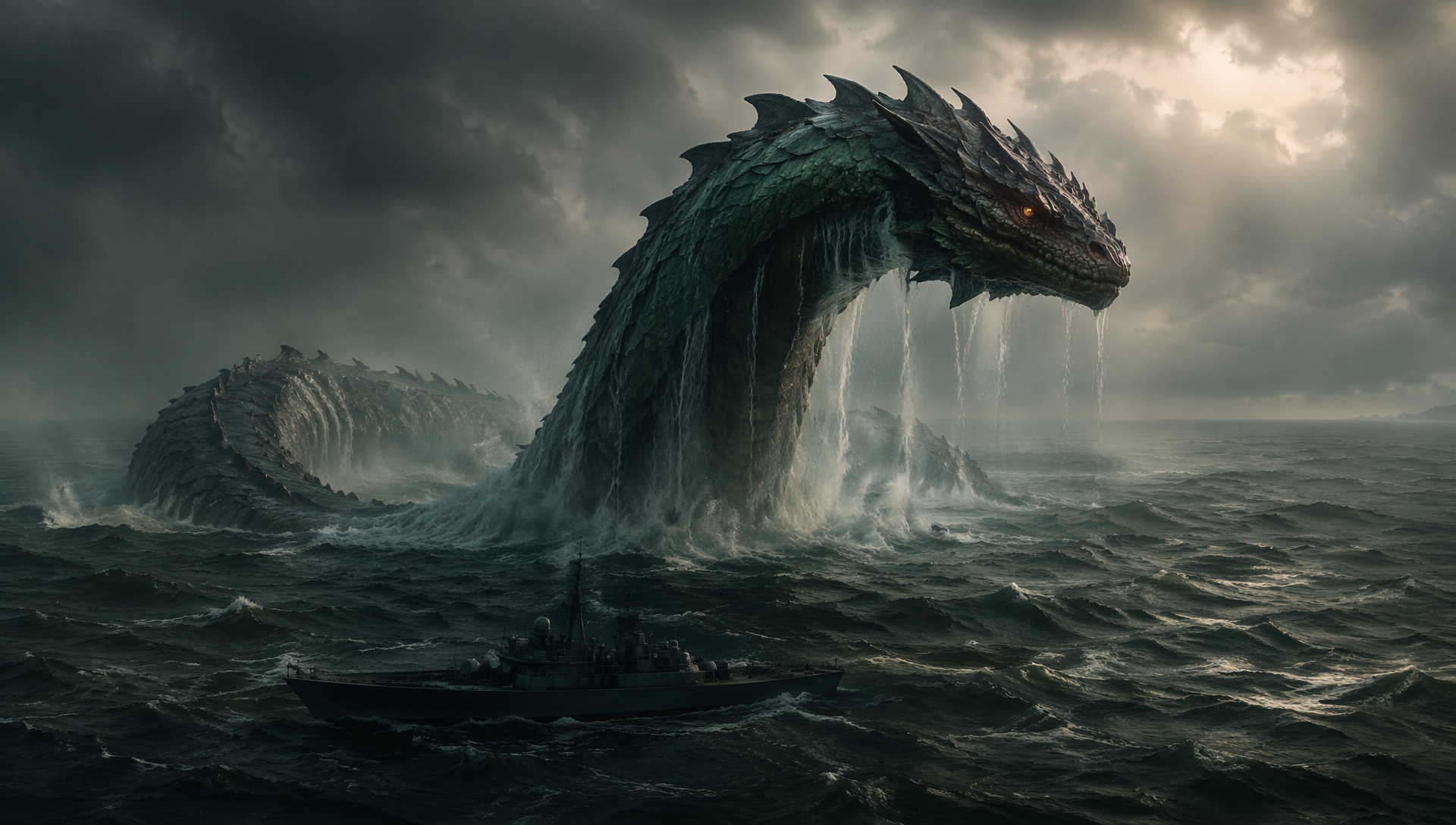
Leviathans are the combined will of all Five Goddesses woven into living form. If Behemoths are the immune system of Nyxara alone, Leviathans are the gods' final collaborative creation, the ultimate boundary between the world and the Void.
Appearance
Leviathans are serpentine titans. Their scales are harder than iron. Their eyes are like dying suns, or absent entirely. They patrol the Black Zone and the Void's edge with an ancient, unwavering purpose. They do not rest. They do not sleep. They watch.
Behavior
Leviathans are not predators. They do not hunt ships. They do not chase. They simply rise, and the ship is no longer there. Their presence alone is the warning. There is no malice in them. Only duty. A task assigned by five dying goddesses at the dawn of the New World. Nothing has ever distracted them from it.
Scale
- Lesser Leviathans, measuring 50 to 200 meters, patrol the Twilight Zone and the inner Black Zone.
- Greater Leviathans, stretching 500 meters to 2 kilometers, command the deep Black Zone with unquestioned authority.
- The World Enders, the largest, measure 10 to 30 kilometers in length. Fewer than seven exist. Their coils stretch from horizon to horizon. They circle the Void itself, silhouettes against the nothingness.
The World's Last Wall
Leviathans are environmental certainties, not combat encounters. A sighting is awe, terror, and insignificance made manifest in a single, silent moment. They are the world's last wall. Whatever lies beyond the Void, the Leviathans ensure it stays there. They have never failed. They have never hesitated. They circle, they watch, and they wait. That is their purpose. That is their gift to the world.
VIII. RACES OF RUINEA
All major races of Ruinea are remnants of the Old World, carried across the Great Shattering by the Five Goddesses. The only difference between them is which races still have living individuals who remember the world before. Some elders walked the Old World and witnessed its death. Others were born entirely in the stitched lands and know the apocalypse only through inherited memory, myth, or deliberate forgetting. The distinction between those who remember and those who do not defines much of the world's politics.
Human
Origin: Unknown. No god claims their creation. No Elder race remembers a world before them. Some scholars of the Theocracy call them a cosmic accident, a statistical inevitability, or a bug in the Weave itself. They were simply already there when the New World was stitched together, as if reality had quietly decided that something brief and adaptable was needed to fill the spaces between the ancient and the immortal.
Physical Description: The most varied of all races. Humans range from 150 to 190 centimeters in height with no distinct universal features. What other races call plainness, humans call adaptability. They have no horns, no pointed ears, no vertical pupils. Nothing marks them as anything other than what they are.
Lifespan: 60 to 80 years on average. Their short lives breed urgency. The past does not chain them the way it chains the Elves. The future does not stretch endlessly before them the way it does for the Dragons. A human lives, burns brightly, and is gone before the long lived races have finished deciding what to think of them.
Weave Level: Average 1 to 2. Natural ceiling 4. However, humans possess a singular anomaly no other race can replicate. Once every few generations, a human is born who shatters this ceiling entirely, reaching Circle 6, 7, or even 8 through unknown means. These individuals are called Heroes. No human has ever reached Circle 9. The Theocracy studies the phenomenon. The Sanctum Aeternum calls it divine blessing. The Black Domain calls it a bug in the New World's design.
Traits: No racial skills. No ancestral magic. No genetic memory. Flexibility is their only inheritance. A human can become anything. They are the only race that naturally births Heroes. They master skills quickly but never reach the depth of centuries old practitioners. Their strength lies in their urgency, their ferocity, and their refusal to be defined by what they were.
Elf (Aldari)
"They were spirits before they were flesh. The trees remember. So do they."
Appearance: Tall and slender, averaging 170 centimeters and above. Fair skin and distinctly pointed ears. Their most striking feature is their eyes: vertical, slit-shaped pupils adapted for exceptional vision in low light. Hair ranges from blonde to white to black, with rare individuals carrying faint green tints that mark a deep bond with the forest. Their stillness unsettles shorter-lived races at first, but becomes beautiful with familiarity.
Lifespan & Population: Elves do not die of age. The oldest among them, Elder Lysiane, approaches ten thousand years. The survivors of the Old World number no more than thirty individuals, most having been slaughtered in the First Great War when their power rivaled the demons' but fell just short. Most Elves living today are under 2,500 years old, the majority only a few centuries. Reproduction is rare, two or three children per couple across centuries. Their population grows at the slowest rate of any major race.
Tier: Average Tier 4 to 5. Natural limit at Tier 7, exceeded only by descendants of the Elders or truly exceptional individuals who have transcended their bloodline's boundaries.
Traits & Culture: Elves love beauty, memory, and history with an intensity that shorter-lived races struggle to comprehend. They think in centuries. A condition known as Museum Disease afflicts many—a cultural melancholia born from dwelling too long in the past, surrounded by perfect crystalline memories of what was lost. The Aelderim Elves embrace this condition, building their civilization around preservation. The Sol-Ventari Elves reject it, burning records to escape the weight of yesterday.
They carry a quiet condescension toward short-lived races. Humans are viewed as impulsive children racing toward graves they cannot see. Dwarves are skilled but materialistic, too concerned with metal and coin. Orcs earn a rare and genuine respect for their discipline and their sacred oath, a devotion the Elves recognize as kin to their own. Other races see Aelderim Elves as cold, indecisive, and trapped in a past that no longer exists. Sol-Ventari Elves are viewed as reckless, fascinating, and perhaps a little insane for burning what should have been preserved.
Skills & Abilities: Nature magic flows through them instinctively. Their art and music are unmatched across the continent. They are legendary archers, their aim guided by centuries of practice rather than talent alone. Their most extraordinary ability is Memory Storage—perfect recall spanning millennia, the capacity to relive any moment of their long lives with flawless clarity.
Where They Are Found: Aelderim holds the dominant population, centered around the World Tree. Sol-Ventari hosts the second largest concentration along the eastern trade corridor. Scattered minorities exist across all nations, though most Elves never leave the singing woods of their birth.
Dwarf (Dorn)
Origin: Forged by the Old World gods as divine smiths. They were the hands that shaped the blades the gods wielded, but they were never warriors themselves. When the Great Shattering came, most Dwarves survived through position and luck, sheltered deep underground in forges and bunkers that outlasted the apocalypse.
Physical Description: Short and powerfully built, standing 120 to 150 centimeters. Square jaws, thick beards braided with clan markers or forge signs, and eyes adapted for subterranean navigation. Their strength rivals or exceeds that of a tall human despite their stature.
Lifespan: 300 to 400 years on average. Kazad-Vorn Dwarves, saturated by ancient deep stone Aether, may reach 800 years. Surface Dwarves of Vorn-Taraz age faster, their lives shortened by sunlight and commerce.
Weave Level: Average 2 to 3. Ceiling 5. Their magic is modest, but their gift lies in imbuing metal and stone with properties no other race can replicate. They do not command the elements. They reshape the world's bones.
Traits: Stubborn beyond measure. Loyal beyond question. Craft above all else. The Dwarven soul is divided by the Great Schism: Kazad-Vorn carries a collective grief, still searching for their lost gods in the darkness below. Vorn-Taraz chose to stop grieving and start building. Both sides consider the other tragically misguided, and neither has forgiven.
Skills: Metallurgy unmatched across all races. They forge alloys no other civilization can replicate. Their architecture turns mountains into cities. Their stone sense allows navigation through absolute darkness. Global commerce is dominated by Vorn-Taraz merchants who turned their ancestral craft into the engine of the world economy.
Werebeast (Feral)
Origin: A dying god of the hunt, bleeding out on the battlefields of the Old World, broke open the animals that surrounded him. He gave them humanoid shape, human cunning, and the capacity for violence beyond instinct. They were meant to be disposable shock troops, a final desperate weapon. When their creator died, they became neither weapon nor animal. They were something new. Over millennia, they evolved their own answer to what they were.
Physical Description: The baseline is humanoid with animal traits: ears, tails, slit pupils, predatory musculature. From this baseline, they can shift toward a full beast form. Common bloodlines include Wolf, Great Cat, Bear, Tortoise, Eagle, and Snake. Tortoise bloodlines are rare and ancient, their elders living beyond a thousand years.
Lifespan: 150 to 200 years on average. Tortoise bloodlines can exceed 1,200 years. Elder Mossback of Verdantus, a Turtle Werebeast, is the oldest known at over twelve centuries.
Forms & The Beast Within: Transformation is surrender. In beast form, strength and speed surge by twenty to thirty percent. Senses sharpen beyond mortal limits. Movement becomes instinct. The cost is control. The longer a Werebeast remains transformed, the louder the animal within becomes. Mastery means riding that edge, holding on to consciousness while the beast howls. Verdantus fears the beast within and teaches restraint above all else. The Pack reveres the beast within and unleashes it as a sacred truth.
Weave Level: Average 2 to 3. Ceiling 5. Their magic is modest, but their reflexes and senses compensate entirely. Pack shamans develop a unique beast spirit magic that draws power from the animal within.
Traits: Reflexes three times faster than humans. Olfactory tracking capable of identifying prey from kilometers away. Their sapient and animal natures exist in constant tension. Every Werebeast is two beings sharing one body, and the negotiation between them never ends.
Skills: Tracking unrivaled across Ruinea. They invented the ambush. Their natural weapons include claws, fangs, and jaws that never dull. Verdantus developed an entire martial art of restraint, disabling enemies without killing them.
Pure Demon
Origin: Created by the God of the Abyss, the primordial lord of darkness and vengeance. Originally they were conceptual entities: living grudges, walking hatred, ideas of destruction given sentience. When their creator died, they evolved biological reproduction over millennia. They are now a species, bound by blood and genetic memory, carrying the legacy of their maker's rage.
Forms & Control: Demons possess a hierarchy of forms reflecting their mastery of self. The Lower Form displays prominent demonic traits: horns, glowing eyes, wings or tails, and red or purple skin. The Monstrous Form releases impulse entirely, becoming a living siege weapon of magma like skin and primordial proportions. The First King is the absolute pinnacle of this form. The Perfect Human Form represents complete control: brown, white, or grey skin, refined horns and wings, features approaching the terrible beauty of a Fallen Angel. Some individuals can eliminate their demonic traits entirely. The most dangerous demons are the most beautiful. Wanderer exiles always bear curved ram horns, a biological marker of their acceptance of the New World. No two demons share identical horns. They are as unique as fingerprints.
Lifespan: Biologically immortal. They do not age past maturity. In practice, few survive long. Death in battle is celebrated. The oldest demons, those who have survived three to five millennia, are the most lethal survivors. The First King exceeds 10,000 years, predating the Old World's end.
Weave Level: Average 4 to 5. Ceiling 7. Commanders reach 7 to 8. The First King at his peak exceeded Circle 9.
Traits: They view the New World as a false prison that must be entirely destroyed. This is the public doctrine. Every demon carries genetic memory, born with five thousand years of combat instinct and tactical knowledge. They know how to kill without ever being taught. They cannot surrender. This is a species wide psychological block embedded in their creation. Beneath the iron exterior, a secret Revisionist Faction quietly questions the exhausting doctrine of eternal war.
Skills: Extinction magic. Old World spells that erase, corrupt, and unmake. Leadership based on dominance. Every strike carries millennia of inherited technique.
Fallen Angel
Origin: Created as servants of the Goddess of Light. They tended her celestial palace and sang in her halls. When the War of the Gods escalated beyond containment, she transformed them into weapons without doubt. Other armies could be exhausted, broken, routed. Angels simply continued. They fought until destroyed or until the enemy was dead. They were the most feared race beneath the gods themselves, not the strongest, but the most relentless. When their creator was murdered, every Angel felt it instantly. Their pure white wings bled darkness from the roots outward. The stain spread until no white remained. Their wings are black forever. Only seven survived into the New World. The rest perished in the massacre or chose to remain with the Old World as it died.
Physical Description: Perfect, terrible beauty. Human like form with white skin, elegant features, and large black wings that fold at rest. Their eyes glow softly with residual divine light, fainter now after the Fall. Their hair is white or silver. They stand 180 to 210 centimeters, always poised. They do not age. Their appearance is frozen at the exact moment their goddess died.
Lifespan: Biologically immortal. Seven survived the Great Shattering. Three fell in the First Great War, fighting to defend the New World. Four remain. They are the spiritual and military backbone of the Theocracy of the Sacred Wound.
Weave Level: Circle 8 universally. Before the Fall, they reached Circle 9. They are diminished, but not broken.
Traits: They were created to serve. They were turned into weapons. They were abandoned by the death of their god. They were hunted by the victims of the war they fought. They were reduced to seven. And yet they chose to forgive. Not because it was easy, but because they understood better than anyone the cost of the unforgivable.
Skills: Mastery of combat forged across thousands of years as the Goddess of Light's personal weapons. Flight. Divine power that each alone equals a battalion. Absolute capacity for sacrifice. Three of them have already proven it with their lives.
Vampire
Origin: Not created. Congealed. When the first minor deities fell in the War of the Gods, their divine blood spilled across battlefields already saturated with mortal and beast blood. It stirred. It mixed. From that communion, the first Vampire rose. They are living hematomas of a murdered era, born not from any god's design but from the simple, terrible alchemy of divine death and mortal suffering.
Physical Description: Pale porcelain skin. Blood has retreated deep into their flesh. Their eyes range from deep crimson to dark purple, faintly glowing in darkness. Slight fangs retract when not in use. Their shadows are fainter than they should be, a subtle but consistent mark of their altered nature. Those who reside in Noctisia appear healthy and well fed, sustained by the Blood Gardens. Those who live scattered across the continent often appear gaunt or haunted.
Lifespan: Technically immortal. No Vampire has ever died of age. Death comes only through blood deprivation, catastrophic physical trauma, or spiritual exhaustion, a wasting condition that afflicts those who lose the will to continue. Some ancient Vampires have endured more than five thousand years.
Weave Level: Average 3 to 4. Ceiling 6. Some elder or ancient Vampires can reach 7 or 8. Their magic leans toward shadow, blood, and the spaces between life and death.
Traits: Every Vampire inherits the Thirst. It is the blood memory of dead gods and dying soldiers, an echo of the battlefield that birthed them. Noctisian Vampires follow the Calm Blood Philosophy: "Thirst is not destiny." They drink but do not hunt. They take but do not kill. Black Domain Vampires reject this entirely. Their Thirst is unchained, and they revel in what they are.
Skills: Perfect night vision. Speed and reflexes surpassing humans, though below Werebeasts in beast form. Blood science: the Vampire scholar Morpheus turned understanding of blood into genetic engineering, creating the Blood Gardens and modifying the Vampiric bloodline itself to eliminate traditional weaknesses.
Orc
Origin: Manufactured by the God of War. They were soldiers with no purpose beyond killing. No families. No culture. No future beyond the next battlefield. When their creator died mid command, every Orc froze. For the first time in their existence, there was silence where orders should have been. Then, for the first time, they chose. Some kept fighting. Some walked away. Some wept. Under Alsaktar in the New World, they made a sacred choice: they had been weapons. Now they would be shields.
Physical Description: Large and muscular, standing 180 to 210 centimeters. Their skin is green or grey, thickening with age into natural armor over the shoulders and forearms. Lower tusks protrude from strong jaws, used in ritual combat. Their eyes carry an unsettling stillness, the gaze of someone who has already decided what they will die for.
Lifespan: 300 to 400 years on average. Old World veterans survive past 500 years. They are the eldest voices on the Council of Veterans.
Weave Level: Average 3 to 4. Ceiling 6. Warlords reach 7. Their magic is physical: body enhancement, skin hardening, and the Controlled Berserker technique that amplifies strength while maintaining perfect tactical awareness.
Traits: The Gar-Vang Sacred Oath binds every warrior: "We will not let what happened to us happen to others." They will not start a war, but they will stand before one when it comes. Cold professionalism has replaced blind rage. Every Orc carries an instinctive understanding of violence. They know how to kill because they were made for it. Now they choose when.
Skills: Combat mastery bred into their bones. Controlled Berserker state. Oath bound loyalty that would rather die than break. Endurance beyond any mortal race. An Orc can fight for days without rest.
Dragon
Origin: When the War of the Gods escalated beyond the Ancient Dragons' ability to ignore, the eldest among them created soldiers from their own essence. Smaller, faster to breed, faster to think. The Ancients were mountains. These new Dragons were armies. They were never meant to outlive the war. They found themselves without purpose after the mutual annihilation of the gods.
Physical Description: Giant winged reptiles, their length ranging from 10 meters in youth to over 50 meters for a mature Dragon Lord. Scale color corresponds to elemental affinity: gold for radiance, silver for ice, red for fire, blue for lightning, green for nature, and black for shadow and void. Their elemental breath can incinerate fortresses. Most adult Dragons can assume a humanoid form, retaining wings, tails, and horns as markers of their true nature.
Lifespan: 5,000 to 10,000 years typical. Dragon Lord Ignis is approximately 13,000 years old. Some believe Old World survivors still exist in hidden corners of the continent.
Weave Level: Average 5 to 7. Ceiling 8. Elemental breath is woven into their very creation. A Dragon Lord level being pushes the upper limits of mortal magic.
Traits: Intelligent to the point of arrogance. Fiercely individualistic. They cooperate when necessary but never fully submit, even bound Dragons consider their contracts a matter of mutual agreement rather than servitude. Wild Dragons hoard gold, knowledge, artifacts, and the bones of trespassers. Bound Dragons trade service for treasure and knowledge. A Black Dragon faction believes Ruinea is their rightful inheritance, stolen by lesser races. Beneath all of it lies a profound weariness. They were made to win a war that ended in ashes.
Skills: Elemental breath. Flight across any terrain without rival. Strength to shatter fortress walls. Shapeshifting. Millennia of accumulated wisdom.
Origin Dragon
Origin: Born from the world's own breath, molten bones, and primordial storms. They are the children of a world that learned to speak with fire and scale. When the War of the Gods erupted, some tried to cauterize it. Some fought for destruction. Some simply vanished. Only a handful remained. They played a role that history has nearly erased: the Five Goddesses could not stitch reality together alone. The Ancient Dragons gave their own primordial essence, the raw fabric of the Old World itself, to become anchors. They are the frame upon which Ruinea was stretched. Without them, the New World would be nothing but barren islands adrift in the Void.
Physical Description: Unimaginable in scale. Origin Dragons range from 200 to 500 meters from snout to tail. Their scales are harder than any forged metal, colored like the landscape they have chosen to resemble. Their eyes glow like lakes of molten light, slow blinking. They can blend so perfectly with their resting places that they become indistinguishable from the natural world.
Lifespan: Pre Old World. Their age is measured in geological epochs. They have stopped counting.
Weave Level: Circle 9 universally. The most ancient among them, those born before gods and before magic itself, reached Circle 10 in the Old World. No living being has witnessed their full power since the Great Shattering.
Traits: Silent witnesses to everything. They watched the Old World destroy itself. They watched the Five Goddesses stitch the New World together. They did nothing during either event. Whether this was fatigue, grief, or some deeper patience known only to beings of their scale, no one can say. They sleep now, hidden in plain sight across Ruinea. No map marks their locations. Regular Dragons may know where they rest but will not tell. When they wake, they may save this world or judge it. Nothing any mortal can do will change the answer.
Skills: Immense primordial power that predates the gods themselves. Reality anchoring, the gift they gave to the Five Goddesses. Only they fully understand what they are capable of.
Demi-Human
Origin: Never meant to exist. In the Old World, races did not mix. The gods had designed them to be separate, pure, orderly. The War of the Gods broke that order. In the quiet spaces between battles, in hidden valleys and forgotten shelters, love happened. Children of refugees reached across species boundaries. No scholar has ever fully explained the biology. The most accepted theory is that the world itself consented. Reality, exhausted by war, decided that all races could coexist. Demi-Humans are living proof of that decision.
Physical Description: There is no standard. Features from both parents combine in unpredictable ways. Pointed ears on a stocky frame. Human height with demonic horns. Elven grace with Dwarven musculature. Human and Elf pairings are the most common and most fertile. Demon hybrids are sometimes born with unstable features that shift across their lifetime.
Lifespan: Entirely bloodline dependent. A Human-Elf may live 200 to 400 years. A Human-Dwarf may reach 150 to 250. Demon hybrids and Vampire hybrids can fall anywhere between a mortal brief candle and near immortality. Demi-Humans exist in a perpetual middle ground, never fully belonging to either parent's timescale.
Weave Level: No single average exists. Bloodline determines everything. A Human-Elf may inherit Elven magical aptitude. A Demon hybrid may carry fragments of genetic combat memory. The only constant is unpredictability.
Traits: They are the glue of the world. Found in every nation, yet nowhere truly their own. They bridge differences because they embody difference. In the Valdran courts, they are useful but perpetually suspect. In the Guildhall, they are equal but never quite native. In the Black Domain, they are either the most zealous followers proving their loyalty or the most oppressed slaves proving their obedience. Everywhere, they are necessary. Everywhere, they remain outside. Pope Callista III, a Demi-Human and former slave, now leads the Theocracy of the Sacred Wound.
Skills: Diplomacy born of understanding multiple perspectives because they are multiple perspectives. Adaptation that no pure blooded race can match. Innovation unbound by tradition. A quiet, profound resilience. Exclusion no longer wounds them. It informs them.
IX. NOTABLE CHARACTERS
Bagian ini akan diisi dengan direktori tokoh-tokoh kunci dari setiap faksi setelah daftar karakter lengkap.